

Should You Repair Your Car Or Trade It In?
Ownership costs
A repair estimate and a replacement payment answer different questions. To decide whether to repair a car or trade it, compare the same ownership period, separate known work from uncertain future repairs, and keep the old loan balance visible. The most useful result is a documented choice between actual options, rather than a rule based on the size of one bill.
Updated October 16, 2026
Start with what the repair will accomplish
Ask for an itemized estimate tied to the diagnosed concern. It should identify the work, parts, labor and any further diagnosis needed before the price is firm. Separate an immediate repair from maintenance that can be planned later, and ask what problem will remain if only the quoted work is completed.
Kelley Blue Book’s repair-pricing tool supplies a vehicle- and location-based Fair Repair Range for common work, including parts and labor. That is context for a quote, not a substitute for inspecting the vehicle. Compare estimates for the same procedure and parts before concluding that one is cheaper.
The repair’s purpose matters more than its label. A brake repair, an unresolved stalling complaint and an air-conditioning repair create different transportation questions. Ask the repairer how the car should reach the shop if its condition is uncertain. A budget comparison does not establish that it can safely be driven while the decision is pending.
Use the same time period for both options
Choose a practical horizon, such as the next twelve months, and make two cash-flow worksheets. For keeping the car, include the quoted work, known upcoming maintenance, existing payments and ordinary running costs. For replacing it, include cash due at purchase, the actual payment schedule, insurance, taxes and fees, running costs and any work the replacement needs.
| Question | Keep and repair | Replace |
|---|---|---|
| Immediate cash required | Repair, diagnosis and transport | Cash due at purchase and transaction costs |
| Payments during the period | Remaining current payments or repair financing | Quoted replacement payments |
| Known vehicle work | Itemized upcoming service and repairs | Inspection findings and required service |
| Operating costs | Current insurance, fuel or charging and registration | Actual quotes and realistic usage estimates |
| Uncertainty | Undiagnosed concerns and possible downtime | Condition, coverage and costs not yet verified |
Keep assumptions separate from bills. An upcoming tire replacement supported by measurements is different from an unspecified allowance for “something breaking.” Set aside a contingency if useful, but label it as a planning assumption rather than a predicted repair.
A cash-flow comparison shows what must be paid during the period; it does not measure every economic cost. The replacement may retain a different value at the end, while loan principal payments reduce a balance. If you also compare depreciation and financing costs, calculate that separately so the full purchase price or principal is not counted again as depreciation.
A trade does not erase the existing loan
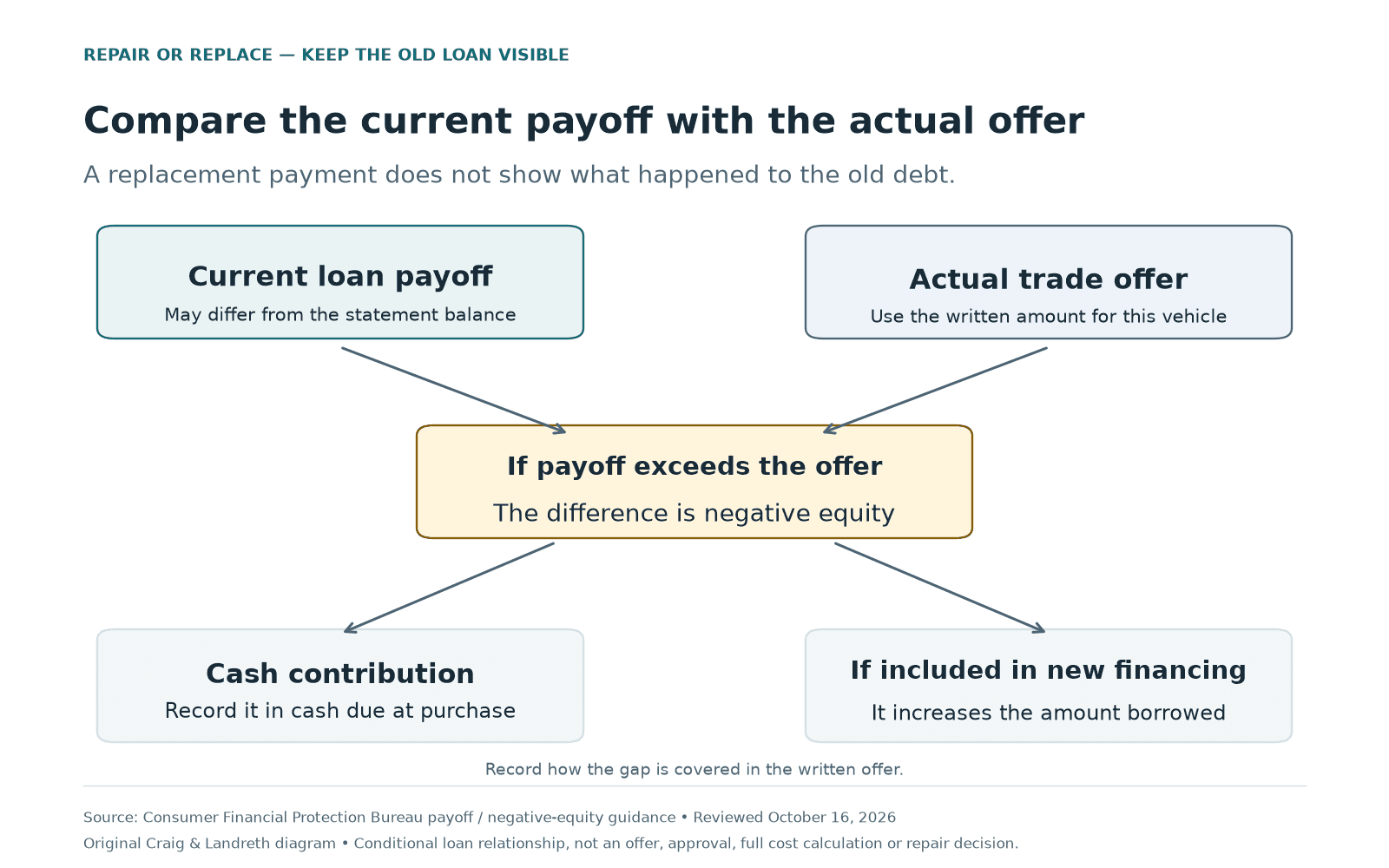
The Consumer Financial Protection Bureau’s payoff guidance explains that the amount needed to pay off a loan can differ from the balance on a statement. Obtain the current payoff and compare it with an actual offer for the car.
If the payoff exceeds that offer, the difference is negative equity. Adding it to a replacement loan increases the amount borrowed and can increase interest costs. Show the old balance, trade allowance, cash contribution and new amount financed separately. A lower payment does not demonstrate that the old debt disappeared.
The CFPB’s auto-loan terms guide is useful when comparing APR, loan term, amount financed and total payments. The existing monthly-payment versus total-cost guide develops that distinction. Use the complete written offer, rather than comparing the repair bill with one month’s advertised payment.
Compare the replacement’s evidence, too
Replacement changes the vehicle, but it does not establish freedom from repairs. Review its condition, maintenance needs and written coverage. The existing used-car inspection worksheet helps turn a visit into questions for an independent inspection.
Check both vehicles for open safety campaigns through NHTSA’s recall lookup where relevant. A recall remedy may be free through the manufacturer, but it is not a diagnosis of unrelated symptoms. Keep that action distinct from a paid repair estimate.
Finally, put the unresolved questions beside the numbers: what the repair restores, what downtime is likely, which replacement costs are confirmed and which are still estimates. A repair costing a large share of the car’s value deserves scrutiny, but that ratio alone does not price the replacement or determine which choice fits the household.
0 comment(s) so far on Should You Repair Your Car Or Trade It In?