

Monthly Payment Vs Total Cost: Car Loan Basics
Ownership costs
A payment tells you what leaves the bank each month. It does not tell you how much you borrowed, how long the obligation lasts or what the car will cost to run. Compare those three questions separately before deciding that one offer is cheaper than another.
Updated October 16, 2026
Start with the purchase, then compare the loan
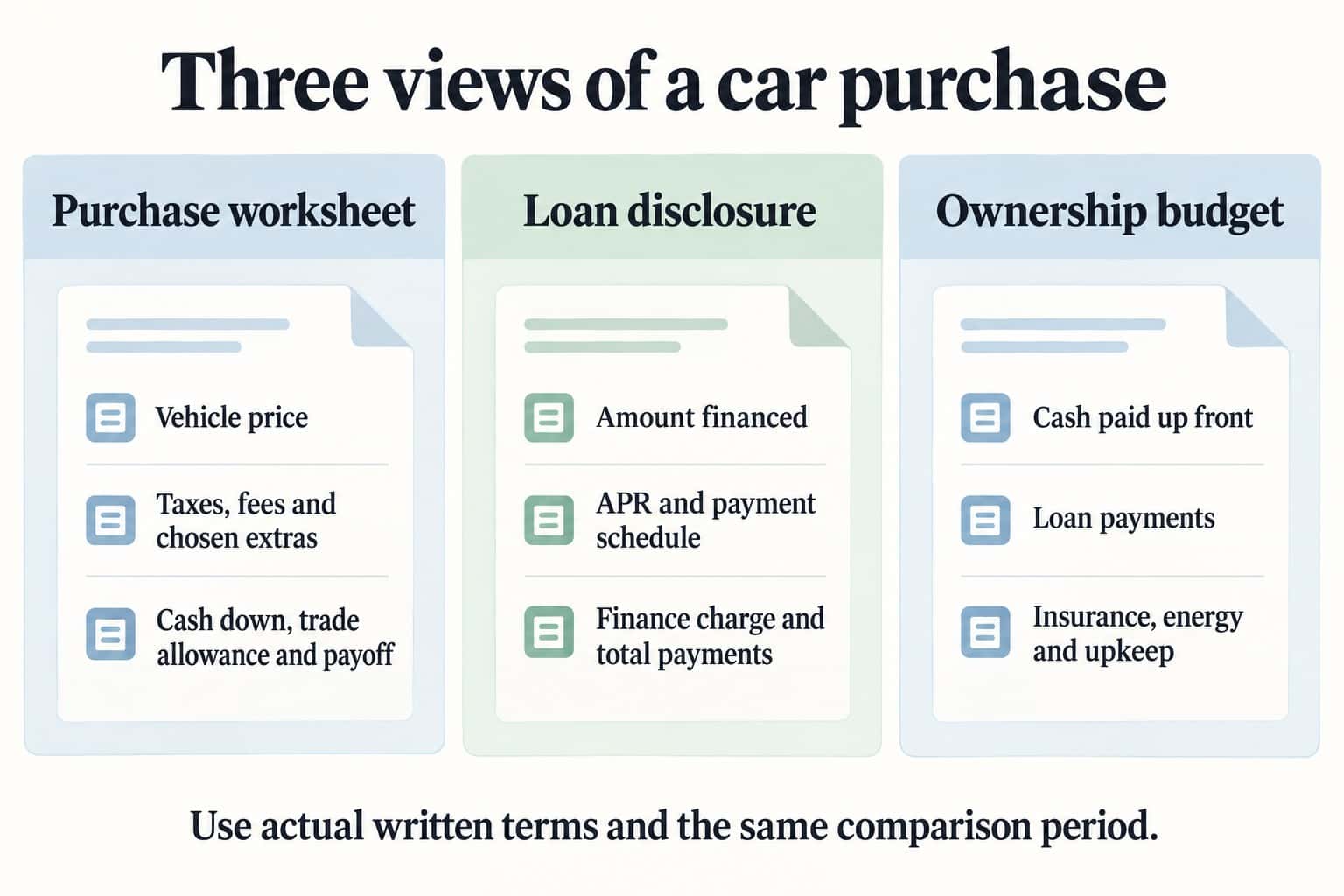
Ask for an itemized purchase total for the particular vehicle. Keep the vehicle price, taxes, registration and other fees, accessories and any chosen optional products visible. Then identify the cash down payment, the trade allowance and the payoff on an existing vehicle loan. A trade allowance is not all available equity when part of it must repay the old lender.
Keep that purchase worksheet alongside the financing disclosure. The two explain different things. The purchase worksheet shows what is being bought and how the transaction is assembled. The loan disclosure shows the credit terms. Moving money between a down payment and the loan can change the payment without making the vehicle itself less expensive.
Read these numbers together
| Number | What it answers |
|---|---|
| Amount financed | How much credit is being provided? |
| APR | What is the annual cost of the credit, including interest and applicable fees? |
| Finance charge | What is the disclosed dollar cost of borrowing over the scheduled loan? |
| Payment schedule | How much is due, how often and for how long? Is the final payment different? |
| Total of payments | What will all scheduled loan payments add up to? |
The CFPB’s explanation of auto-loan disclosures distinguishes those terms. APR and the interest rate are not interchangeable, and the total of payments is not the entire ownership budget. Cash paid up front is outside the scheduled loan payments; insurance, fuel, registration renewals and repairs are separate expenses.
A smaller payment needs an explanation
When two quotes differ, ask which inputs changed. Was the vehicle price lower? Was more cash required up front? Did the term grow? Did the rate change? Were optional products added or removed? A payment comparison becomes useful when each difference has an answer.
The CFPB recommends comparing the loan amount, APR, term and payment. With the same amount borrowed and interest rate, spreading repayment over more months generally reduces the monthly amount but increases interest paid. That tradeoff can be assessed from the actual offers; there is no need to assume a current market rate or an approval you have not received.
Do not compare only the installment amount when the schedules differ. Check the number and frequency of payments, any irregular first or final payment, fees and the disclosed total. If an online calculator assumes a conventional monthly amortizing loan, its estimate may not reproduce a contract with different terms.
Keep the trade payoff visible
Obtain a current payoff from the existing lender and compare it with the written trade allowance. If the payoff is larger, the difference must be handled somewhere in the transaction. The CFPB explains that financing that shortfall in the next loan increases the new borrowing and cost. A promise to pay off the old lender does not, by itself, mean the debt has disappeared.
Build a budget that survives ordinary ownership
Put the proposed payment beside an insurance quote, expected fuel or charging expense, registration costs and a maintenance allowance. Use the particular car’s condition and service needs rather than assuming that a newer vehicle eliminates repair risk. Keep uncertain repairs separate from documented work due soon.
Finally, compare the written terms with the offer you selected. A useful decision fits the monthly budget and makes sense over the intended ownership period. Neither the lowest payment nor the shortest term settles that question alone.
0 comment(s) so far on Monthly Payment Vs Total Cost: Car Loan Basics