

First-Time Car Buyer Guide: Budget, Inspection and Paperwork
Buying your first car
Your first car should solve a transportation problem without making the rest of your budget unworkable. Start with what you need each week, then compare the written purchase total, financing terms and condition of the exact vehicle. A low advertised payment settles only one part of that decision.
Updated October 16, 2026
Start with the trips the car needs to make
Write down your usual passengers, commute, parking space and anything you regularly carry. Try the seating position, visibility and cargo access in person. If a child seat, wheelchair or other equipment matters, check its fit rather than assuming a vehicle category answers the question.
Use the model year, engine, transmission and fitted equipment when comparing cars. A reputation attached to a brand does not establish the service history or remaining life of the particular example for sale.
Separate the money needed now from the cost of keeping it
Build the budget from income you actually receive, existing commitments and the car’s expected expenses. Put the proposed payment beside an insurance quote for the exact vehicle, likely fuel or charging use, registration renewals and maintenance. Keep room for costs that do not arrive as neat monthly bills.
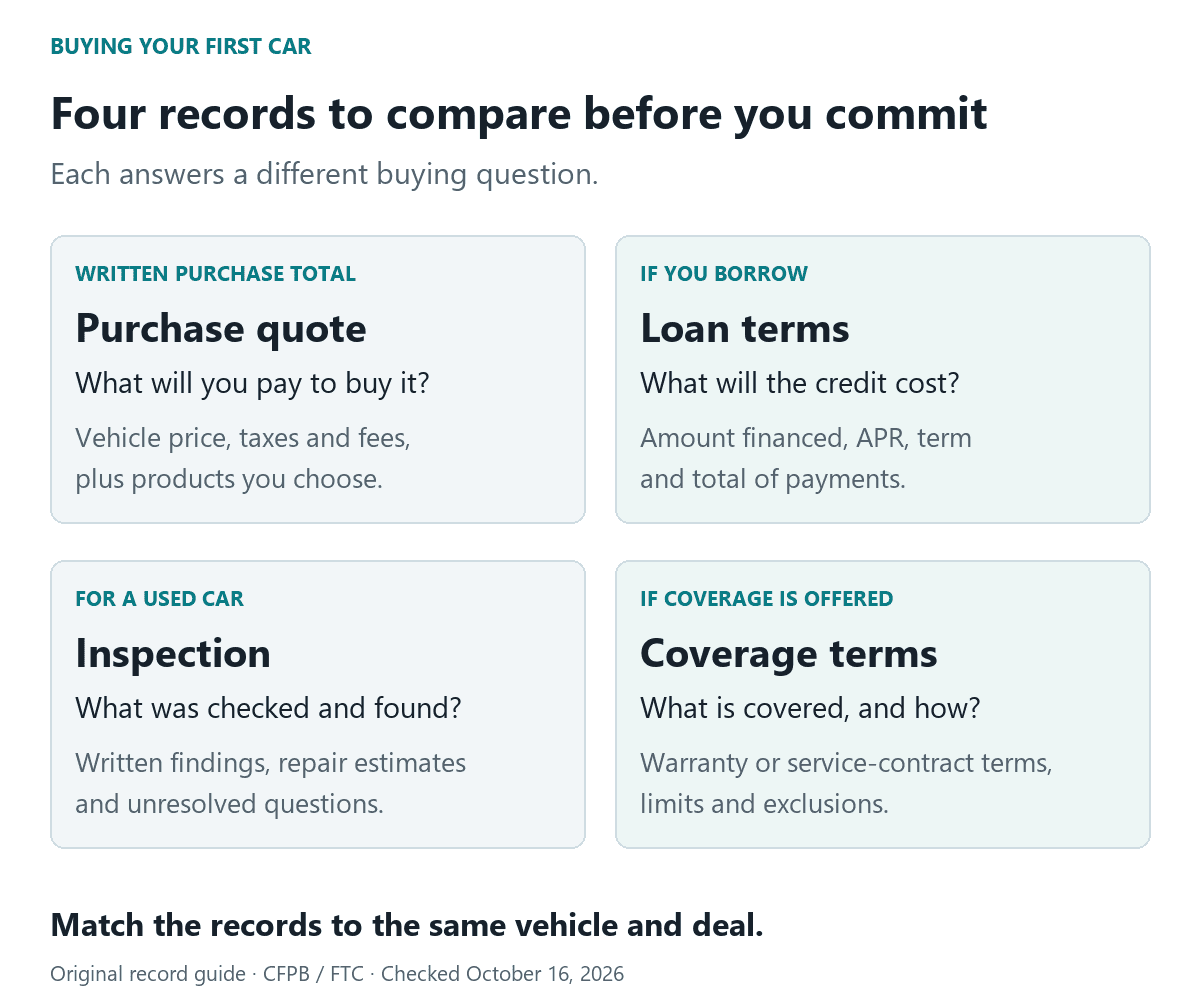
Then ask for an itemized written purchase total. Identify the vehicle price, taxes, title and registration charges, other fees and any products you chose. Confirm the amount due up front separately from the amount to be financed. A price limit and a payment limit are different constraints.
The CFPB recommends comparing the loan amount, APR, term and payment, while accounting for ownership costs. No fixed income percentage can establish what this car will cost you to insure, maintain or repair.
If you borrow, compare complete written offers
Compare bank or credit-union financing with dealer-arranged offers. Ask what conditions remain and how long a quote is valid. A preliminary estimate should not become an assumed approval or a promise that one lender will beat another.
A lower installment can come from a longer term, a different down payment or less borrowing. Ask which inputs changed. Our payment-versus-total-cost explanation shows how to keep the purchase worksheet, loan disclosure and ownership budget separate.
Read the completed auto-loan disclosure before signing. Check the amount financed, APR, finance charge, payment schedule and total of payments. APR is not interchangeable with the interest rate, and scheduled loan payments do not include every ownership expense.
Inspect the car, not just the listing
Read available service and history records, but leave gaps as questions. The FTC recommends an independent mechanical inspection even when a dealer has inspected or certified a used car. A history report does not replace that assessment. Ask for written findings and estimates for work the mechanic identifies.
On an agreed, safe and legal test-drive route, observe ordinary acceleration, steering, braking, comfort and visibility. Do not make sharp maneuvers or hard stops to provoke a fault. Stop if the car seems unsafe. Record the circumstances of a noise or warning instead of diagnosing the failed part.
The used-car inspection checklist helps organize those observations. It also distinguishes what you checked from work that needs a technician.
Check recalls and the final paperwork
Use the actual VIN in NHTSA’s recall lookup and follow applicable manufacturer instructions. Its search has limits, including some recently announced recalls and campaigns already repaired. An empty open-recall result is not a mechanical inspection or complete repair history.
Before committing, reconcile the vehicle, written price and chosen financing with the final documents. For a used car bought from a dealer, read the Buyers Guide. Review any warranty or service-contract terms, and put material repair promises in writing. Price optional products separately and read their coverage, exclusions and cancellation terms before deciding whether they suit your needs.
Keep copies of what you sign and a list of unresolved questions. If the price, borrowing terms, condition or coverage still differs from what you understood, resolve that difference before agreeing to the purchase.
0 comment(s) so far on First-Time Car Buyer Guide: Budget, Inspection and Paperwork