

Honda’s Wireless-Road Charging Research Heads Toward Trials
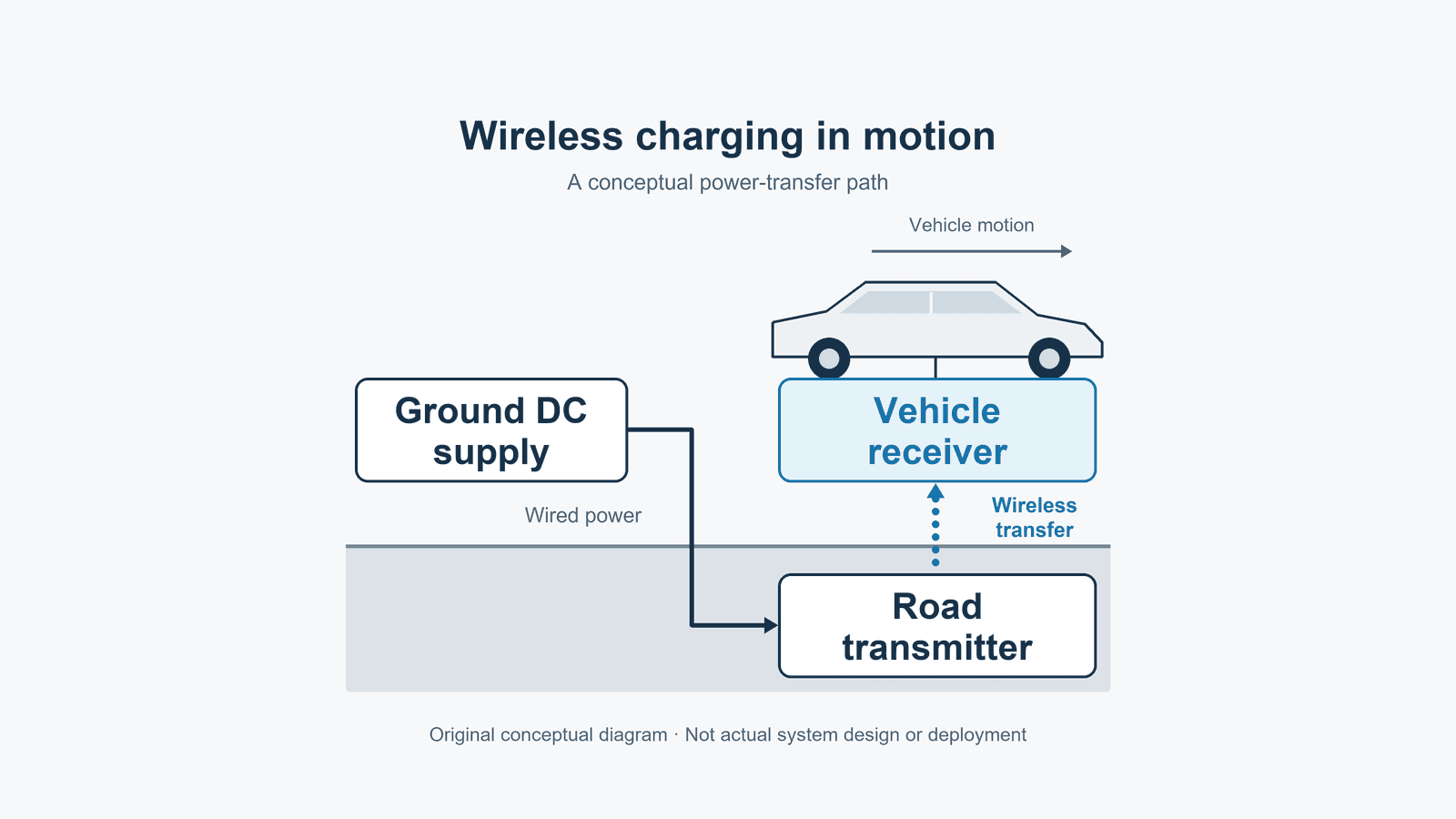
Honda is showing research into charging electric vehicles while they move during this week’s Japan Mobility Show Bizweek. Its exhibition announcement places dynamic wireless power transfer among future charging-infrastructure technologies at the October 13–16 event in Chiba, Japan. The display concerns development work, rather than a charging service available to U.S. drivers.
In an October 5 technical announcement, Honda R&D, Taisei Corporation and Taisei Rotec described a road system that transfers power magnetically to an equipped vehicle. They plan public-road demonstration testing from Japan’s fiscal 2027, which begins April 1, 2027. Honda says initial practical applications are aimed at logistics and transportation.
The road and the vehicle both need equipment
The partners identify three main elements: a ground-based DC power supply, transmitter units embedded in the road and a receiver installed on the vehicle. Taisei is developing the power supply, Honda the transmitting and receiving systems, and Taisei Rotec the road-construction methods. Their shared work also addresses pavement durability and equipment upgrades.
That architecture explains a basic distinction from conventional charging. Power transfer depends on compatible infrastructure and compatible vehicle hardware working together. A roadway announcement alone does not establish that a production car can receive power from it. Compatibility must be documented for the actual vehicle and system.
A demonstration has questions to answer
Honda describes test-road work supporting the underlying technology. A public-road demonstration is a further stage of evaluation. The announced schedule does not specify when a broadly available consumer service might launch in the United States, which retail models would be equipped or what a driver would pay.
Those are separate milestones. A test can investigate whether equipment performs as intended under its stated conditions. A public service also needs a defined coverage area, vehicle eligibility, operating arrangements and a way for users to understand access. Until those details are announced, they remain questions rather than features a buyer can count on.
The project also illustrates why charging-infrastructure research spans more than a vehicle component. Equipment embedded in a road must be installed and maintained alongside a surface used by traffic. The partners’ stated responsibilities divide that work between electrical systems, vehicle hardware and construction, rather than assigning the entire task to the automaker.
Keep today’s charging decision grounded in available equipment
The Department of Energy’s charging-station guide distinguishes AC Level 1, AC Level 2 and DC fast charging, and also discusses inductive charging. Plug-in charging time depends on the vehicle, battery state of charge, equipment and electrical supply. A headline station power rating alone does not establish the time a particular car will need.
For a vehicle available today, check its supported connectors, charging capability and the locations that can actually serve it. Evaluate ordinary charging access first, then consider emerging infrastructure as a technology development to follow. Future research should not be treated as an assured replacement for a workable current charging routine.
The separate IONNA network expansion report discusses a conventional public-charging network. It concerns a different kind of infrastructure and a different stage of availability. Keeping those stories distinct helps readers follow innovation without confusing a research program with an operating network.
Honda’s project is worth watching for what the planned trials establish about in-motion power transfer and roadway integration. Its near-term significance is the coordinated research effort and the move toward public-road testing. Buying decisions still need to rest on the capabilities and charging access documented for the vehicle being considered.
0 comment(s) so far on Honda’s Wireless-Road Charging Research Heads Toward Trials