

BMW Survey Separates Daily EV Miles From Desired Range
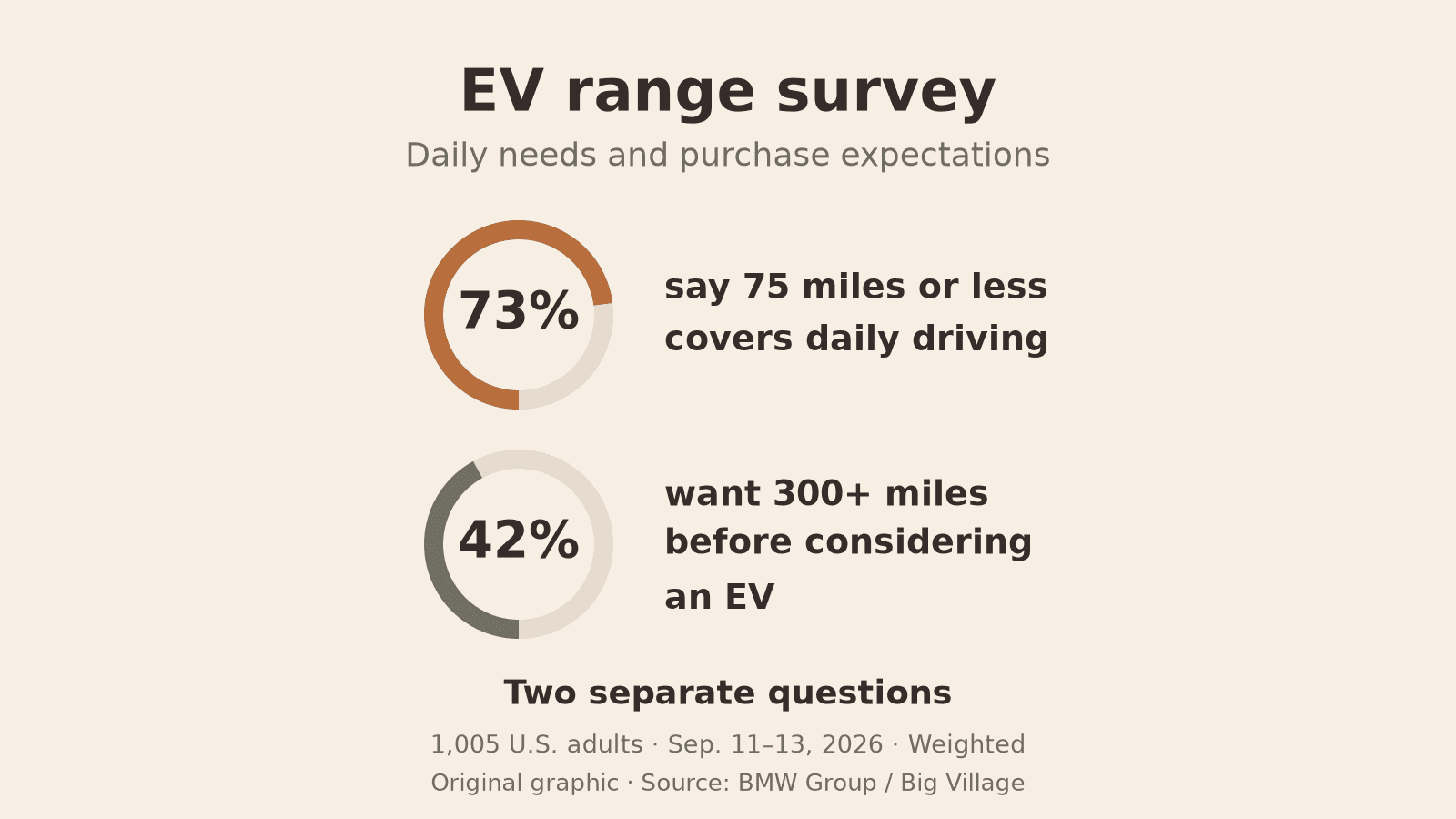
A BMW Group U.S. survey released October 8 captures two different ways Americans think about electric-vehicle range. Seventy-three percent of respondents said 75 miles or less would cover their daily driving routine. In a separate question, 42% wanted at least 300 miles of range before considering an EV.
Those responses are compatible. Daily transportation is one use case; longer journeys, charging convenience and a reserve for unexpected travel are others. The results describe preferences across two questions, rather than proving that individual respondents misunderstand their own needs.
Read the questions and the sample together
Big Village conducted the online survey September 11–13 among 1,005 U.S. adults aged 18 and older, with weighting intended to represent the adult population. BMW commissioned the research. It measures stated attitudes, not logged mileage, completed purchases or an independent road test.
The 73% and 42% groups cannot be added together, and the published toplines do not establish exactly which people selected both answers. A daily-mileage response also does not specify how much range a driver wants available at the start of an unusual trip. Those distinctions are essential when interpreting a headline about a range gap.
Charging frequency changes what range means
The Department of Energy’s home-charging guidance explains how overnight charging can serve everyday driving. Whether Level 1 is sufficient or Level 2 is appropriate depends on the vehicle, miles driven and the available electrical service. A suitable parking location and equipment installation are part of that assessment, with a qualified electrician needed for electrical work.
A hypothetical driver covering 40 miles each day and reliably replenishing that energy overnight faces a different planning problem from a driver who covers the same daily distance but can charge only once every few days. Both drive 40 miles per day; their opportunities to replenish energy differ. A single survey mileage answer cannot capture that difference.
For that reason, compare the expected interval between charging opportunities as well as the distance of a typical trip. Include weekend travel and situations in which a usual charger is unavailable. Establish which charging locations are usable before choosing a battery size around a daily average.
Allow for the conditions in which the vehicle will operate
FuelEconomy.gov’s cold-weather guidance documents the effects of low temperature and cabin heating on EV energy consumption and range. Its published examples describe particular test conditions and vehicles; they are not a universal percentage reduction for every new EV. The important practical point is that a rated range should not be treated as an all-weather guarantee.
A longer winter journey therefore deserves its own assessment. Consider the model’s documented behavior, the charging stops available along the route and the time needed to use them. Where the manufacturer supports it, warming the cabin while plugged in can reduce the energy drawn from the battery after departure. Follow the particular vehicle’s instructions.
Used-EV comparisons add another evidence question. A battery-health report should identify the vehicle and method being measured. Its result can inform an assessment of that car, while the national survey remains a separate account of consumer preferences. Neither should be substituted for the other.
BMW’s findings are a useful starting point for a more precise conversation: how far the vehicle must travel, how often it can charge and which less-frequent journeys matter. Answering all three produces a more meaningful comparison than choosing a vehicle from either the daily-mileage number or the desired-range number alone.
0 comment(s) so far on BMW Survey Separates Daily EV Miles From Desired Range