

Can You Rotate Staggered Tires? Check These Limits
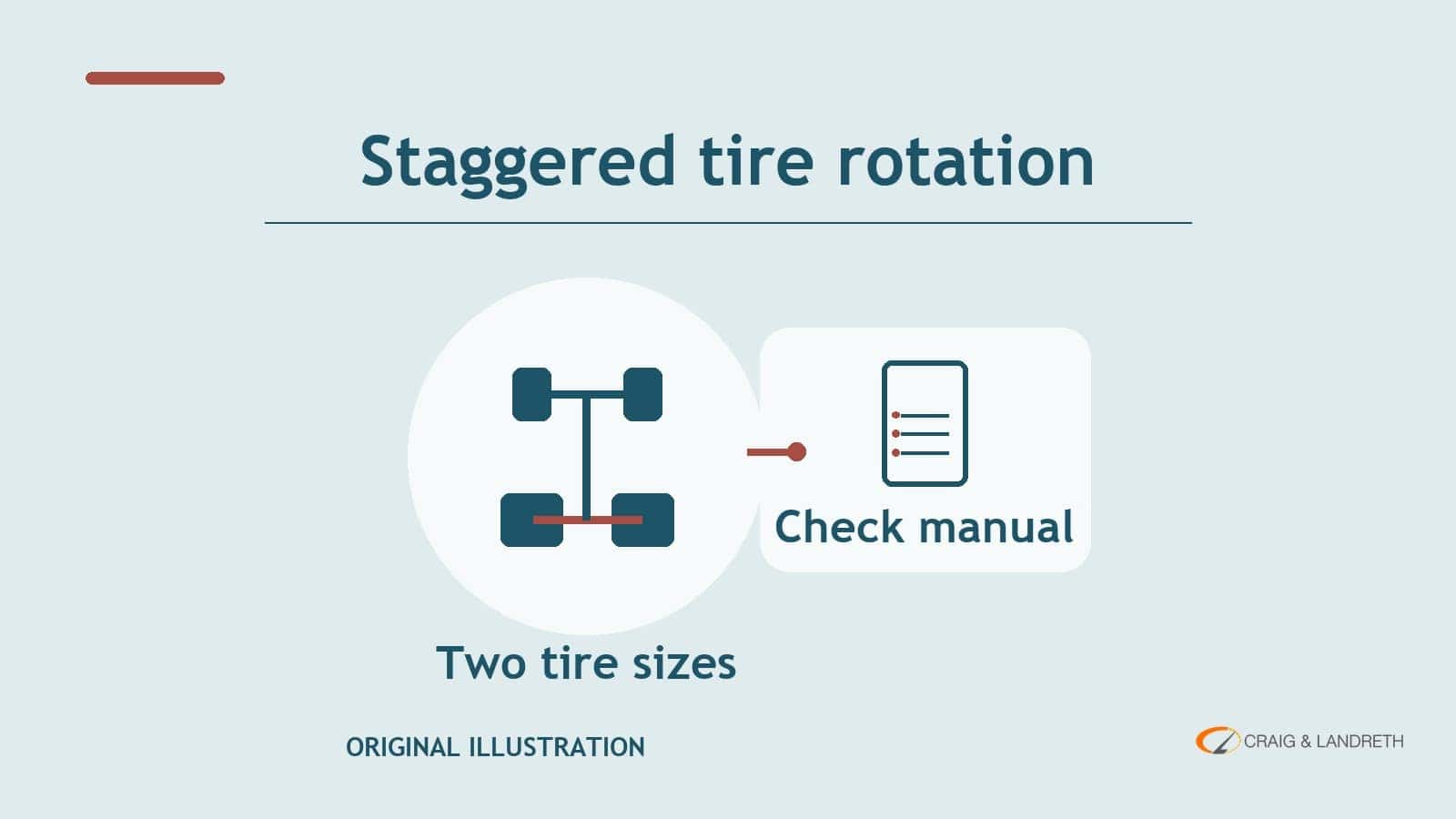
With a staggered setup, meaning different front and rear tire sizes, the assemblies usually stay on their assigned axle. A side-to-side swap on the same axle may be possible if the owner’s manual allows it and the tire direction and wheel fit still work. Some setups have no approved rotation pattern. In that case, inspect and record wear at each position rather than improvising a swap.
Confirm that it is a factory-approved arrangement
Compare the front and rear sidewall sizes with the tire label and the specifications in your owner’s manual. NHTSA’s TireWise guidance explains where to find the tire label. If you bought the car used and the sizes differ, ask whether those sizes and wheel widths belong together on your exact trim. Wheel offset, which affects how far the wheel sits inward or outward, can differ too. A staggered setup someone installed before you bought the car may not be a factory-approved fit.
What can still limit side-to-side rotation?
Michelin’s rotation guide explains why a directional tire typically stays on the same side when it is already mounted. Moving a directional assembly across the car can reverse the indicated rolling direction. An OUTSIDE mark on an asymmetric tire instead identifies the sidewall that faces out. Ask which rotation the vehicle and tire manufacturers allow before moving wheels or having tires dismounted. The guide to rotation patterns and uneven wear explains what to track between inspections.
Also check the pressure and monitoring setup after any approved position change. Front and rear recommended pressures can differ. The Bridgestone and Firestone tire safety manual also explains how differences between the front and rear tire or wheel sizes restrict rotation. Ask the shop to identify the manufacturer-approved same-axle pattern if one is available. Follow the instructions for your own setup.
When routine inspection takes the place of rotation
If there is no approved rotation, record cold pressure, tread depth across the tread and the wheel position at regular checks. Inner-edge wear can be easy to miss. Do not reach under a vehicle or raise it just to see the inner edge; ask a technician to inspect that area if you cannot see it safely. Uneven wear calls for a check of pressures, tire condition, alignment and the suspension as appropriate.
Use position labels to prevent a wrong swap
For a complete second wheel set, record which wheel came from each corner. A label on a storage bag is helpful, but compare the fitted wheel and tire markings with the vehicle requirements before using it. If a previous owner fitted different wheels, ask the shop to verify the front and rear wheel specs as well as the tires. The same outside diameter does not show that the assembly can move to another position. Ask the installer to record what moved and why. If the left rear consistently wears faster while its position stays fixed, the record gives you a specific tire to compare at the next visit and can help direct a pressure or geometry check before replacement.
If the shop quotes rotation as part of a bundled maintenance package, ask what service applies to a set that cannot move. An inspection, pressure adjustment and tread measurements can still be worthwhile. Document those items on the invoice so there is no confusion later about whether the tires were moved or simply checked.
When you request a tire check, share your VIN and the front and rear tire sizes so the team can confirm which setup it needs to inspect.
For help confirming a used wheel setup or choosing an allowed pattern, review Cooper Automotive’s tire services or request a fit and wear check.
0 comment(s) so far on Can You Rotate Staggered Tires? Check These Limits