

Auto Approval Averages
An increase in a national auto-loan approval average can accompany weaker approval rates within much of the market. Cox Automotive’s November 10 Dealertrack report gives a concrete example: October’s overall approval rate rose 20 basis points to 73.9%, even though most channels and lender types recorded lower approval rates. Cox attributes much of the aggregate increase to a near-prime lender leaving the dataset; its lower approval rate had previously pulled down the average.
The broader Credit Availability Index rose 0.1% to 107.1, its sixth consecutive monthly improvement. Its six components moved in different directions, with three supporting access and three offsetting those gains. This is a report about the measured lending population, not a probability of approval assigned to a particular applicant. Its comparison uses September’s revised reading of 107.
A worked example of changing membership
Consider two imaginary lenders in an initial period. Lender A approves four of twenty applications, a 20% rate. Lender B approves sixty-four of eighty, an 80% rate. Together they approve sixty-eight of one hundred applications, producing a pooled approval rate of 68%. The combined rate comes from total approvals divided by total applications. Simply averaging the two lender percentages would instead give 50%, a different calculation that ignores their unequal application counts.
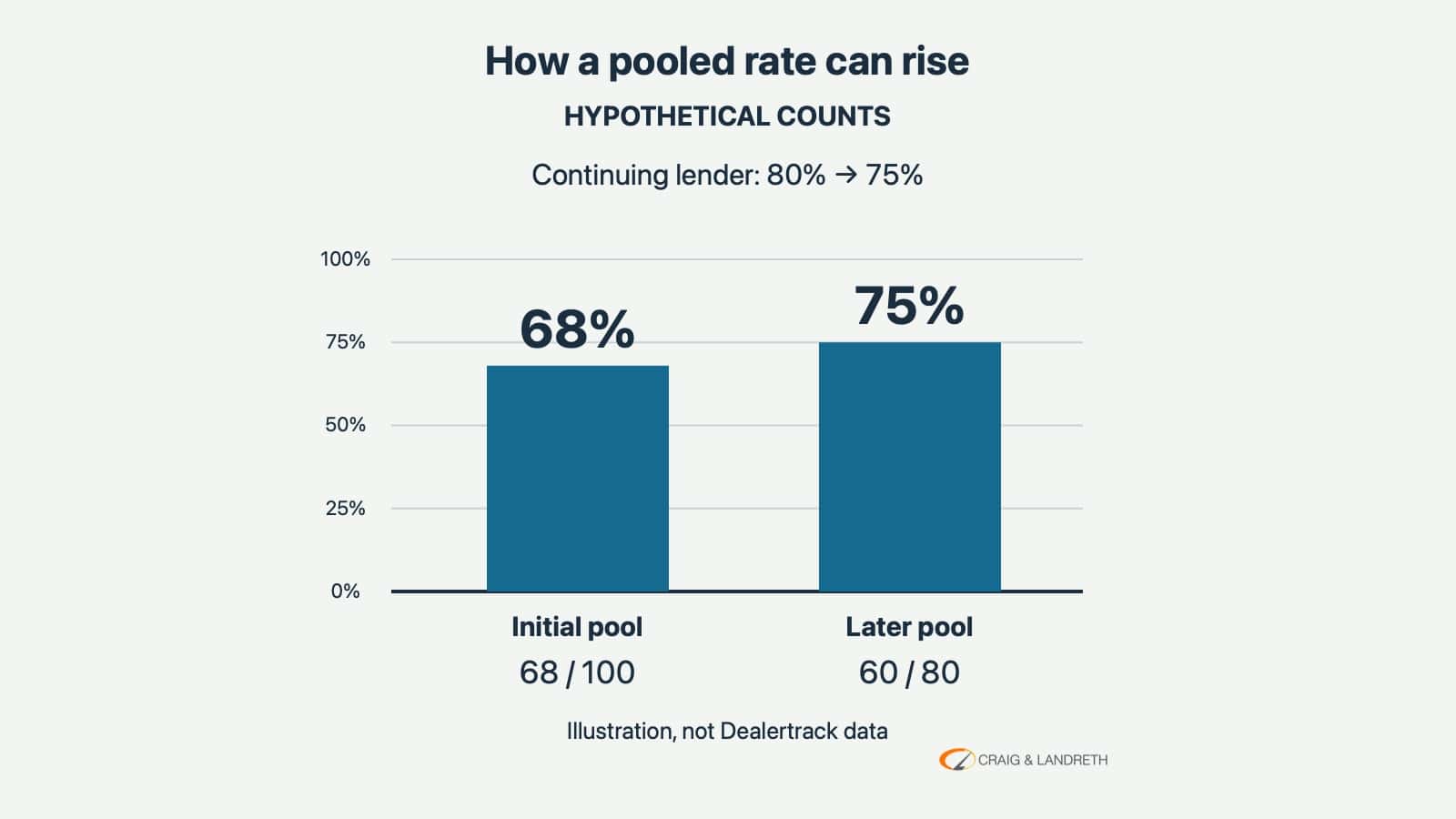
Now suppose A leaves the measured population. In the next period, B approves sixty of eighty applications, or 75%. The reported total rises from 68% to 75%, although the continuing lender’s approval rate falls from 80% to 75%. Fewer approvals at that lender coexist with a higher pooled percentage because the lower-approval group is absent. The number of counted applications also falls, from one hundred to eighty.
These invented counts illustrate the arithmetic only. They are not Dealertrack records, an estimate of the departed lender’s activity or a reconstruction of its index methodology. The calculation demonstrates why a comparison needs the population and denominators alongside the percentages. It does not establish that every aggregate increase is caused by a membership change.
Use the decision information for your application
For a denied application, the Consumer Financial Protection Bureau’s credit-report guidance points to the adverse action notice. It provides the main reasons or explains how to request them within 60 days. When the decision relies on a credit report, the notice identifies the reporting company and explains the right to request a free report from that company within 60 days of the notice. It also describes how to address errors or incomplete information. Those details concern the actual application and report.
The bureau’s current Regulation B interpretation adds a useful distinction: when a lender has sufficient information to decide, a denial needs specific reasons or notice of the right to obtain them. In that situation, missing information or an incomplete application cannot be substituted as the reason for a decision made on other grounds.
A borrower can therefore read the market report and the application record for separate purposes. Keep the report’s month and measured population with its headline. For the personal outcome, examine the decision explanation and the information it identifies. Neither a favorable national direction nor an unfavorable one resolves whether the details used for that applicant were correct.
0 comment(s) so far on Auto Approval Averages