

2027 Chevrolet Blazer EV: NACS Charging and Prices Explained
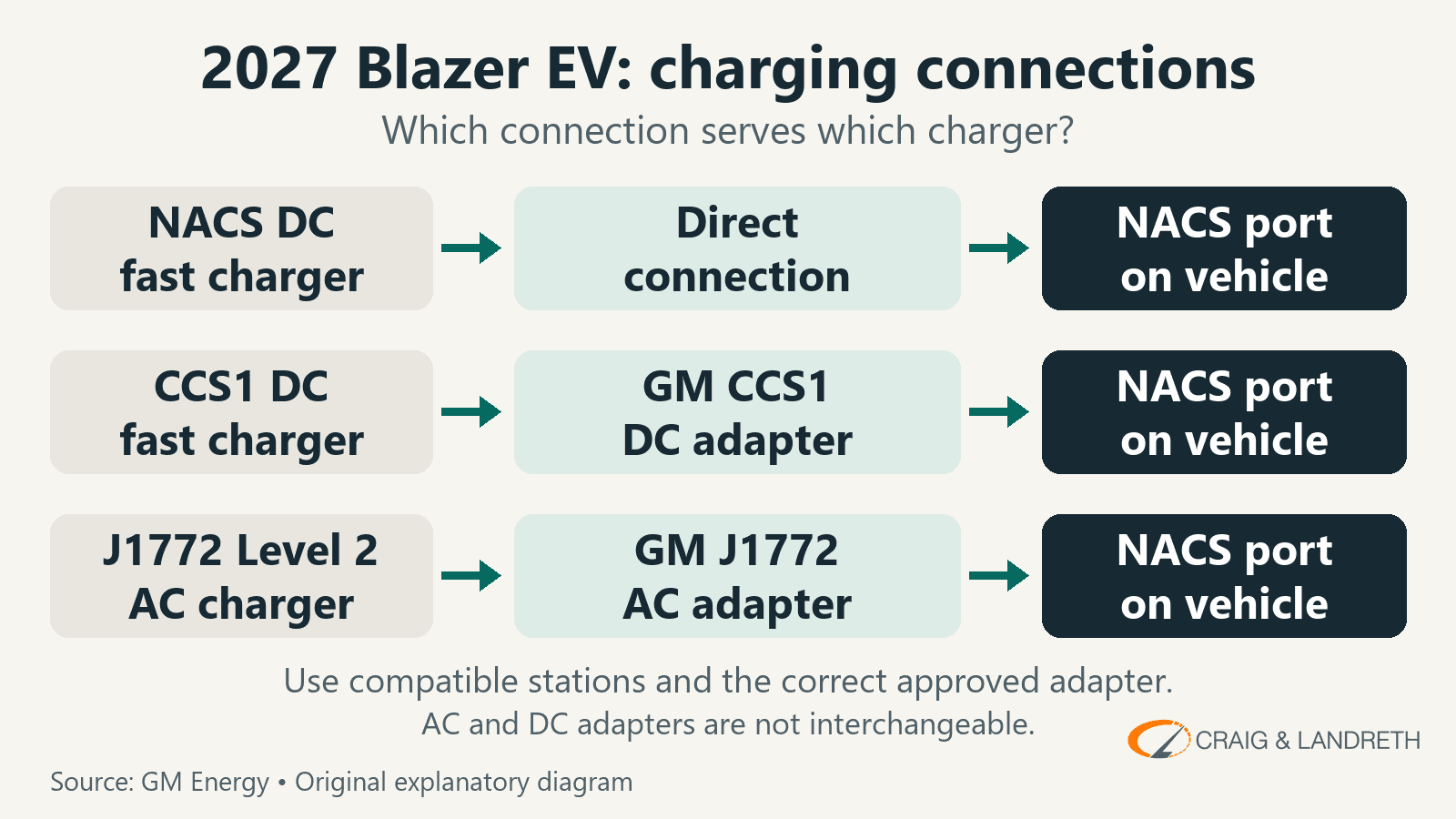
The 2027 Chevrolet Blazer EV comes with a native North American Charging Standard port, changing which public chargers can plug directly into the electric SUV. The starting LT lists at $45,000 before Chevrolet’s $1,795 destination freight charge, or $46,795 with that charge included and before options and other applicable costs.
This is a current model-year buying update, rather than a newly announced charging breakthrough. GM outlined its broader move to native NACS in August. For someone comparing a 2027 Blazer EV with an earlier example, the important distinction is the hardware on the vehicle and the equipment needed at the chargers they expect to use.
What the 2027 Blazer EV costs
Chevrolet’s current model page lists three starting prices. Adding the official 2027 destination charge gives the figures below. These are starting configurations; drivetrain choices, packages, taxes, title, registration and dealer fees can change the total.
| Model | Base MSRP | With $1,795 destination |
|---|---|---|
| LT | $45,000 | $46,795 |
| RS | $50,800 | $52,595 |
| SS | $60,700 | $62,495 |
The LT’s advertised EPA-estimated range is 312 miles with front-wheel drive. That is a specification for that configuration, not a guarantee for every trim or journey. The choice between versions should include the exact vehicle’s range label, equipment and price rather than pairing one trim’s lowest price with another configuration’s specifications.
Native NACS changes the connection, not every charging stop
GM’s charging overview distinguishes cars with factory NACS ports from earlier vehicles that reach compatible NACS fast chargers through an adapter. The 2027 Blazer EV belongs to the first group. A compatible NACS plug can connect without the NACS-to-vehicle adapter used by a CCS-equipped car.
That does not mean every station carrying a Tesla logo is available to every vehicle. Tesla’s support guide separates Supercharger access for other EVs by charger and vehicle compatibility. Verify the actual location through the supported charging tools before making it the only stop in a travel plan. Connector shape, network access and an operating charger are separate requirements.
There is also a practical difference between an easier connection and a faster charging session. Removing an adapter does not, by itself, establish a shorter stop. Battery state, temperature, the vehicle’s charging behavior and available station power still matter. Our guide to charging time versus peak power explains why a single headline number is incomplete.
Which adapters might owners still need?
A native NACS car can still encounter other plug types. GM Energy’s adapter guide specifies a GM CCS1 DC adapter for compatible CCS1 fast chargers and a GM J1772 AC adapter for compatible J1772 Level 2 charging. Those perform different jobs; the DC adapter does not support ordinary Level 2 home charging.
This reverses the question many owners of earlier EVs ask. Instead of buying an adapter to reach NACS, a 2027 Blazer EV owner may need one to keep using a familiar non-NACS charger. Identify the plug at home and the public stations on recurring routes before choosing accessories. An adapter bought for a previous vehicle should not be assumed compatible merely because it looks similar.
The useful comparison for an earlier Blazer EV
Put a photograph of the charging inlet, the window sticker and an equipment list alongside the written price for each car. Confirm which charging accessories are actually included, particularly with a used vehicle. Then price only the additional equipment your own routine requires.
For a driver who relies on compatible NACS fast charging, the factory port is a tangible convenience. For someone with an existing J1772 home setup, keeping that charger useful may matter more than changing it. The strongest reason to choose a particular Blazer EV is how its complete specification fits those real charging patterns.
0 comment(s) so far on 2027 Chevrolet Blazer EV: NACS Charging and Prices Explained