

PHEV MPG vs. MPGe: Read the Fuel-Economy Label
A plug-in hybrid’s fuel-economy label can show a large MPGe rating beside a smaller MPG number. Neither is the vehicle’s single efficiency figure for every trip. The numbers describe different operating conditions, and understanding that distinction is the first step toward a useful estimate of energy use and cost.
MPGe does not mean gasoline MPG
MPGe means miles per gallon of gasoline-equivalent. It expresses travel using an amount of energy equivalent to the energy in a gallon of gasoline, allowing comparison across fuels. It does not mean that a plug-in hybrid travels the displayed number of miles on an actual gallon of gasoline. EPA’s PHEV label explanation describes the separate ratings and their combined city/highway basis.
The charged-operation rating can cover electricity-only driving or a blend of gasoline and electricity, depending on the vehicle. The federal PHEV guide explicitly distinguishes gasoline-only ratings from electric-only or gas-and-electric ratings. Read the fuel wording beside the number rather than assuming every MPGe figure means the engine remains off.
The MPG figure describes operation after the externally charged energy has been depleted. The car still manages its hybrid system; that condition does not mean its battery has no usable energy whatsoever. For a long trip without another charge, the gasoline-operation rating becomes a particularly useful part of the label.
Read consumption and range alongside efficiency
Do not average MPGe and MPG. An arithmetic midpoint would mix different energy measures and imply a driving split the label has not established. Instead, look for the electricity-consumption figure in kilowatt-hours per 100 miles and gasoline consumption in gallons per 100 miles. EPA’s interactive PHEV label shows these fields, along with range and the assumptions behind estimated fuel costs.
Consumption is useful for a cost calculation because each quantity can be multiplied by its own price. If the charged mode uses both fuels, include both consumption figures. Do not price its MPGe as though all the energy came from the electrical outlet, or count only the gasoline and omit the electricity.
All-electric range answers another question: approximately how far the vehicle can travel on a full charge under the rating conditions. It is not a guarantee that the engine stays off for every shorter journey. The Alternative Fuels Data Center’s PHEV overview notes that engines can run when the battery is mostly depleted, during rapid acceleration or with intensive heating or air-conditioning loads. Designs and conditions differ.
A transparent 100-mile example
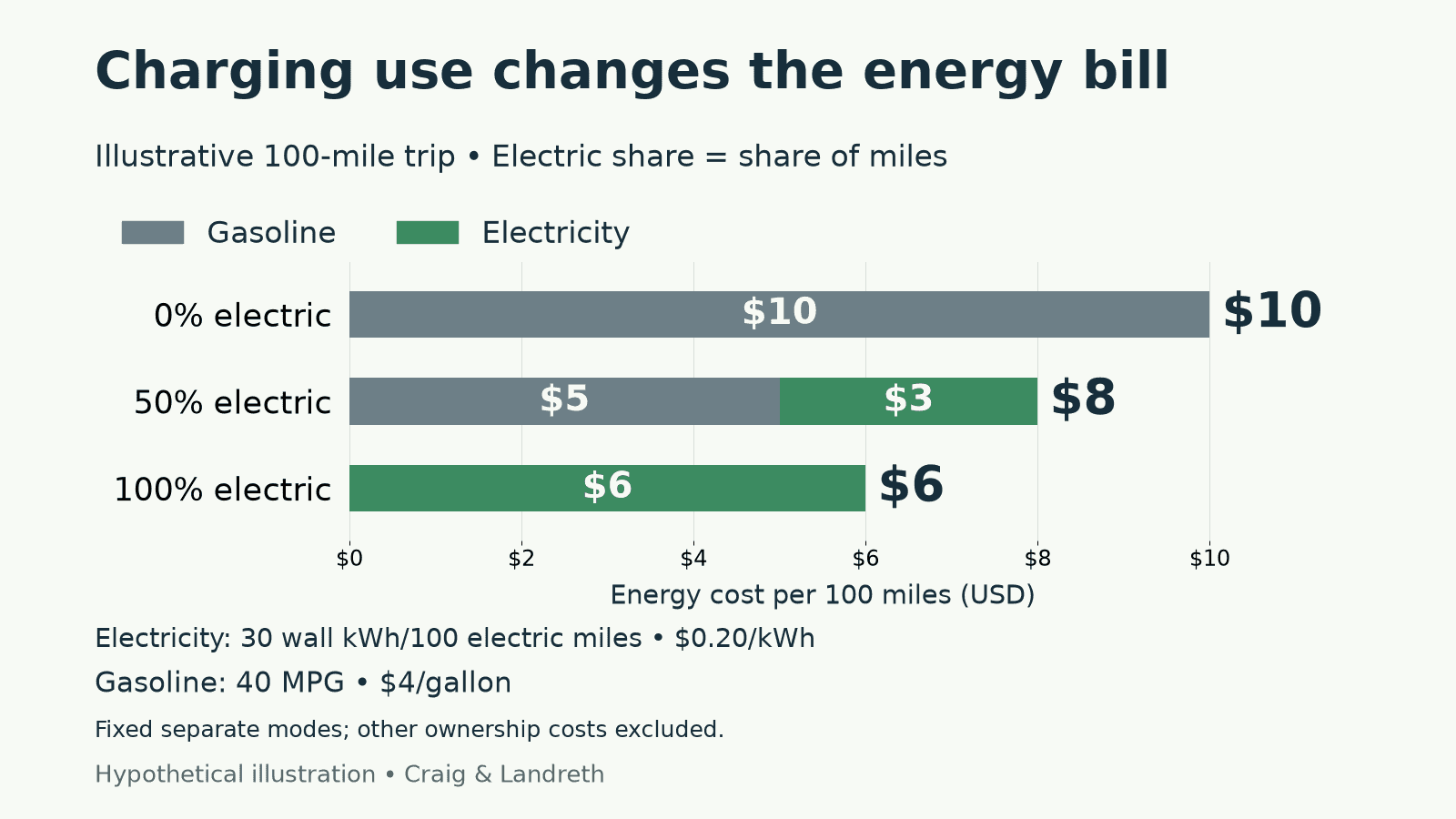
Consider a hypothetical PHEV that uses 30 kWh from the wall per 100 electric miles and returns 40 MPG in gasoline operation. Assume electricity costs $0.20 per kWh and gasoline costs $4 per gallon. These are chosen arithmetic inputs, not ratings or current price claims for a real vehicle.
At zero electric miles, 100 miles divided by 40 MPG requires 2.5 gallons, costing $10. At 100 electric miles, 30 kWh multiplied by $0.20 costs $6. For 50 electric miles and 50 gasoline miles, 15 kWh costs $3 and 1.25 gallons costs $5: $8 in total.
The resulting $10, $8 and $6 per 100 miles show why the share of electric driving matters even when the vehicle’s ratings do not change. The illustration assigns each mile to one mode. Real trips may blend energy sources, so an actual calculation needs both fuels used in that operation. Here, electricity is explicitly measured at the wall, including the energy purchased for charging.
Use the label to build a cost estimate
Fuel-cost figures on the label use standardized assumptions. For an individualized estimate, the federal plug-in hybrid calculator accepts driving habits, fuel prices and charging schedules. Its result remains an estimate. Energy spending also leaves out purchase price, financing, insurance and other ownership costs.
For the separate model-choice question, our Prius hybrid and plug-in comparison examines price and charging costs. When reading any PHEV label, keep the sequence clear: identify the rated mode, read each fuel’s consumption, and apply the prices and driving mix that fit the calculation.
0 comment(s) so far on PHEV MPG vs. MPGe: Read the Fuel-Economy Label