

Winter Tires vs. AWD: What Helps You Stop in Snow?
All-wheel drive can make a snowy departure feel reassuring. It can distribute driving force to more wheels and help a vehicle get moving. That initial traction does not establish how confidently the same vehicle will stop or turn when the road is slick. Those maneuvers still depend on the grip available where the tires meet the surface.
For a buyer choosing an AWD vehicle—or an owner deciding whether to buy winter tires—the useful comparison is between two different functions. The drivetrain helps deliver power. The tires provide the contact with snow, ice and pavement. Adding powered wheels does not remove the importance of choosing tires for the conditions.
Acceleration can hide a braking limitation
The U.S. Tire Manufacturers Association’s seasonal driving guidance draws the distinction directly: four-wheel drive can help acceleration in snow without improving the ability to stop or avoid skidding. Drivers should not use an easy launch as a test of the grip available for the next corner or stop.
Tire Rack demonstrated the difference in a 2006 comparison using an AWD Porsche Cayenne on ice. It tested summer, all-season and winter tires on the same type of vehicle and found meaningful differences in traction and control. The test is a dated, controlled illustration using its stated tire models and surface, not a ranking of current tires or a prediction of a particular driver’s stopping distance.
That qualification matters. Vehicle weight, tire condition, road temperature and the surface all affect a result. The lesson is to examine the tire setup alongside the drivetrain, rather than transferring one test’s numbers to every SUV or winter road.
What the snowflake marking establishes
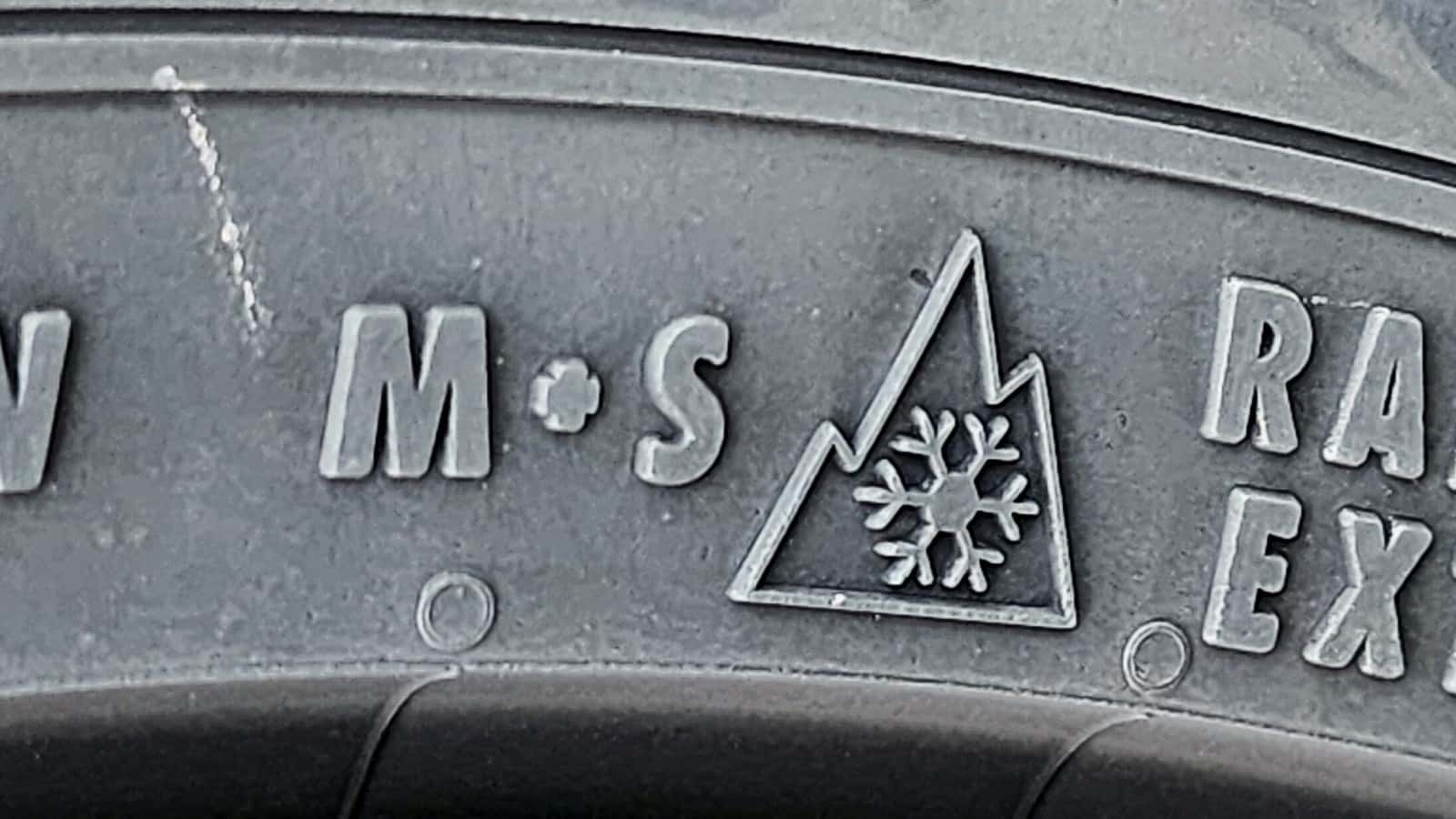
M+S lettering and the Three-Peak Mountain Snowflake symbol should not be treated as identical evidence. USTMA’s severe-snow tire definition ties the snowflake symbol to a specified snow-traction qualification. That defined test has a narrower meaning than a blanket guarantee of winter performance.
In particular, the mark does not by itself establish a tire’s ice-braking distance or show that every tire bearing it performs equally. Use it as one piece of information, then compare the tire’s intended season, published tests and suitability for the vehicle. A recognizable symbol is useful when its limits are understood.
NHTSA’s TireWise guidance describes winter tires as more effective than all-season tires in deep snow and says summer tires are not designed for below-freezing, snow or ice conditions. That makes the existing tire category relevant even when the vehicle already has AWD.
A matched set is part of the vehicle’s balance
Thinking only about the driven axle can miss how the vehicle behaves when turning or braking. USTMA’s replacement guidance recommends replacing all four tires together for optimal performance and directs owners to vehicle and tire manufacturer requirements. A winter setup should be evaluated as a complete matched set, with appropriate size, load and speed specifications.
Follow the exact vehicle’s instructions for acceptable combinations and any AWD tread-depth requirements. There is no single mismatch allowance that can safely be assigned to every AWD system. A tire professional should work from those requirements rather than assuming the same rule fits all vehicles.
The purchase decision depends on the winter conditions the vehicle will actually encounter. Persistent snow and ice present a different task from occasional cold rain. Compare suitable tires using relevant testing and the manufacturer’s guidance, while leaving room for cautious speed and greater following distance. AWD can improve the launch; tire selection remains central to the parts of the drive that follow it.
0 comment(s) so far on Winter Tires vs. AWD: What Helps You Stop in Snow?