

How to Read a Used-EV Battery Health Report
Used EVs
Updated October 17, 2026
Ask for the complete battery report, including its method and date. A percentage alone cannot explain what was checked.
Match the record to the car
Match the report’s VIN to the car. Note its date, mileage, provider, tool or software name, and the metric reported. Ask for the complete document rather than a cropped score. If an item is missing, ask the provider to explain how the result is tied to this particular vehicle.
Define the percentage before comparing it
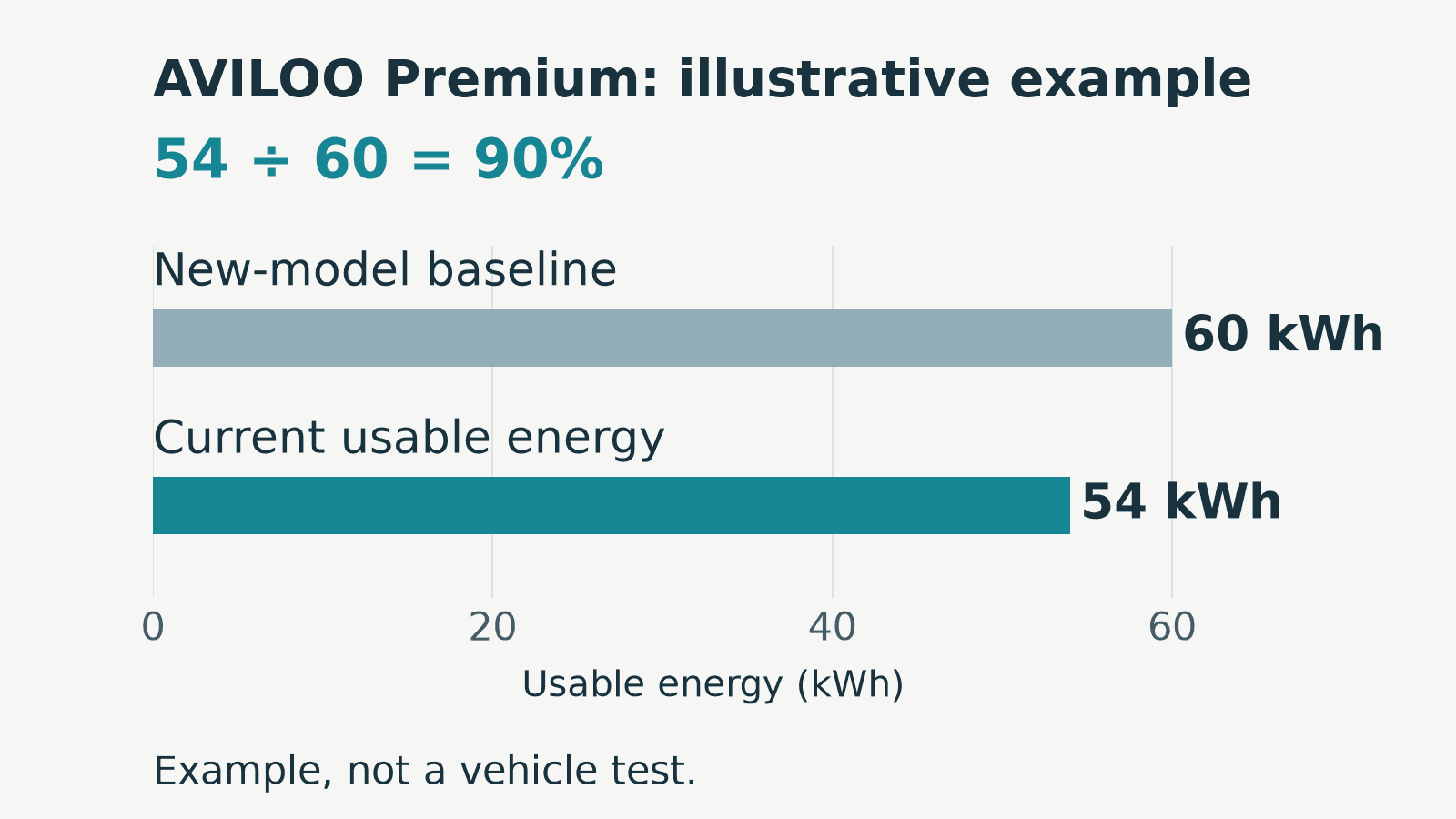
AVILOO’s Premium whitepaper defines its calculation using current usable energy relative to the model’s usable energy when new. Its illustrative 54-kWh versus 60-kWh example produces 90%. This explains that provider’s method; it is not a test result for a car offered here.
Ask which process the document records. AVILOO’s read-out comparison distinguishes accessing the vehicle’s battery-management-system value from performing its own diagnostic test. This is the provider’s explanation, rather than an independent validation of its product. Have the provider identify the process used for the report in front of you.
Keep range separate from battery health
Recurrent’s FAQ describes its result as a statistically probable range estimate, with actual range affected by how a vehicle is used, where it resides and how it is charged. That is a different question from the usable-energy comparison above. Preserve the provider’s qualifications when saving or sharing the report; a range forecast should not become a guaranteed distance or a promise about battery health.
The Department of Energy’s consumer guidance also asks buyers to consider daily travel, longer trips and compatible chargers along the route. Hills, heavy loads and substantial heating or air-conditioning use can reduce range. Apply those considerations to the journey you need to make. A report’s headline number does not establish that a particular route can be completed between available chargers, or that a charger accepts the vehicle’s connector. Keep the travel question alongside the report, rather than replacing one with the other.
Find the warranty for the actual vehicle
Tesla’s warranty page provides a useful example of document identity: its linked warranties are general information, while the warranty supplied with the vehicle is authoritative for that vehicle. Tesla also identifies a “Specs & Warranty” section in its app for checking coverage details. A current website document should not simply be substituted for the one applicable to an older car.
For any brand, use the VIN to request the applicable battery-warranty document and coverage confirmation. Check time, mileage, any capacity threshold, transfer conditions and the required diagnostic process. A third-party report does not itself create or extend manufacturer coverage.
Connect the report to the wider inspection
The Department of Energy’s maintenance guidance advises checking with the dealer about battery life and warranties. It also explains that some battery systems use liquid coolant and may need regular checks, with details available from the dealer or owner’s manual. Ask which maintenance requirements apply to the vehicle and whether the records show them being addressed. This is separate from interpreting a health score, and it does not identify a cooling fault or establish that a particular battery has been inspected.
Compare the report with the service history and inspection findings. Our used-car inspection checklist organizes the wider vehicle review. Ask which battery checks were performed, which systems were outside the inspection and who can explain the measurements. Keep any promised follow-up in writing with the complete report.
If two reports disagree, compare dates, mileage and methods before concluding that the battery changed. Recurrent’s distinction between an estimated outcome and actual use is a reason to preserve context. Ask the providers to explain the difference; averaging incompatible scores would not resolve it.
0 comment(s) so far on How to Read a Used-EV Battery Health Report