

2026 Toyota SUV IIHS Ratings: Awards and Test Results
Safety ratings explained
No Toyota-branded SUV appears on IIHS’s 2026 Top Safety Pick or Top Safety Pick+ list checked October 16, 2026. That is an award-list result, not a finding that every Toyota SUV has the same weakness. The individual tests explain more: the Grand Highlander and Sequoia miss different crashworthiness thresholds.
Updated October 16, 2026
The current Toyota award list includes the Prius and Camry at Top Safety Pick+ and the Tundra crew cab at Top Safety Pick. Those are specific models and body styles, rather than a rating for every Toyota vehicle. Award lists can change as evaluations are completed.
What changed in the 2026 award rules
IIHS’s March 24 explanation of its 2026 criteria identifies an important change: both award levels require a Good rating in the updated moderate overlap front test. For the 2025 awards, Acceptable was sufficient for the base award. The updated test adds emphasis on protection for a passenger in the back seat.
Both 2026 awards also require Good small overlap front and side ratings, with Acceptable or Good headlights across all trims. The qualifying front-crash-prevention systems must be standard equipment. Meeting one of those requirements does not compensate for missing another.
The awards differ in crash avoidance. Top Safety Pick requires Acceptable or Good pedestrian front crash prevention. Top Safety Pick+ requires Good pedestrian performance and Acceptable or Good performance in the newer vehicle-to-vehicle front crash prevention 2.0 evaluation. A car can therefore have a useful set of safety features without meeting every award threshold.
Two SUVs show why the test names matter
| 2026 model | Small overlap front | Updated moderate overlap front | Updated side |
|---|---|---|---|
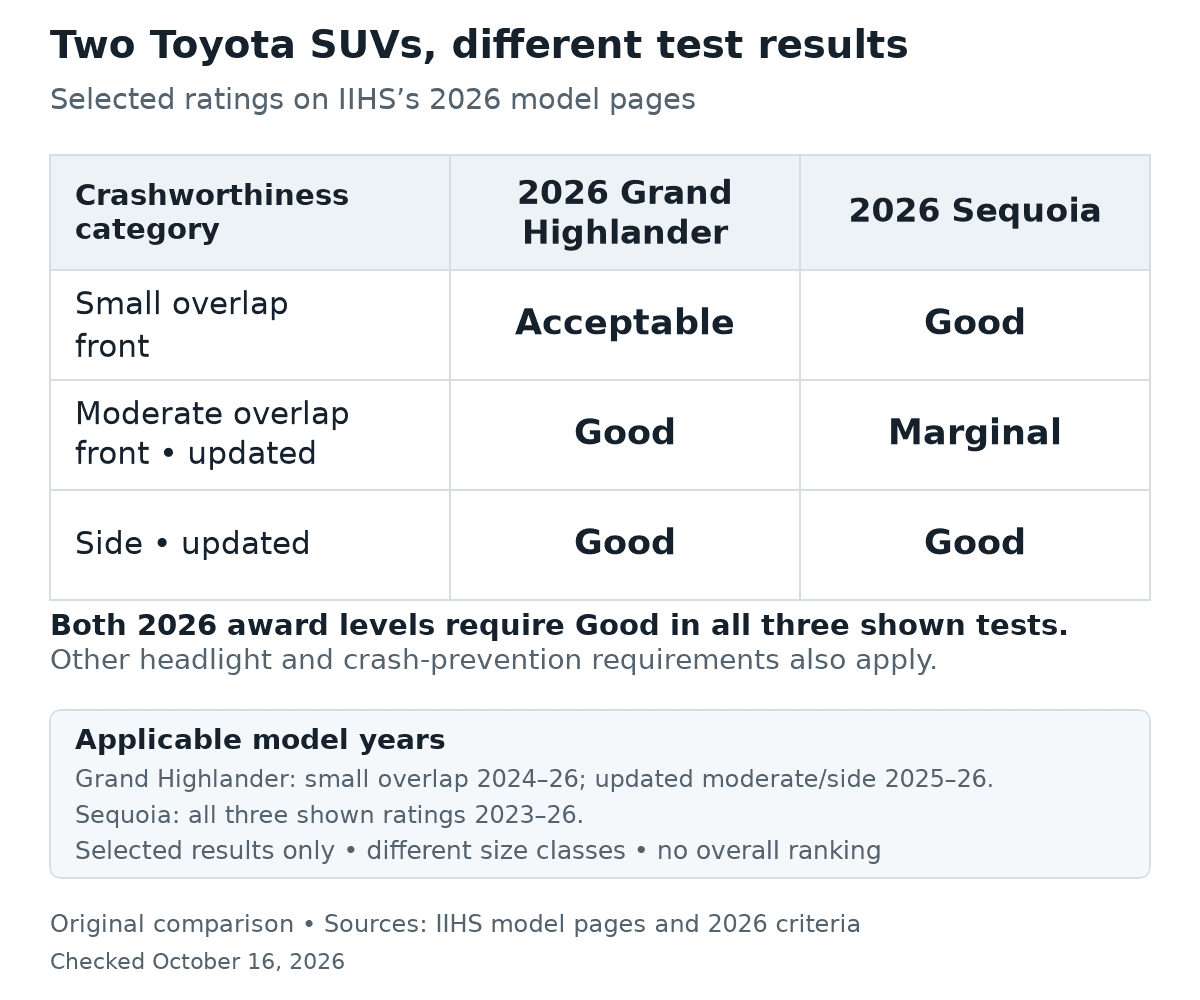
| Toyota Grand Highlander | Acceptable | Good | Good |
| Toyota Sequoia | Good | Marginal | Good |
The Grand Highlander’s combined small overlap result is Acceptable: its driver-side evaluation is Acceptable and its passenger-side evaluation is Good. IIHS uses the lower of those two results for the combined rating. Its updated moderate overlap and side results are Good. Describing every Toyota SUV’s award gap as a rear-seat-test problem would miss this distinction.
The Sequoia’s updated moderate overlap result is Marginal. Within that test, IIHS lists rear-passenger restraints and dummy movement as Marginal, while the structure rating is Good. Those are components of a specified evaluation, not a prediction of what will happen to every occupant in every crash. Its complete page also shows equipment-dependent headlight results and separate crash-avoidance evaluations.
Check what each result actually covers
The model-year heading is only the beginning. The Grand Highlander’s small overlap result applies to 2024–26 models; its updated moderate overlap and side ratings apply to 2025–26. The Sequoia’s three crashworthiness results shown here apply to 2023–26. A tested vehicle’s year and the years covered by its result can differ.
A missing award and an unpublished individual test result are different things. Neither makes an unreported score Poor. Read the available test categories and their applicability notes before deciding why a vehicle does not qualify. Do not transfer a previous model’s result to a redesigned vehicle simply because the name stayed the same.
IIHS frames its awards within size categories. A badge alone is not a complete comparison between vehicles of different sizes, and a published model rating does not establish the condition of a particular used example. Match the model year, body style and any build-date or equipment restrictions, then review that car’s repair and equipment records.
Learn the fitted systems and their warning messages using the owner’s manual while parked. Do not recreate crash-avoidance tests in traffic. If the actual vehicle has an adaptive-cruise warning, the obstruction, repair-history and calibration questions are separate from whether its model earned an award.
0 comment(s) so far on 2026 Toyota SUV IIHS Ratings: Awards and Test Results