

2027 Kia Sportage Hybrid Prices: FWD, AWD and Plug-In
Hybrid SUV pricing
Kia’s July 20, 2026 U.S. pricing announcement adds front-wheel-drive choices for the 2027 Sportage Hybrid S and EX. The announced lineup starts at $32,085 for the Hybrid LX FWD and $42,085 for the Plug-in Hybrid X-Line AWD after destination. Those figures are manufacturer price baselines, not current dealer quotes.
Updated October 16, 2026
What the announced prices include
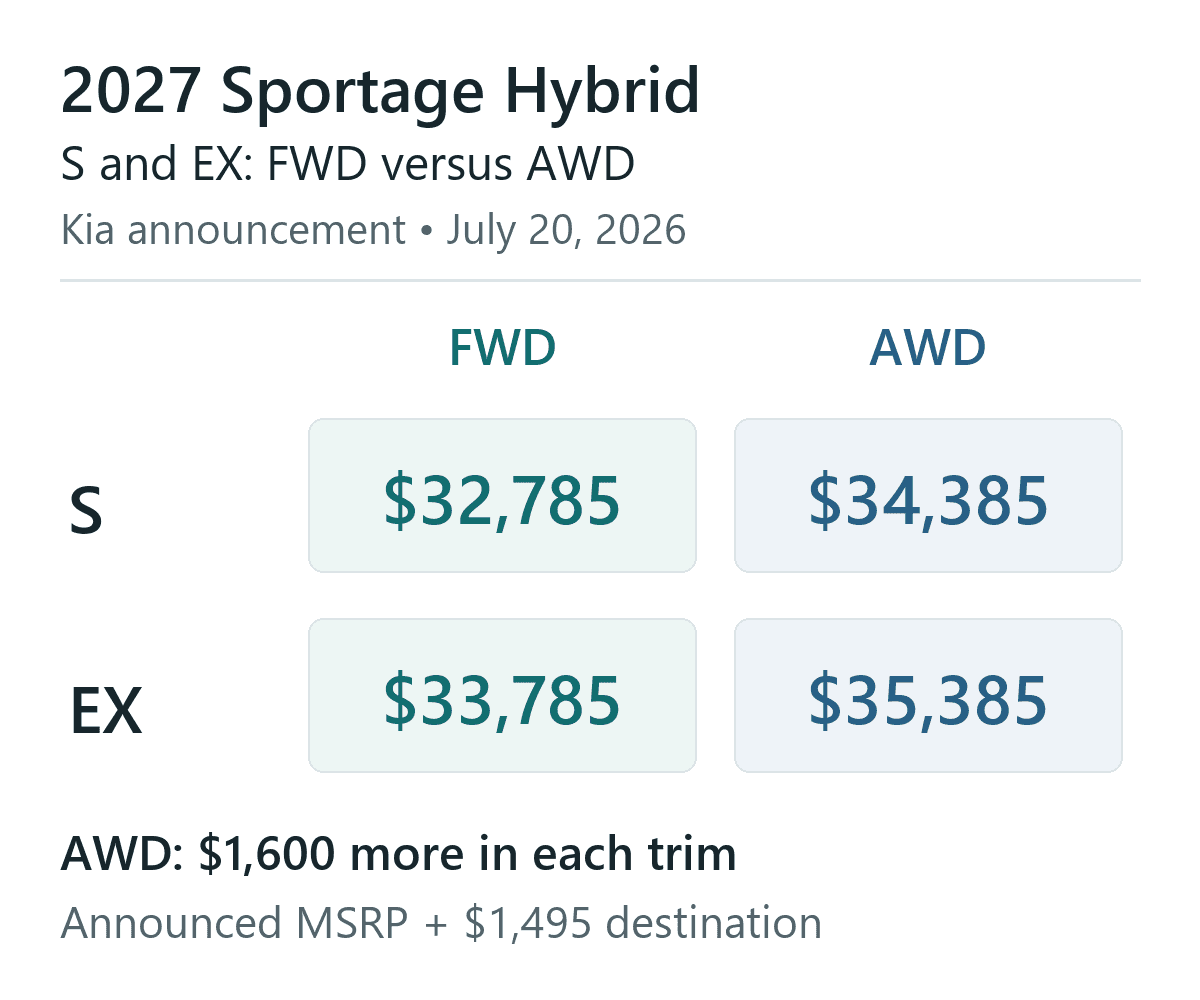
Kia America’s release lists these nine versions. We added its $1,495 destination charge to each MSRP. Taxes, title, license fees, options and retailer charges remain separate; Kia says retailers set actual prices.
| Version | Drive | MSRP | MSRP + $1,495 destination |
|---|---|---|---|
| Hybrid LX | FWD | $30,590 | $32,085 |
| Hybrid S | FWD | $31,290 | $32,785 |
| Hybrid S | AWD | $32,890 | $34,385 |
| Hybrid EX | FWD | $32,290 | $33,785 |
| Hybrid EX | AWD | $33,890 | $35,385 |
| Hybrid X-Line | AWD | $35,790 | $37,285 |
| Hybrid SX-Prestige | AWD | $40,690 | $42,185 |
| Plug-in Hybrid X-Line | AWD | $40,590 | $42,085 |
| Plug-in Hybrid X-Line Prestige | AWD | $47,390 | $48,885 |
FWD expands the S and EX choices
The S and EX FWD rows are each $1,600 below their respective AWD rows. Because destination is the same, that difference remains after adding it. This compares the announced drivetrain versions; it does not establish identical optional equipment or a difference in total ownership cost.
Decide which drive layout suits your use before moving between trims. A higher-trim FWD price should not be mistaken for an AWD price, and a hybrid badge does not identify the fitted equipment.
The two starting prices also compare different trims and drive layouts: LX FWD versus X-Line AWD. Their $10,000 difference does not isolate the cost of adding a plug or establish which vehicle offers better value for your needs.
A hybrid and a plug-in ask different things of the owner
The Department of Energy’s powertrain overview distinguishes a conventional hybrid’s gasoline engine and electric motor from plug-in vehicles. An HEV recovers energy through regenerative braking and does not plug in. Its electric assistance does not create a home-charging task.
A plug-in hybrid can take energy from external charging equipment as well as recover braking energy. DOE explains that its fuel use depends on the distance driven between charges. Regular charging and trips suited to electric operation affect the benefit; the plug-in label alone cannot predict your gasoline use.
For a PHEV, ask where you could charge consistently, what it would cost and how long the car would normally remain parked there. Include trips between charging opportunities, rather than considering only the shortest daily journey. Confirm compatible equipment and the vehicle’s charging instructions before assigning a benefit to an outlet or public station.
Read both sides of the plug-in’s label
The FuelEconomy.gov label guide separates MPGe, an energy-equivalent efficiency measure, from the MPG figure for gasoline operation after the battery’s plug-in energy is depleted. MPGe should not be read as the number of miles traveled on a gallon of gasoline.
Check electricity consumption, gasoline-mode MPG and rated electric range for the exact model year and drivetrain you are considering. Label estimates use stated assumptions; they do not guarantee the same result for your route, weather or energy prices. Compare the assumptions with your own mileage and charging plan.
Build the comparison around the actual car
Put the exact trim, drivetrain and chosen equipment beside a written purchase quote. Keep the announced MSRP and destination calculation visible, then identify every difference in the actual offer.
If you are financing, keep the purchase price, borrowing terms and operating budget separate. Our payment-versus-total-cost explanation shows why a smaller installment does not settle the overall comparison. Decide whether the equipment and charging pattern fit first, then judge the complete numbers.
0 comment(s) so far on 2027 Kia Sportage Hybrid Prices: FWD, AWD and Plug-In