

Used-Car Values vs. Retail Prices: Reading the Q2 Report
Used-vehicle market
Updated October 16, 2026
Wholesale values and retail asking prices can tell different stories without contradicting each other. Cox Automotive’s July 8, 2026 report described June wholesale values settling after spring strength while used-car listings remained expensive. Those were June and first-half observations, not today’s asking prices or a valuation of an individual vehicle.
Read the date and the measure together
The June Manheim Used Vehicle Value Index reached 212.9, up 2.1% from June 2025 and 0.1% from May 2026 after adjustments for vehicle mix, mileage and seasonality. Cox said values were roughly 1% below their March peak. A slower monthly change still left the index above its year-earlier level.
| Reported figure | What it describes |
|---|---|
| 212.9 | June’s adjusted wholesale index level, not a dollar price. |
| +2.1% year over year | Change in that index from June 2025. |
| +0.1% month over month | Change in that index from May 2026. |
| Listing prices approaching $27,000 | The report’s approximate contemporary retail asking-price observation, not a completed-sale average or a current quote. |
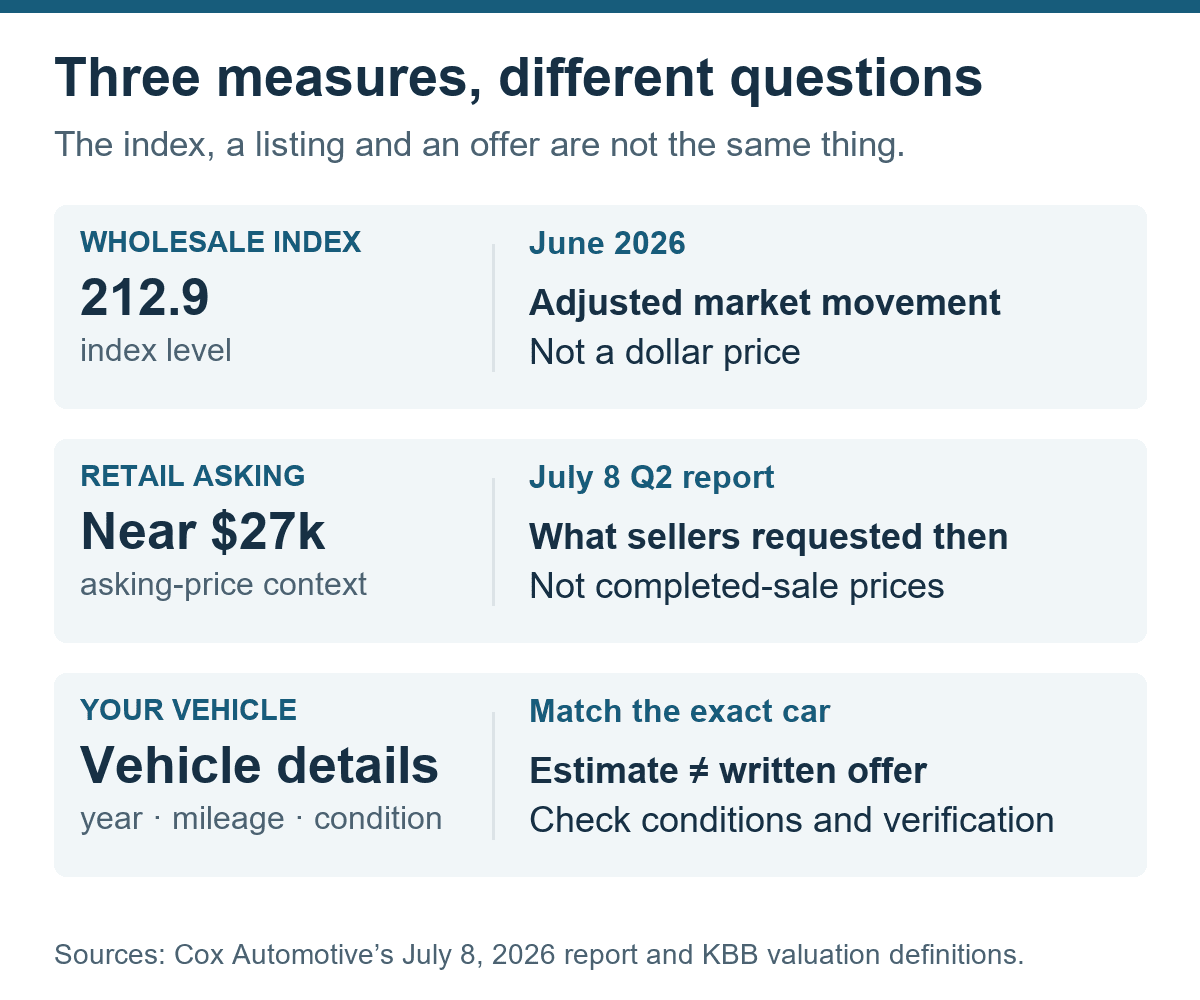
“Normalizing” in that report meant a return toward usual seasonal behavior after an unusually strong spring. It did not mean used cars had returned to a particular affordable price, nor that every model’s value was falling.
The index is built from wholesale transactions
Manheim’s methodology begins with U.S. sales in 20 market classes, excluding categories such as heavy trucks and motorcycles. It removes specified outliers, adjusts for mileage and weights the classes using a rolling 24-month sales average before applying a seasonal adjustment.
Those steps help separate a market movement from changes in the vehicles passing through the sample. They are not an inspection of the car you want to buy. The index is also rebased to January 1997 equal to 100: 212.9 is an index level, not $21,290, a percentage change from last year or an offer to purchase your car.
A retail listing answers a different question
The Q2 release said asking prices had climbed back toward $27,000 and noted limited supply in some four- to six-year-old age groups. That is context for the advertisements shoppers were seeing then. An asking price records what a seller is requesting; it does not establish what the buyer ultimately paid.
Use the report to understand its period, then compare actual alternatives. Record the model year, trim, equipment, mileage, stated condition and price date. A market-wide percentage cannot reconcile different engines, missing equipment or a documented repair need between two cars.
Keep an individual estimate separate from an offer
Kelley Blue Book’s own valuation FAQ asks for the vehicle’s year, model, style, mileage, equipment, location and condition. It also distinguishes estimated trade-in and private-party values. Those are different selling situations; a number from one channel should not quietly become the expected result in another.
When you receive an offer, keep its written conditions alongside the estimate you used for planning. Check whether it concerns the same vehicle details and what remains subject to verification. The June index does not determine the offer, a loan approval or the amount left after an existing payoff.
For the later market period, the September Manheim index explanation separates that month’s adjusted, non-adjusted and EV results. Read the dates together rather than treating July’s report as an October price update.
0 comment(s) so far on Used-Car Values vs. Retail Prices: Reading the Q2 Report