

Consumer Reports Safety Verdict: Basic, Better and Best
Understanding Safety Research
Updated October 16, 2026
Consumer Reports’ Safety Verdict brings braking, handling, usability, crash-test evidence and standard safety equipment into one new-car assessment. Its Basic, Better and Best labels answer a different question from a star rating or an equipment list: how much of CR’s published safety framework does a vehicle satisfy?
What the three labels mean
CR introduced the system in its February 3, 2026 announcement. The table summarizes selected requirements from that launch framework; the higher tiers include the requirements below them.
| Verdict | What it adds |
|---|---|
| Basic | Compliance with federal motor vehicle safety standards. |
| Better | CR braking and handling requirements, pedestrian-detecting automatic emergency braking standard across trims, and specified IIHS results when tested. |
| Best | Further IIHS crash-test and CR usability requirements, plus standard highway-speed automatic emergency braking, blind-spot warning and rear cross-traffic warning on every trim. |
The all-trim requirement matters. Finding one well-equipped version does not establish that a model meets CR’s highest tier. Conversely, a model’s lower verdict does not explain the reason on its own. Equipment availability, a test result or another requirement may be the limiting factor; the underlying assessment is more informative than guessing from the label.
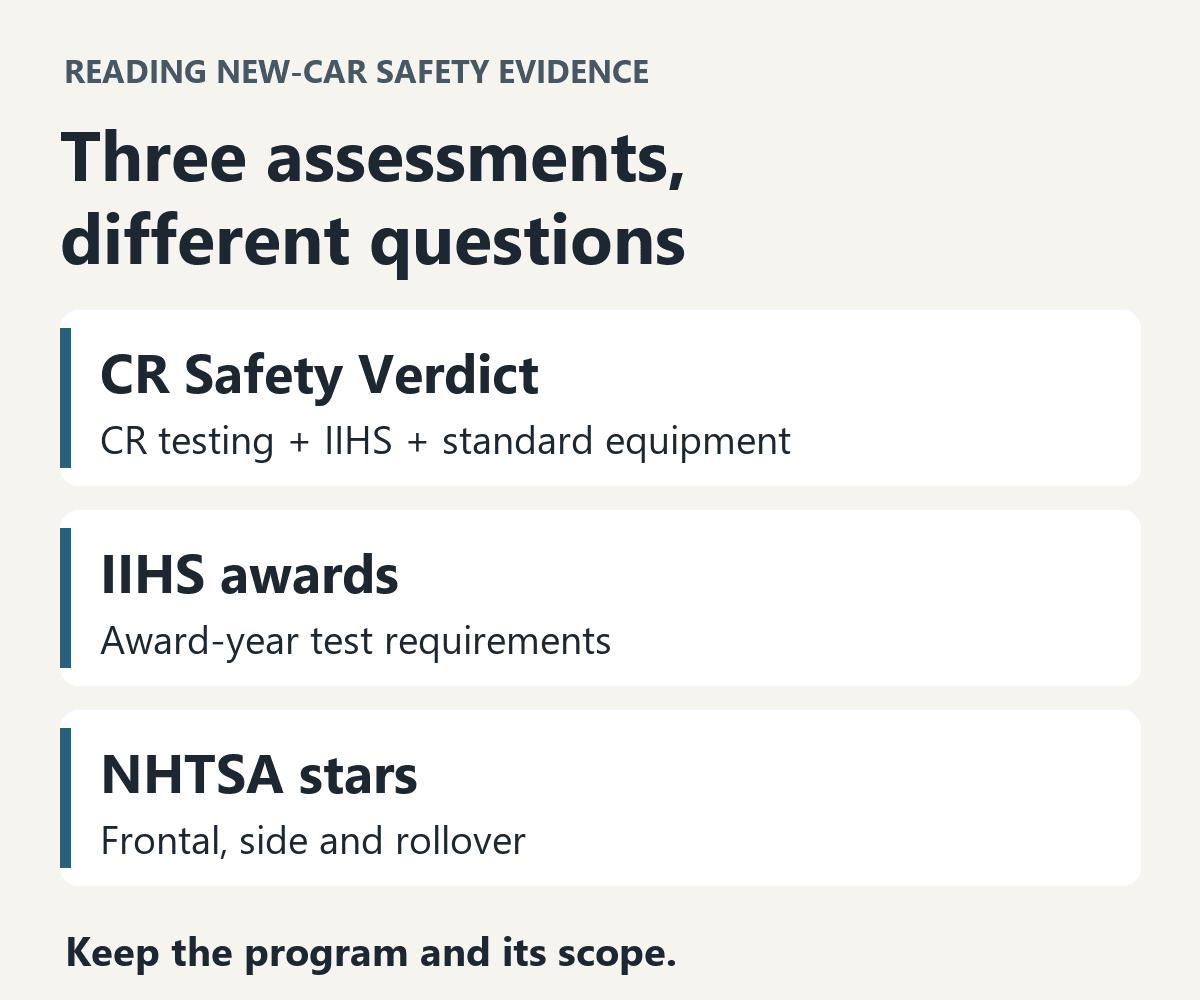
A verdict, an award and a star rating are different evidence
A CR Safety Verdict is not the same designation as an IIHS Top Safety Pick award. The organizations have their own requirements. For 2026 IIHS awards, both award tiers require Good ratings in the small-overlap front, moderate-overlap front and side tests, along with standard Acceptable or Good headlights. Top Safety Pick+ adds stronger crash-prevention requirements.
Check the qualification beside the exact entry. For example, the current IIHS small-SUV list restricts the 2026 Kia Sportage award to vehicles built after May 2025. A model-year label alone would miss that distinction. Our 2026 IIHS criteria and build-date explainer shows how to read those qualifications together. Award criteria also change, so a 2026 award should not be substituted for an older award or a different model-year result.
IIHS also cautions that its awards identify choices within size categories. A smaller award winner is not automatically more protective than a larger vehicle without an award. That is a limit on the comparison, rather than a reason to discard the individual test results.
NHTSA’s 5-Star Safety Ratings are a separate federal assessment of frontal, side and rollover performance. NHTSA permits frontal and overall star comparisons only within the same vehicle class and within 250 pounds of the rated vehicle’s weight. Its “Not Rated” label means a vehicle was not tested for that condition; it is not a zero-star result.
Turn the label into a specific equipment question
When comparing two new vehicles, keep the exact model year, configuration and assessment date alongside each result. Then identify the feature behind the claim. “Available automatic emergency braking” and “standard on all trims” say different things, even if the advertisements use similar safety language.
Controls and displays deserve their own look while parked. Can the driver identify a warning, adjust the mirrors and find frequently used controls? That observation can help assess personal usability; it does not reproduce CR’s track testing or establish a crash-prevention system’s performance. Deliberately provoking braking or lane interventions is not a substitute for published testing.
The most useful comparison keeps the evidence separate: CR’s verdict and its stated requirements, the applicable IIHS tests and award conditions, and the comparable NHTSA ratings. None supplies a prediction that a particular trip will be crash-free.
0 comment(s) so far on Consumer Reports Safety Verdict: Basic, Better and Best