

IIHS 2026 SUV Awards: Criteria and Build-Date Limits
Vehicle Safety Ratings
Updated October 16, 2026
The 2026 IIHS awards give SUV buyers a more demanding test of back-seat protection and crash avoidance. The useful detail is the qualification attached to the exact vehicle: award level, model year, standard equipment and, sometimes, production date. A familiar model name on a winner list is only the beginning of that comparison.
What changed for the 2026 awards
In its March 24, 2026 announcement, the Insurance Institute for Highway Safety required a Good result in the updated moderate-overlap front crash test for both award levels. Previously, the base Top Safety Pick award could qualify with Acceptable. The updated test emphasizes protection for a rear-seat occupant, making the change relevant to people regularly carrying passengers in back.
Both awards also require Good small-overlap front and side results, plus Acceptable or Good headlights across trims. For 2026, qualifying front crash-prevention systems must be standard equipment. Top Safety Pick+ adds a stronger pedestrian requirement and a result in the newer vehicle-to-vehicle test.
| Evaluation | Top Safety Pick | Top Safety Pick+ |
|---|---|---|
| Pedestrian front crash prevention | Acceptable or Good; standard | Good; standard |
| Vehicle-to-vehicle front crash prevention 2.0 | No award requirement | Acceptable or Good; standard |
The March announcement counted 63 winners: 45 Top Safety Pick+ and 18 Top Safety Pick. Those were the results available at that date. Treating the number as a permanent total would miss later additions or changes to the list.
Read the model-year and build-date line together
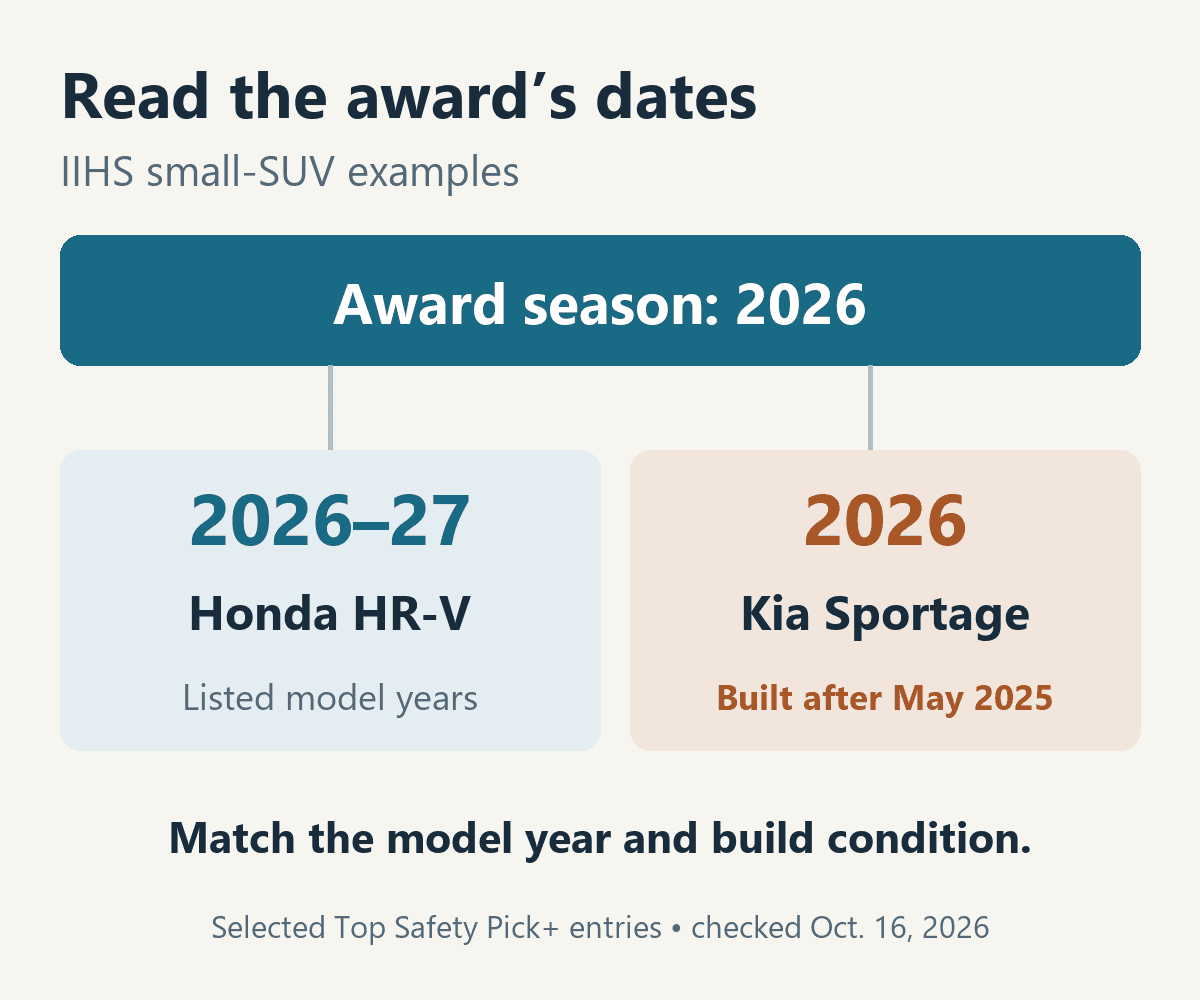
The current 2026 small-SUV award list, checked October 16, 2026, illustrates why the detail matters. It lists the 2026 Kia Sportage as Top Safety Pick+ only for vehicles built after May 2025. It also lists the 2026 Subaru Forester and 2026–27 Honda HR-V as Top Safety Pick+.
These are examples of the list’s qualifications, rather than a ranking of the three vehicles. “2026 awards” identifies the award season; the HR-V entry includes two model years. The Sportage entry adds a production boundary within a model year. A listing that says only “2026 Sportage” leaves that necessary build-date question unanswered.
Match a candidate’s model year and production information to its actual IIHS entry before applying an award. If the row points to a particular body style or other condition, carry that qualification into the comparison. A shared name does not erase the limits printed alongside it.
IIHS awards and NHTSA stars answer different questions
NHTSA’s 5-Star Safety Ratings are a separate federal program covering frontal, side and rollover performance. An IIHS Top Safety Pick+ is not a five-star score, and one program’s result should not be substituted for the other’s.
NHTSA says its frontal ratings and Overall Vehicle Scores should be compared only among vehicles in the same class and within 250 pounds of one another. Side-crash and rollover ratings can be compared across classes. That distinction matters when an SUV shortlist spans very different sizes: two prominent ratings on advertisements may not form a valid like-for-like comparison.
Look beyond the award badge
Start with the current award row, then open the vehicle’s detailed results to see the individual evaluations. The award is a threshold decision across several tests. It does not mean every underlying result is identical between two winners, or that all unlisted vehicles performed identically.
IIHS describes its award winners as strong choices within size categories. It also says larger, heavier vehicles generally offer more protection than smaller, lighter ones. A small SUV’s award does not automatically make it more protective than a larger vehicle without that award.
0 comment(s) so far on IIHS 2026 SUV Awards: Criteria and Build-Date Limits