

TOP TIER Gasoline: Detergent Quality, Octane and GDI Limits
Fuel quality and engine care
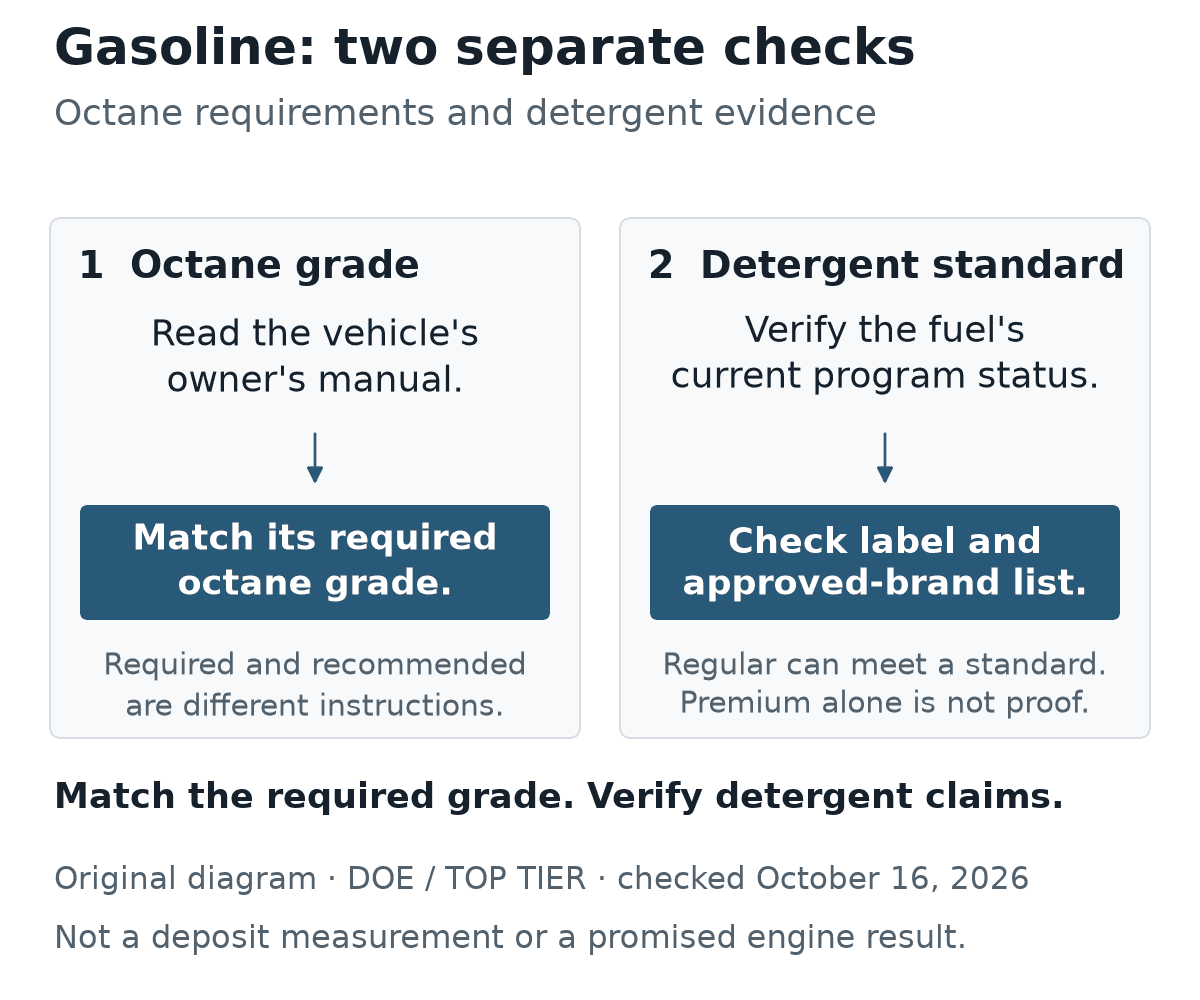
Octane grade and detergent performance answer different questions at the pump. A premium label does not by itself establish deposit-control quality, and a TOP TIER label does not authorize using less octane than the engine requires. Keeping those decisions separate makes fuel claims easier to assess.
Updated October 16, 2026
Choose the required octane first
The Department of Energy distinguishes premium required from premium recommended. An engine requiring premium should receive it. An engine designed for regular fuel is unlikely to gain much from higher octane; one that recommends premium may have conditional performance benefits. Read the actual manual rather than treating every turbocharged engine alike.
The TOP TIER program’s consumer explanation addresses a separate standard for detergent performance. Its gasoline requirements apply across a participating marketer’s octane grades. Regular gasoline can therefore meet the standard; buying the premium button is not the definition of buying TOP TIER gasoline.
What the direct-injection update actually tests
The program’s January 2025 Revision G standard adds gasoline direct-injection fuel-injector cleanliness testing. It also specifies checks intended to ensure the additive does not worsen particulate emissions or stochastic pre-ignition under the defined tests. These are controlled approval requirements for an additive package, rather than a diagnosis of an owner’s engine.
The program is rolling out TOP TIER+ gasoline. Check the current label and approved-brand information rather than assuming every participating station has already transitioned to the newer requirements.
An injector, an intake valve and a combustion-chamber surface are different deposit locations. Evidence of injector cleanup should not be stretched into a claim that one tank will remove every kind of carbon buildup. The test named in a fuel claim matters as much as the component shown in its accompanying photograph.
Read the older AAA result in its original scope
AAA’s 2016 fuel-quality report remains useful background, but it is not a 2026 road test. Its main deposit comparison used six fuel brands, premium-grade samples and a Ford 2.3-liter port-injected test engine under ASTM D6201. The often-repeated deposit result belongs to those conditions; it is not a promised mileage improvement for a different vehicle.
The report illustrates the physical distinction: port injection supplies fuel ahead of the intake valve, while direct injection supplies it inside the combustion chamber. That difference is another reason to keep intake-valve and direct-injector evidence separate. A statement about detergent performance needs to identify what was measured.
Separate a fuel company’s claim from your car’s result
Chevron describes its reformulated Techron gasoline using GDI injector tests and says the formulation is available across its fuel grades. Its injector illustration is identified as color-enhanced. Those are the manufacturer’s product claims and presentation, not testing performed for this article or proof of the condition of a particular used car.
Do not convert a laboratory cleaning claim into a guaranteed horsepower gain, repair outcome or fuel-cost saving. A symptom improving after a fill-up can be useful history, but it does not by itself establish what caused the change.
Keep a drivability complaint separate from routine fuel choice
Use the specified fuel and follow the vehicle’s maintenance instructions. If rough running, stalling or a warning appears, record when it began and what the car actually did; changing brands repeatedly or adding a cleaner is not a complete fault assessment. The TOP TIER program itself says its standard does not address every fuel-related problem and directs owners to their manuals before using aftermarket additives.
For a used-car purchase, a seller’s preferred gasoline brand cannot establish the engine’s present condition. The more useful paper trail is the work actually documented in its maintenance records, assessed alongside the vehicle itself. Fuel choice is one ownership decision, rather than a substitute for those checks.
0 comment(s) so far on TOP TIER Gasoline: Detergent Quality, Octane and GDI Limits