

Used-Car Maintenance Records: How to Read What Was Done
Used-car service history
A maintenance record is most useful when it connects a specific vehicle, date and mileage with work that was actually completed. A stack of invoices can still leave important questions unanswered, while a gap in paperwork does not by itself prove neglect. Read the details rather than counting the pages.
Updated October 16, 2026
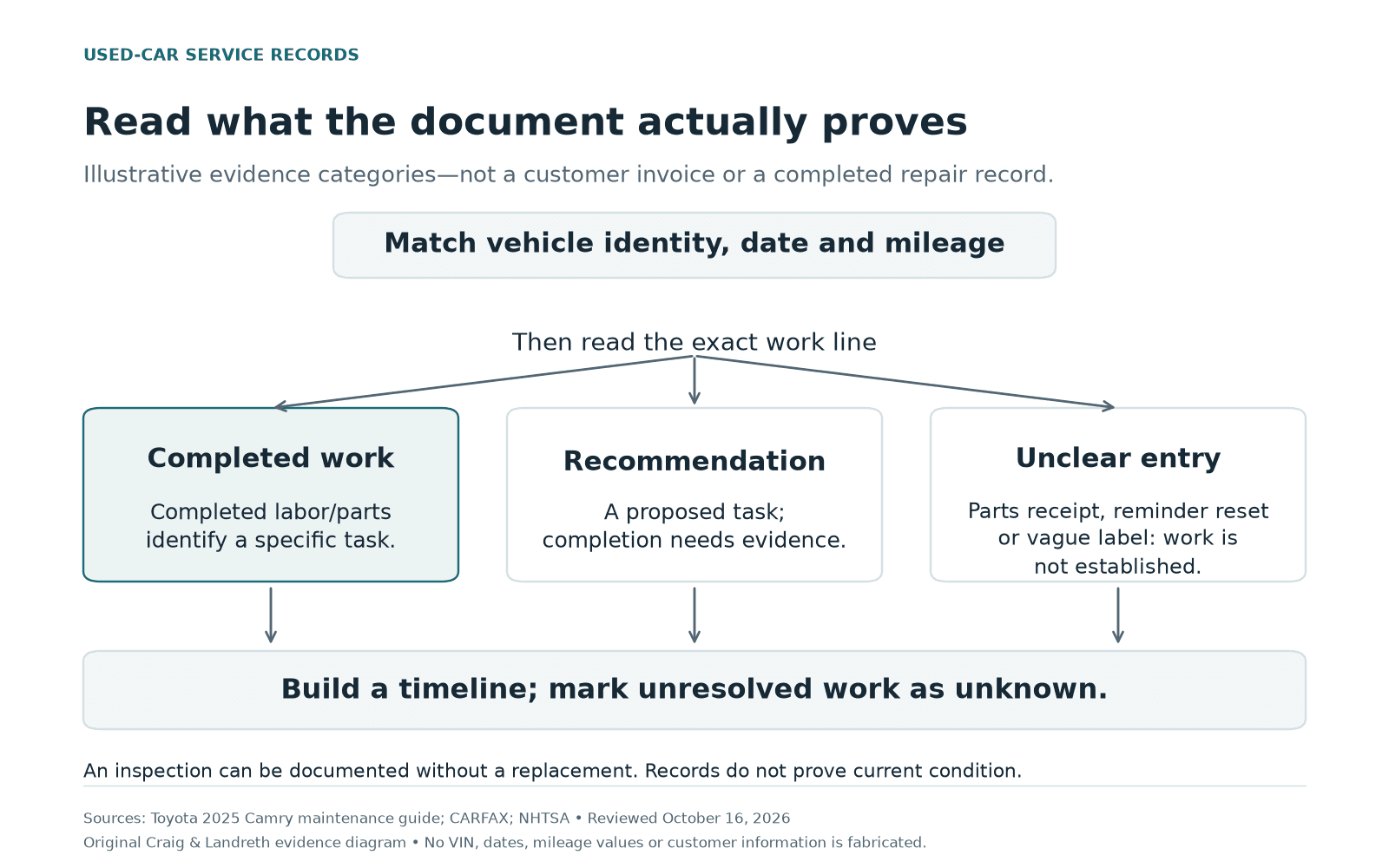
The goal is to understand the car’s service history and what is due next. Records cannot guarantee future reliability, but they can make the difference between a documented replacement, a past recommendation and a task whose status is still unknown.
Read the repair order, not just the service heading
Start with vehicle identity. Check that the VIN or other identifying information matches the car and that the date and odometer reading fit the timeline. Then separate the customer’s complaint, the inspection findings, recommended work and the final completed line items.
| Illustrative entry | What it establishes | What it leaves open |
|---|---|---|
| “Inspect brakes” | An inspection is recorded | Whether any brake parts were replaced |
| “Replace front pads,” with completed labor and parts | A front-pad replacement is documented | The present condition of the brakes or work on other wheels |
| “Recommend fluid service” | A recommendation was made | Whether it was accepted and completed later |
| A maintenance reminder was reset | The reminder setting changed | The work performed before that reset |
| A parts-store receipt | The listed parts were purchased | Which vehicle received them or whether installation was completed |
These are reading examples, not a universal invoice format. A clear completed-work description is more informative than an unfamiliar service-package name. Where an entry is ambiguous, ask for the detailed repair order instead of interpreting a package label as proof of every possible task.
Match the work to the correct schedule
Toyota’s 2025 Camry maintenance guide, for example, asks owners to retain the service date, mileage, work description and installed parts. It provides a log and recommends transferring maintenance records to a new owner. Those details make the history usable beyond a simple “serviced” notation.
Use the manual for the exact model year and engine to decide which entries matter. A timing-belt invoice is relevant only to an engine with that task; it is not a universal requirement for every used car. Likewise, inspecting a fluid and replacing it are different maintenance actions.
Check time-based requirements as well as mileage, and read any conditions attached to a shorter interval. Our normal-versus-severe maintenance guide explains why special operating conditions can apply to individual tasks instead of placing the entire vehicle on one blanket schedule.
Use history reports without treating them as the whole file
CARFAX says its reports can include service and repair information, but not every event is reported. A missing report entry therefore cannot establish that the work never happened. Conversely, a short service notation may not contain the detail available on the original invoice.
Compare the report with the receipts and the vehicle. If dates or mileage do not line up, resolve the discrepancy before drawing a conclusion. Our guide to reading a vehicle-history report explains why the report and an independent inspection answer different questions.
Keep recall completion separate
NHTSA’s VIN lookup identifies unrepaired safety recalls; it is not a complete archive of earlier repairs. Keep the repair order showing a completed campaign instead of assuming a routine service visit or a normal-looking component proves the remedy was performed.
For the next owner, a simple timeline works well: date, mileage, completed task and the supporting document. Mark an uncertain item as unknown rather than inventing a completion date. That leaves a practical handover: what is documented, what is due under the applicable schedule and what still needs confirmation.
0 comment(s) so far on Used-Car Maintenance Records: How to Read What Was Done