

What To Check Before Buying A Used Truck
Used-truck buying
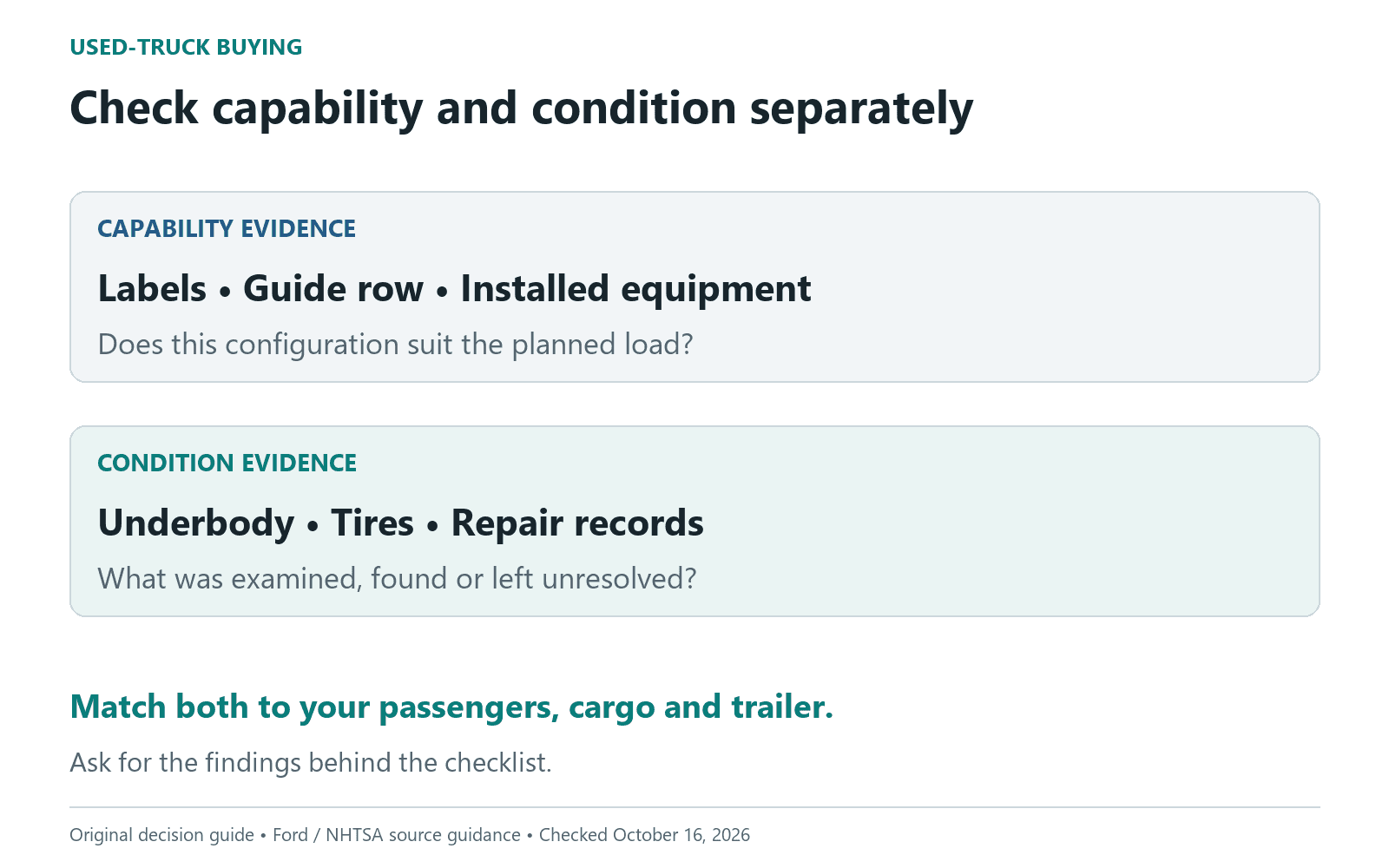
A used-truck inspection should answer two questions: does this configuration suit the work you need, and what does this particular truck’s condition require? A crew-cab badge, clean bed liner or hitch receiver cannot settle both. Start with the people, cargo and trailer you expect to carry, then examine the truck and its records against that job.
Updated October 16, 2026
Identify the truck before comparing its ratings
Record the model year, engine, cab, bed, drive system, axle information and installed towing equipment. Confirm the configuration through the truck’s labels and manufacturer information rather than treating an advertisement’s description as the complete build record. Check passenger space and measure the usable bed with the tailgate in the position you intend to use.
The 2025 F-150 towing guide, for example, separates ratings by engine, axle ratio, cab, drivetrain and wheelbase, with equipment requirements in its notes. Its receiver ratings can exceed the vehicle’s own trailer rating. A receiver is therefore something to identify and inspect, not proof of the truck’s towing limit.
Account for what is already on the truck
The 2025 F-150 owner’s manual distinguishes the tire/loading label’s occupant-and-cargo allowance from vehicle, axle and combined-weight limits. Its allowance describes the truck as built; later equipment must be accounted for, and trailer tongue or kingpin load is part of payload.
A bed cap, drawer system, auxiliary equipment or permanently carried tools can therefore matter before luggage or trailer load is added. Ask what was factory fitted and what came later. Our guide to checking payload and towing on the exact truck explains how to reconcile those records and loaded weights. A higher-rated accessory does not, by itself, establish a higher vehicle rating.
Make the underbody inspection specific
Ask the inspector to document the frame, cab and bed attachments, suspension mounting areas, brake lines, leaks and hitch installation. Request the location and extent of any corrosion, deformation, repair or damaged attachment—not simply a description of the underside as “good.” Photographs and relevant measurements make the findings easier to discuss.
Bed dents, drilled holes and hitch wear are reasons to examine the associated areas. They do not reveal exactly what a previous owner hauled or establish that the truck was overloaded. If a liner, coating or other equipment limits access, have that limitation stated in the report. A concealed area should remain an identified gap rather than an assumed pass.
| Question | Useful evidence |
|---|---|
| Is this the configuration I need? | Matching build information, labels, guide row and required-equipment notes. |
| What condition was actually examined? | Named inspection areas, findings, photographs, measurements and access limits. |
| What work is complete or outstanding? | Dated work orders, identified parts, completion results and unresolved recommendations. |
Check tires and four-wheel drive as a system
NHTSA recommends the original tire size or another manufacturer-recommended size. Compare the installed tires with the applicable placard and manual; include the spare, wear, damage and tire age in the inspection. For a lifted truck or changed wheels, identify the parts and installation records rather than assuming the original configuration still describes everything fitted.
Four-wheel drive also needs the right context. The 2025 F-150 manual describes different systems and prohibits 4H and 4L on dry, hard-surfaced roads. Do not turn a paved parking lot into a test of every selector position. Have operation assessed using the exact vehicle’s procedure, and retain any warning or diagnostic findings.
Read the records alongside the findings
Match service dates and mileages to the actual truck, and compare completed work with its applicable maintenance schedule. An oil-change entry does not establish that every other scheduled task was completed. Ask the inspector to separate repairs needed now, maintenance coming due and questions that still need investigation; use those findings to build the purchase budget.
Check the VIN through NHTSA’s recall lookup as a separate step. It reports unrepaired recalls for covered manufacturers, with limits including some newly announced campaigns and older recalls; it does not display already completed recall repairs. A zero-result screen is not a mechanical inspection or a substitute for the truck’s repair documentation.
0 comment(s) so far on What To Check Before Buying A Used Truck