

Payload vs. Towing Capacity: How to Check the Exact Truck
Truck capability
Payload and towing capacity measure different limits, but they meet at the hitch. Trailer load, people, cargo and added equipment all compete for the truck's carrying allowance. Checking the exact configuration is more useful than shopping by the largest number in an advertisement.
A truck can have enough advertised trailer capacity and still run out of carrying capacity for the people, gear and hitch load involved. The useful comparison is between the exact truck, loaded for the trip, and the exact loaded trailer. A model-wide maximum is only the beginning of that work.
Ford’s towing resources distinguish payload, the weight a vehicle carries, from towing capacity, the weight of a loaded trailer it can pull. A trailer places some weight on the truck through the hitch. That load belongs in the carrying calculation alongside occupants and cargo.
Begin with the truck’s labels and configuration
For a U.S.-market 2025 F-150, the owner’s manual explains the Tire and Loading Information label and separate weight ratings. Photograph the actual truck’s labels and record its engine, cab, drivetrain, wheelbase, axle information and towing equipment. Use the manual and guide for that model year.
The label describes the vehicle as built. Added equipment needs accounting for: a bed cap, tools or other accessories do not become weightless because a previous owner installed them. Ask which equipment was factory fitted and which was added later, so it is not omitted or counted twice.
| Rating or figure | What it helps you check |
|---|---|
| Occupant-and-cargo capacity | The carrying allowance shown on the actual truck’s tire/loading label, adjusted for relevant later additions. |
| GVWR | The maximum permitted weight of the loaded truck. |
| Front and rear GAWR | The limits for each axle; total weight alone does not settle axle loading. |
| GCWR and trailer rating | The combined-weight limit and applicable loaded-trailer limit for the configuration. |
Match the guide row, including its footnotes
The 2025 F-150 towing guide separates configurations by engine, axle ratio, cab, drive layout and wheelbase, with equipment requirements in its notes. A rating from another row cannot be transferred because the trucks share an engine or trim name.
Ford also offers VIN-based towing information through its towing resources. Use an applicable manufacturer tool to help establish the configuration; a general VIN decode or the presence of a receiver is not a complete capability check. Verify the installed hitch and other required equipment against their own identification and instructions.
Keep the guide’s assumptions visible. Additional occupants, cargo, accessories and hitch load still have to fit the truck’s limits. Buying a hitch with a higher rating does not increase the vehicle’s own ratings.
Put people, cargo and hitch load on one worksheet
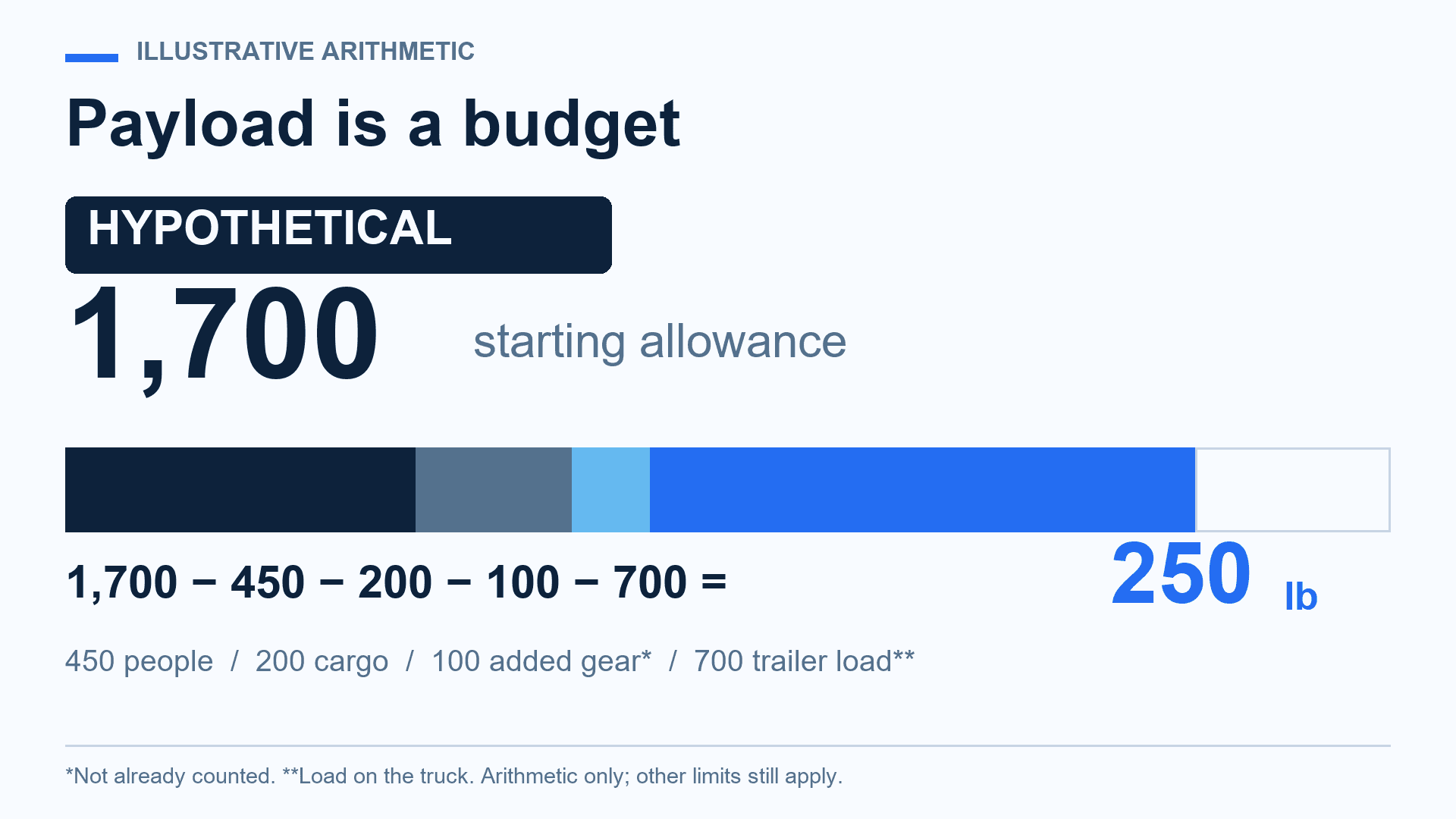
The arithmetic below is deliberately hypothetical. It is not a measured truck, an inventory claim or a towing approval. Its purpose is to show how an apparently generous carrying allowance can be used before the trailer’s weight limit is reached.
| Item | Assumed weight |
|---|---|
| Starting allowance | 1,700 lb |
| People | 450 lb |
| Cargo | 200 lb |
| Added accessories and hitch hardware not already accounted for | 100 lb |
| Trailer’s assumed load on the truck | 700 lb |
| Remaining arithmetic allowance | 250 lb: 1,700 − 450 − 200 − 100 − 700 |
The remaining 250 pounds does not establish that this combination is acceptable. The loaded truck must still meet GVWR and each axle limit, and the truck/trailer combination must satisfy GCWR, trailer, hitch and equipment limits. Nor does the assumed 700-pound hitch load establish the correct load or distribution for another trailer.
Resolve the missing evidence before choosing a combination
Use loaded weights, not only a trailer’s advertised empty weight. Include the items that will actually travel in the truck and trailer, then arrange appropriate weight measurements for the loaded combination. Ask the qualified towing installer or manufacturer to reconcile the ratings and actual equipment where the records are unclear.
Keep the loading arrangement with the measurements: passengers aboard, cargo in place and trailer equipment as it will travel. A scale ticket without that context is harder to interpret later. If the equipment or loading changes, the earlier measurements may no longer describe the combination you plan to use.
A useful used-truck file contains label photographs, the matching guide row and footnotes, equipment identification, the planned loading worksheet and actual weight records. If one is missing, name that gap. It is more informative than declaring a truck suitable from its badge, hitch or highest advertised tow figure.
0 comment(s) so far on Payload vs. Towing Capacity: How to Check the Exact Truck