

May Used-Car Prices: Supply and Value Differ
Market context
Updated October 17, 2026
May 2026 used-car data showed more inventory, slower retail sales and higher average asking prices. That matters when a market headline becomes a comparison with one vehicle.
Supply depends on the price bracket
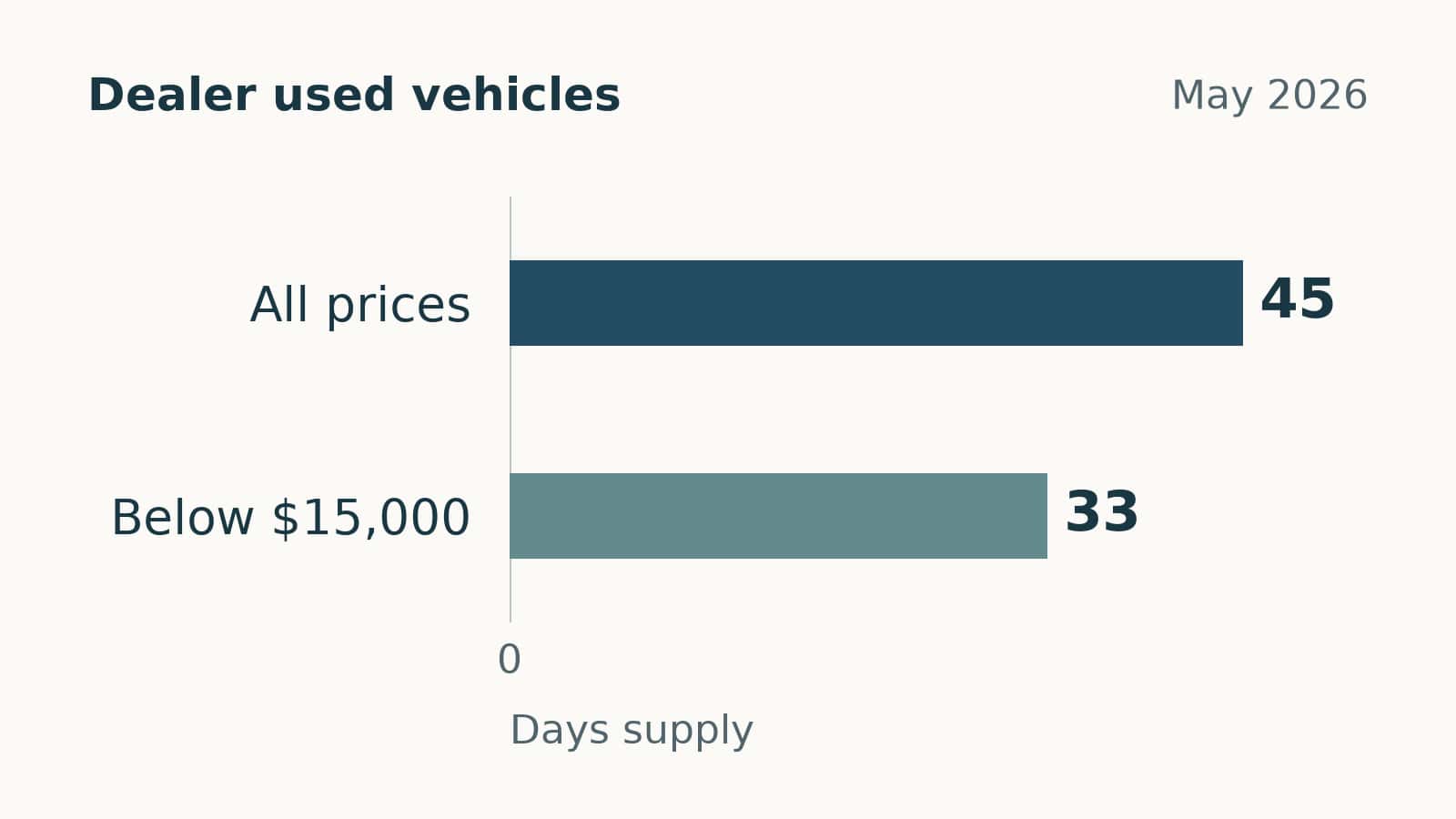
Cox Automotive’s June 12 inventory report estimated 2.12 million used vehicles at franchised and independent dealers, with 45 days of supply. Vehicles below $15,000 had 33 days. That measure relates inventory to the recent sales pace; it is not a promise that a car will remain available for that long. The average listing price reached $26,918, up 6% from a year earlier, while estimated retail sales fell 3.9% to 1.45 million.
Auction prices have two different readings
The May Manheim report, released June 5, put its adjusted wholesale index at 212.6, up 3.6% annually and 0.3% from April. The unadjusted series rose 3.1% annually but fell 1.2% for the month. Those monthly directions can coexist because they are different measures.
The adjusted index accounts for vehicle mix, mileage and seasonality. An auction-market increase therefore does not mean every retail listing rose by that percentage. Keep the report’s month, sales channel and adjustment basis alongside the number before comparing it with an asking price or an offer.
Index points are not a vehicle price
Manheim’s methodology groups eligible U.S. auction sales into 20 market classes. It adjusts for mileage, weights the classes and applies seasonal adjustment. Heavy trucks and motorcycles are excluded, as are specified price and mileage outliers. Those steps aim to track market movement with fewer distortions from the vehicles passing through auction. Class weights use a 24-month rolling period, rather than letting one month’s sales mix determine the comparison.
The index uses January 1997 as 100. A reading of 212.6 is an index level, not $21,260 and not an appraisal. Our later Q2 report follows the same distinction between wholesale values and retail asking prices.
Credit conditions do not establish a payment
Cox’s June 15 weekly summary described credit availability at its strongest since April 2022. It attributed much of May’s improvement to narrower yield spreads, while a smaller subprime share worked against the index. Approval rates also improved, but that is a market observation rather than an approval result for an individual applicant. A composite market reading can improve without describing every borrower or loan.
The useful follow-up is to separate the vehicle’s asking price from the actual financing terms being compared. That report is dated market context, not a lender decision or a payment quotation. It cannot establish that a particular buyer qualifies, or that a higher-priced vehicle costs less to finance.
Compare the vehicle and the value channel
Kelley Blue Book’s valuation FAQ identifies vehicle-specific inputs including year, make, model, mileage, ZIP code, style, options and condition. Its trade-in and private-party values answer different transaction questions. Selecting a different channel can change the comparison before anything about the vehicle changes.
Record which value you are using and whether it is an estimate or a conditional offer. Compare the same configuration and condition assumptions rather than choosing whichever number is highest. A dated national average can explain a trend; it cannot replace those inputs or turn an estimated value into the amount someone will pay.
0 comment(s) so far on May Used-Car Prices: Supply and Value Differ