

Trade or Sell Your Car: Compare Offers and Net Proceeds
Selling and ownership costs
The useful number when trading or selling a car is what remains after the loan payoff and transaction costs. Compare that amount using actual offers and their conditions, then keep the replacement purchase and financing visible as separate decisions.
Updated October 16, 2026
A valuation range and an offer answer different questions
A guide value is a starting point for comparison. An offer names a buyer, an amount and conditions under which that buyer will pay. Keep the date, expiration, inspection requirements and deductions with the number; an asking price or valuation range does not establish sale proceeds.
Kelley Blue Book’s own definitions separate its estimated Trade-In Range from its Instant Cash Offer, which remains subject to inspection and program terms. Its private-party values also allow for the actual condition and market to change the final price. Compare the right value type, and give prospective buyers the same accurate mileage, equipment and condition information.
Use a payoff amount before calculating equity
Ask the current lender for the amount needed to pay off the loan on the intended date and the instructions for doing so. The CFPB’s trade-in guidance explains that payoff can differ from the balance on a statement because of interest, fees or other charges. Confirm how long the quote applies rather than subtracting an old account balance.
If the accepted vehicle amount exceeds payoff, the difference is equity before transaction expenses. If payoff exceeds the amount received, there is a shortfall. For example, a $20,000 payoff against a $16,500 trade allowance leaves $3,500 to resolve. Rolling that amount into replacement financing does not remove it; the CFPB notes that doing so increases the cost of the new loan.
Compare what remains, using the same scope
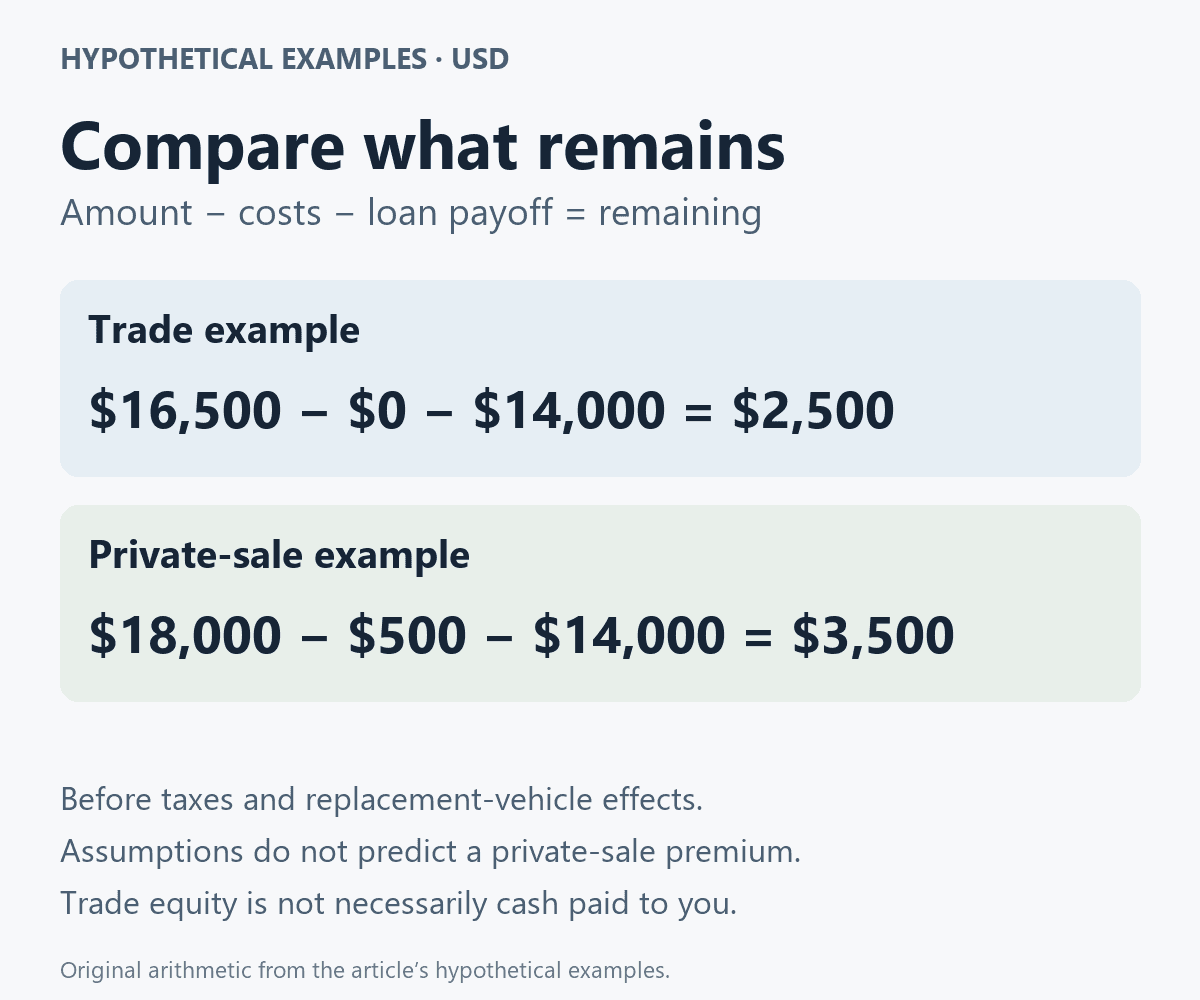
The following figures are hypothetical, not vehicle appraisals, customer balances or quoted selling fees. Both columns use the same assumed loan payoff and exclude taxes and any replacement purchase.
| Item | Trade example | Private-sale example |
|---|---|---|
| Assumed trade allowance or completed sale price | $16,500 | $18,000 |
| Assumed transaction expenses | $0 | $500 |
| Assumed loan payoff | $14,000 | $14,000 |
| Amount remaining after these deductions | $2,500 | $3,500 |
Here, the private sale produces $1,000 more after the stated expenses. That is not a promised private-sale premium. If those selling expenses instead reached $1,500, the remaining amount would equal the trade example’s $2,500. Replace every input with supported figures before deciding whether the extra work is worthwhile.
The trade figure describes remaining equity in this example, not a guarantee of cash paid to the owner. Keep its treatment in the replacement transaction visible. An unsold private listing should remain an estimate in your worksheet until there is an accepted transaction and its conditions are satisfied.
Keep the replacement deal beside the disposal calculation
A trade allowance alone cannot establish the overall replacement cost. Compare the replacement vehicle’s written price and fees separately, then show the trade allowance, old-loan payoff and any new borrowing. This prevents an attractive individual number from standing in for the complete transaction.
If borrowing, review the completed auto-loan disclosures: amount financed, APR, finance charge, payment count and total of payments. Those terms answer different questions from monthly payment alone. A proceeds comparison does not establish loan approval, a particular rate or the most affordable purchase.
Agree on payoff and title handling before handoff
Identify who will send the payoff, how any shortfall is funded and how the original lender will confirm completion. The CFPB advises checking that the old loan was actually paid off after a trade involving replacement financing. A promise to handle payoff is different from confirmation by the lender holding the account.
Use USAGov’s state motor-vehicle directory to find the relevant agency’s current title and transfer instructions, and coordinate any lien release with the lender. Leave tax benefits out of the calculation until the applicable rules and actual transaction have been checked. This example assumes no trade-in tax credit, title deadline, automatic payoff service or guaranteed sale channel.
0 comment(s) so far on Trade or Sell Your Car: Compare Offers and Net Proceeds