

How Much Mileage Is Too Much On A Used Car?
Used-car buying
There is no single mileage at which every used car becomes a bad purchase. The better question is whether this particular vehicle’s condition, maintenance needs and price fit the miles you expect to add. A lower odometer reading is useful information, but it is not a substitute for those checks.
Updated October 16, 2026
Use annual mileage as context, not a verdict
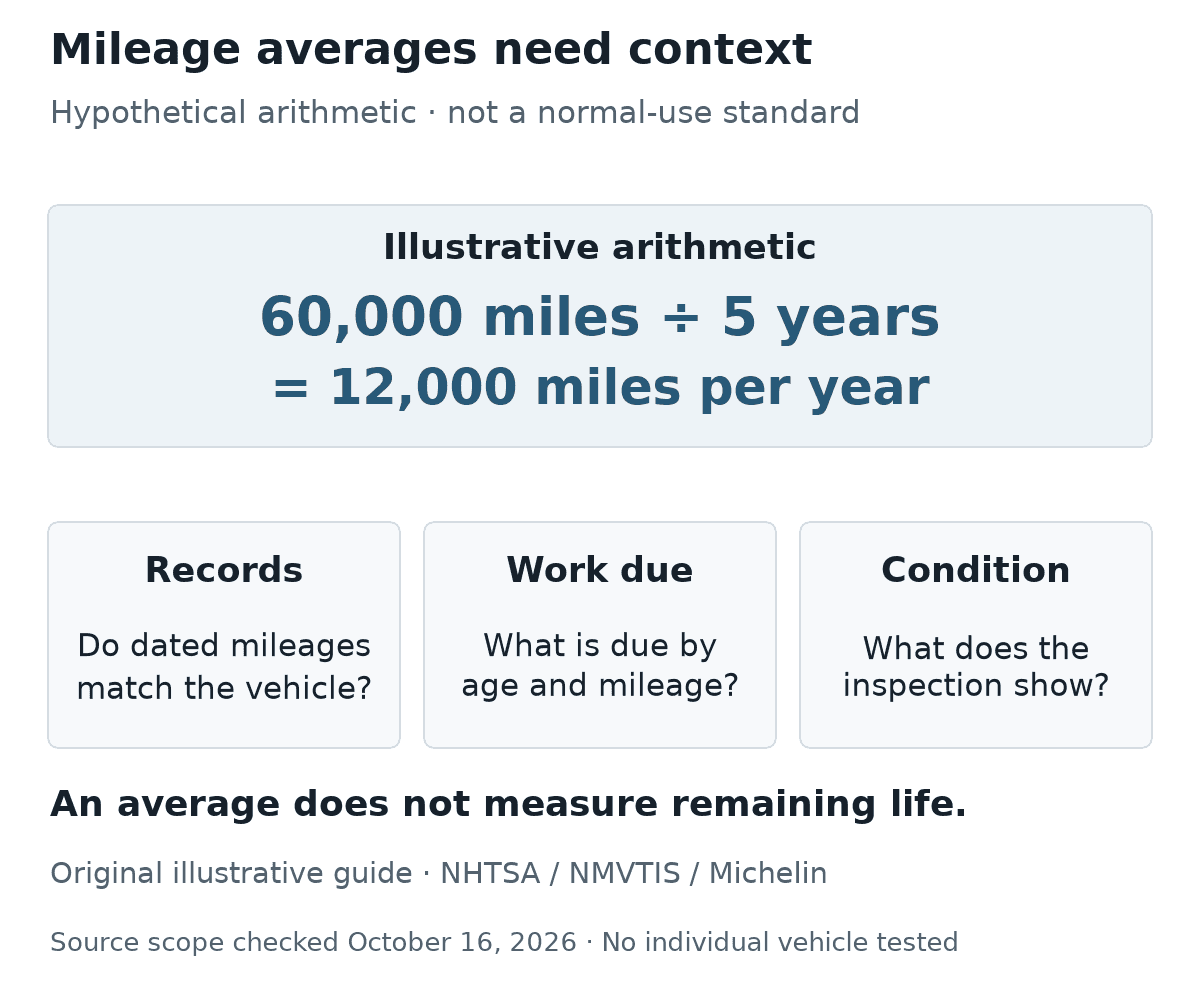
Dividing miles by years can put a number in perspective. A hypothetical five-year-old car with 60,000 miles has averaged 12,000 a year. That arithmetic does not establish how it was driven, whether it was maintained or how many miles remain. It is an example, not a universal industry definition of normal use.
Ask what the available records actually show. A seller’s description of “highway miles” is not the same as a documented history, and even a consistent history cannot predict future repairs. Keep verified facts separate from an account of how the car was supposedly used.
Read the records in sequence
NHTSA recommends comparing the odometer with maintenance and inspection records. Check dates, recorded mileage and the vehicle identity on the paperwork. A discrepancy deserves an explanation and supporting evidence before using the displayed mileage to set a value.
A vehicle-history report answers different questions from a service file. The National Motor Vehicle Title Information System explains that its report focuses on title, brand, odometer and salvage or total-loss information. It is not a complete repair history, and the agency recommends an independent inspection alongside reports and other records.
For maintenance, use the schedule for the exact model, engine and equipment. Ask which items are due by time as well as mileage, and which previous work has a dated receipt. A reset dashboard reminder alone does not demonstrate that a service was performed.
Low mileage does not remove age-related questions
Tires illustrate the difference. A vehicle can have modest mileage and still have older tires. Michelin’s tire guidance considers age, condition and wear together, and describes how the date code identifies the week and year of manufacture. Apply the tire and vehicle manufacturers’ recommendations to the actual tires rather than judging them solely by remaining tread.
The same inspection should document the vehicle’s present condition: leaks, corrosion, brake and tire measurements, warning messages and how it behaves on an appropriate test drive. The used-car inspection checklist gives a practical way to organize that examination. An inspection finding is evidence at that time, not a guarantee against later failure.
Compare the next period of ownership
| Input | What to establish |
|---|---|
| Expected use | Annual miles and the years you intend to keep the vehicle. |
| Known work | Written findings, due maintenance and estimates for identified needs. |
| Purchase and running costs | The complete purchase figure, financing if used, insurance and energy costs. |
| Uncertainty | Missing records or unresolved symptoms; do not enter an unknown repair cost as zero. |
A higher-mileage car may still be a sensible candidate, and a low-mileage one may still need expensive work. Neither conclusion follows from mileage alone. The decision becomes more defensible when the price is considered alongside documented condition and a realistic plan for the next miles.
0 comment(s) so far on How Much Mileage Is Too Much On A Used Car?