

2026 Mazda CX-50: Gas, Turbo and Hybrid Differences
Compact SUV choices
Updated October 16, 2026
The 2026 Mazda CX-50 offers three materially different powertrains: a naturally aspirated gasoline engine, a turbocharged engine or a conventional hybrid. All have all-wheel drive. Their transmissions, EPA fuel-use estimates and passenger and cargo dimensions nevertheless differ, making the powertrain an important part of choosing the vehicle.
Compare the engine and transmission together
Mazda’s 2026 model information lists 187 horsepower for the 2.5 S. The Turbo produces 227 hp on regular 87-octane gasoline or 256 hp on premium 93-octane. The Hybrid has a 219-hp system rating; that is the combined system figure, not its gasoline engine’s output alone.
| Powertrain | Transmission | City / highway / combined MPG |
|---|---|---|
| 2.5 S, non-turbo | Six-speed automatic | 24 / 30 / 26 |
| 2.5 Turbo | Six-speed automatic | 23 / 29 / 25 |
| Hybrid | Electronically controlled continuously variable transmission (eCVT) | 39 / 37 / 38 |
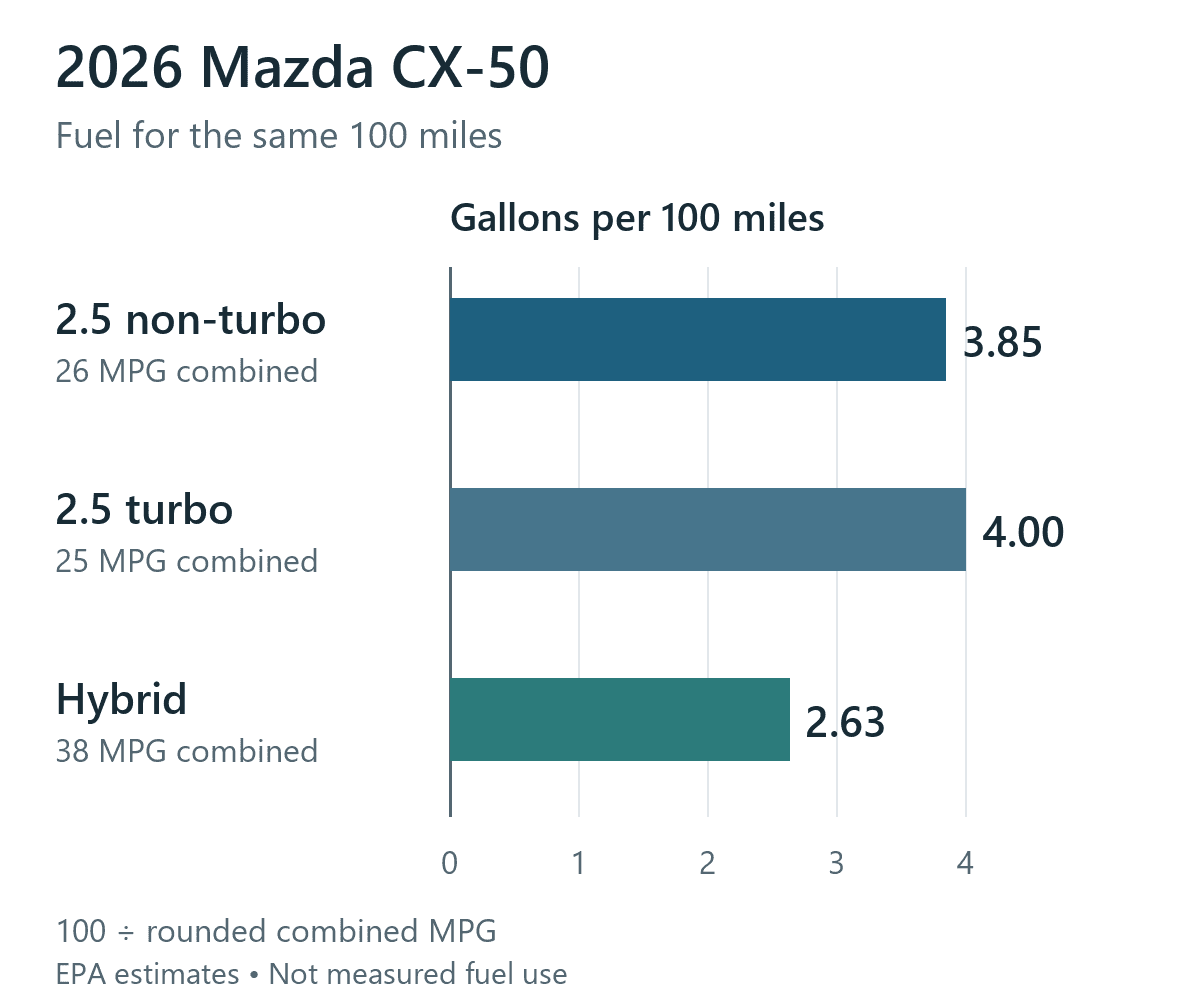
The Hybrid’s combined estimate is 12 MPG above the non-turbo’s and 13 above the Turbo’s. Another way to compare them is gallons per 100 miles: divide 100 by the combined MPG. That gives approximately 3.85 gallons for the 2.5 S, 4.00 for the Turbo and 2.63 for the Hybrid. These are calculations from rounded EPA estimates, not measured consumption or a fuel-cost payback calculation.
Transmission descriptions also matter in a used listing. “Automatic” conceals two different descriptions here. The difference between an eCVT and a conventional CVT is a useful next question, although the abbreviation alone does not identify every component or establish a used vehicle’s condition.
The Hybrid has different rear-seat and cargo dimensions
Mazda’s 2026 specification deck lists 31.4 cubic feet of cargo volume with the rear seats upright for the nonhybrid models, versus 29.2 for the Hybrid. Both list 56.3 cubic feet with the second row folded. Published rear legroom is 39.8 inches in the nonhybrid and 37.8 in the Hybrid.
That matters when the rear seat will stay occupied. A folded-seat maximum cannot answer how the vehicle accommodates passengers and their luggage together. Compare the seating position you actually need and the items that must remain behind it, rather than transferring the gasoline version’s space figures to a Hybrid listing.
Towing ratings separate the three choices again
The specification deck lists towing capacities of 2,000 pounds for non-turbo models, 3,500 for Turbo models and 1,500 for Hybrid models. Mazda also specifies that the Turbo’s Towing mode requires the appropriate Mazda genuine towing accessories.
These published capacities help identify which powertrain is relevant to a proposed trailer. The exact vehicle’s instructions, installed equipment and loading limits still govern the combination. A Hybrid’s fuel-economy advantage does not increase its trailer rating, and a Turbo badge does not establish that all required towing equipment is fitted.
For 2026, “Meridian” no longer means Turbo alone
Mazda added a 2.5 S Meridian Edition for 2026 alongside the Turbo Meridian Edition. Both are described with 18-inch wheels and all-terrain tires. The shared Meridian name therefore does not identify the engine; read the complete trim designation.
Start the comparison with powertrain, transmission and the space or trailer requirement that matters to you, then compare cabin equipment within that group. This keeps a higher equipment grade from obscuring a more basic mismatch. The EPA figures describe standardized configurations, while the used vehicle’s equipment and maintenance history need their own review.
0 comment(s) so far on 2026 Mazda CX-50: Gas, Turbo and Hybrid Differences