

eCVT vs. CVT: Why the Hardware Matters More Than the Name
Powertrains explained
The letters CVT describe how a powertrain can vary its drive ratio, but they do not identify every part inside it. Toyota's gasoline and hybrid Corollas—and Honda's two-motor Accord—show why the hardware matters more than a shortened listing label.
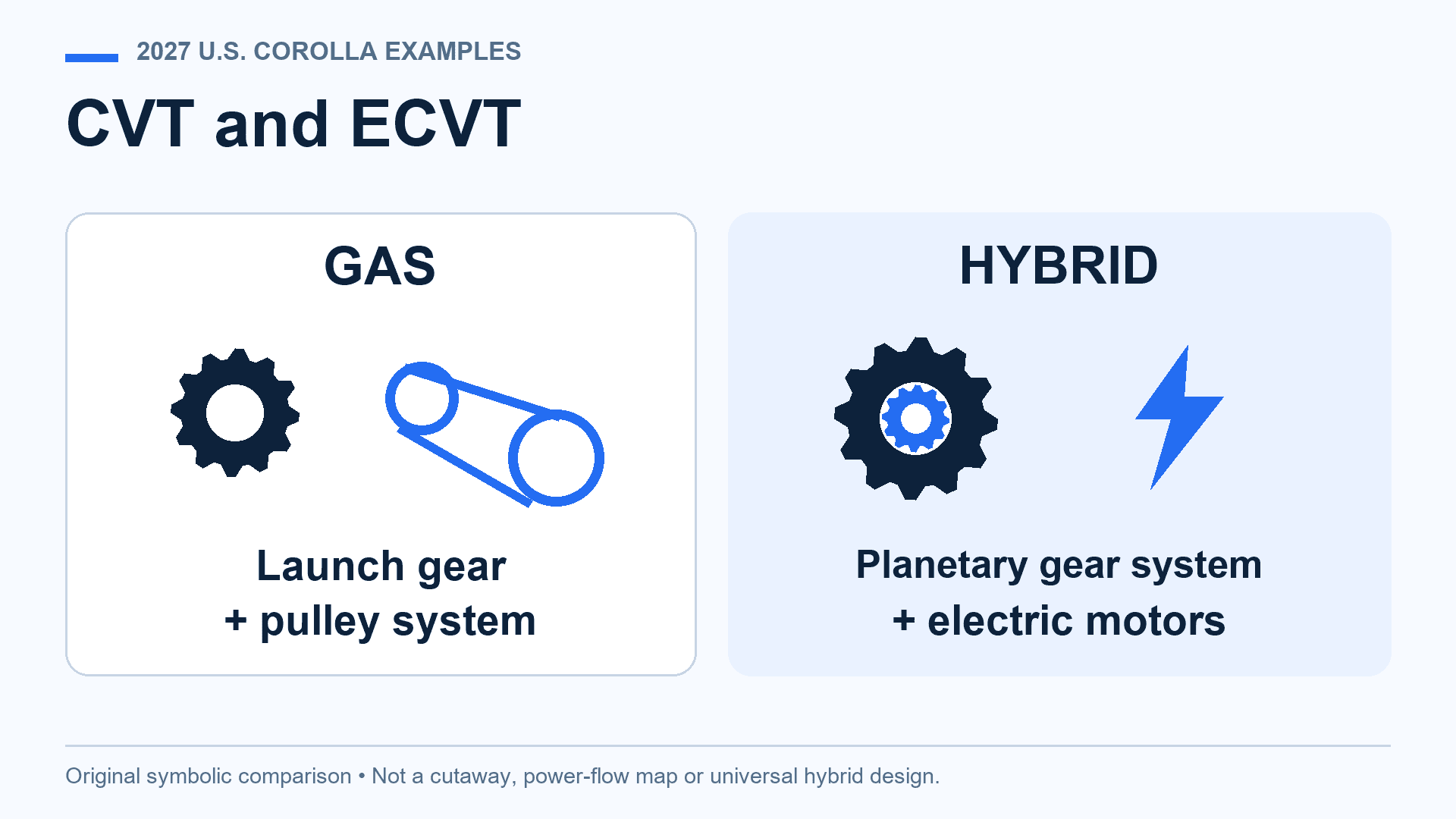
Transmission abbreviations can make two cars look more alike than they are. A gasoline car described as having a CVT and a hybrid listed with an eCVT can deliver a similar absence of conventional shifts while using different hardware. For a buyer, the useful question is which system the exact powertrain uses.
What a conventional CVT changes
CVT means continuously variable transmission. Instead of choosing only among a set of fixed forward ratios, it can vary the relationship between engine speed and road speed across a range. A familiar mechanical approach uses a belt and variable pulleys. That is one documented design, rather than a complete description of every transmission carrying the abbreviation.
Toyota’s 2020 U.S. Corolla technical release explains a useful variation: the Dynamic-Shift CVT offered with the 2.0-liter engine starts through a physical launch gear, then transfers power to its belt-and-pulley system. A CVT can therefore contain a launch gear without becoming an ordinary stepped automatic.
Programmed shift sensations are another separate feature. A manufacturer can give a continuously variable system selected ratio steps or a shift-like response. Counting the shifts you feel is not a reliable way to identify what is inside the case.
Toyota’s hybrid eCVT uses a different arrangement
In Toyota’s 2027 U.S. Corolla specifications, the distinction is explicit. Gasoline models use a Dynamic Shift CVT with a launch gear and pulley system. The hybrid’s electronically controlled continuously variable transmission, written ECVT by Toyota, uses a planetary gear system and electric motors to combine power from the engine and hybrid battery.
The shared “CVT” lettering therefore does not mean the hybrid is simply the gasoline transmission with an electric motor added to its belt. The manufacturer’s description identifies a different architecture. A parts recommendation, fluid assumption or internet diagnosis that treats the two as interchangeable starts with the wrong comparison.
These are model-specific examples. They do not prove that every Toyota, every model year or every hybrid uses an identical transaxle. They do show why the complete engine and hybrid designation belongs beside the transmission name when comparing vehicles.
| Vehicle and powertrain | Manufacturer’s description |
|---|---|
| 2027 Corolla, gasoline | Dynamic Shift CVT: launch gear followed by a pulley system. |
| 2027 Corolla Hybrid | ECVT: planetary gear system and electric motors. |
| 2026 Accord Hybrid | Two-motor hybrid system; Honda’s specifications call the transmission a Direct Drive Unit. |
Honda shows why “hybrid transmission” is still too broad
Honda describes the 2026 U.S. Accord Hybrid’s two-motor system as operating without a traditional transmission or CVT for propulsion and generation. It relies on the motor system rather than a torque converter or mechanical pulley and belt. The specifications on that release call the hybrid’s unit “Direct Drive Unit,” while the gasoline Accord has a CVT.
That is a third description worth keeping intact. Applying Toyota’s planetary-system explanation to the Honda merely because both are hybrids would erase an actual engineering difference. The manufacturer’s specification for the exact vehicle is a better starting point than a marketplace’s shortened transmission field.
Honda also describes Linear Shift Control that imitates the relationship between vehicle speed and engine revs of a conventional shifting drivetrain. Again, the sensation and the hardware are different pieces of information. Neither an especially smooth acceleration nor a programmed shift establishes the internal design on its own.
What this changes when buying a used car
First, identify the full powertrain: model year, market, engine and whether it is a hybrid or plug-in hybrid. Then match it to the manufacturer’s specification and maintenance information. A trim name alone may leave out the distinction you are trying to resolve.
Next, read maintenance records against that powertrain’s requirements. A receipt that says “transmission service” is more useful when it identifies the procedure, the specified fluid and the vehicle it covered. The letters CVT or eCVT do not establish a universal fluid or maintenance interval.
Finally, keep design and condition separate. Knowing that a unit uses a planetary system or a belt does not establish how a particular used example was maintained, whether a symptom has been diagnosed or what a future repair will cost. Compare the documented equipment and records, and evaluate any actual concern on that vehicle. The transmission name helps you ask the right question; it does not answer the condition question.
0 comment(s) so far on eCVT vs. CVT: Why the Hardware Matters More Than the Name