

Jeep Grand Wagoneer REEV: Specs and Launch Plans
Powertrain explained
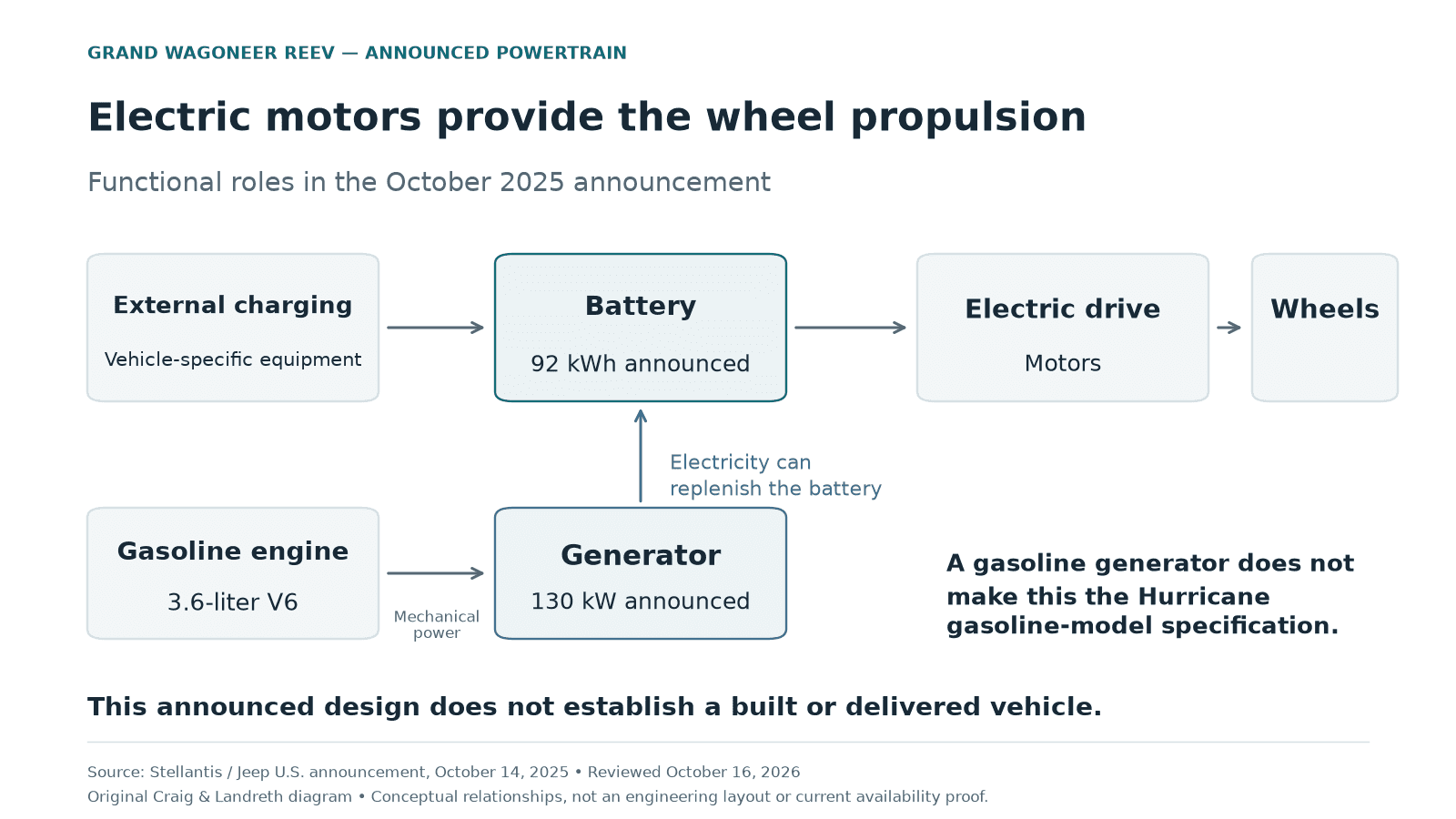
Jeep’s announced Grand Wagoneer REEV combines electric drive with a gasoline-powered generator. The wheels are driven by electric motors, while the onboard engine can generate electricity for longer journeys. For a shopper, the important questions are how that arrangement fits everyday charging and which specifications belong to the actual vehicle being offered.
Updated October 16, 2026
What Jeep announced
Stellantis introduced the powertrain in its October 14, 2025 U.S. Grand Wagoneer announcement. It described the REEV as a later-availability addition to the 2026 lineup. Those launch details should be read with their original qualifications.
| Item | October 2025 announcement | What it establishes |
|---|---|---|
| Battery | 92 kWh, liquid-cooled | The announced pack capacity; it is not an electric-range rating. |
| Engine and generator | 3.6-liter V6 with a 130-kW onboard generator | The engine supplies mechanical power to the generator. |
| Wheel propulsion | Electric motors | Jeep described electric drive at the wheels. |
| Output | Estimated 647 horsepower and 620 lb-ft of torque | Manufacturer estimates, not a road test of a particular vehicle. |
| Total range | Anticipated range above 500 miles | A total-range projection involving both energy sources; not 500 miles on battery power. |
Total range and electric range answer different questions
The total-range figure addresses how far the vehicle might travel using its available battery energy and gasoline. Electric range addresses travel before gasoline operation is needed under the applicable rating conditions. A large total-range number cannot be substituted for the distance of an electric commute.
Jeep’s launch release did not provide an EPA-rated electric range or a production-vehicle efficiency result. For an actual comparison, look for the matching model year’s final specifications and the vehicle’s fuel-economy label. EPA and DOE’s vehicle comparison tool can help compare listed configurations; do not use a different engine or powertrain because the model name looks similar.
Charging still shapes the ownership experience
An onboard generator changes the long-distance plan, but access to charging remains relevant to how often a plug-in vehicle can use stored electricity. The U.S. Department of Energy explains that plug-in-hybrid fuel consumption depends on the distance traveled between charges and the way the vehicle is used.
Consider where the vehicle would normally charge, what equipment is supported and what electricity and gasoline cost for your routine. Check the actual vehicle’s charging connection, instructions and supplied equipment before planning a home installation. A projected range figure alone does not answer charging time, running cost or electrical-installation questions.
Keep the gasoline model’s figures separate
The Grand Wagoneer name also applies to a Hurricane-powered gasoline SUV. Jeep’s 2026 capability information identifies that engine and its available towing figures. Those figures should not be transferred to the REEV simply because both vehicles share a name.
The launch announcement’s entry pricing also described the Hurricane-powered lineup. It does not establish a REEV transaction price. Compare the powertrain, trim, destination charge, options and itemized quote for the vehicle in question.
For a towing plan, identify the exact configuration and its own payload, axle, hitch and trailer limits. The payload and towing-capacity worksheet explains why a large advertised tow number cannot approve a loaded combination by itself.
A launch plan is different from an available vehicle
Stellantis’s April 2026 presentation still listed the REEV launch as planned for 2026. A launch plan does not establish that a specific vehicle has been built or delivered. Confirm a current offer’s delivery status, final specifications and REEV price before treating it as an available alternative.
If an offer describes a Grand Wagoneer as a REEV, ask for the exact model year, powertrain documentation, current order or vehicle status, final specifications and itemized price. That makes the comparison about a defined vehicle rather than a mixture of a gasoline model’s listing and an earlier electric-powertrain announcement.
0 comment(s) so far on Jeep Grand Wagoneer REEV: Specs and Launch Plans