

Safe Used Cars For Teens: A Family Buying Checklist
Teen drivers and vehicle choice
A useful teen-car shortlist starts with the exact model year, safety equipment and vehicle condition—not a familiar badge or a claim that a car is “safe.” Published recommendations can narrow the search, but they do not establish that an individual used car has sound tires, completed repairs or the equipment a family expects.
Updated October 16, 2026
Use a dated recommendation list
The IIHS and Consumer Reports teen-vehicle list, updated May 27, 2026, separates Best Choices and Good Choices. Both apply criteria for vehicle weight, driver-side small-overlap crash performance, braking, handling and control usability. Best Choices add good or acceptable headlights across trims and standard pedestrian-detecting automatic emergency braking: Advanced or Superior in the daytime pedestrian test, or Acceptable or Good in the combined pedestrian test.
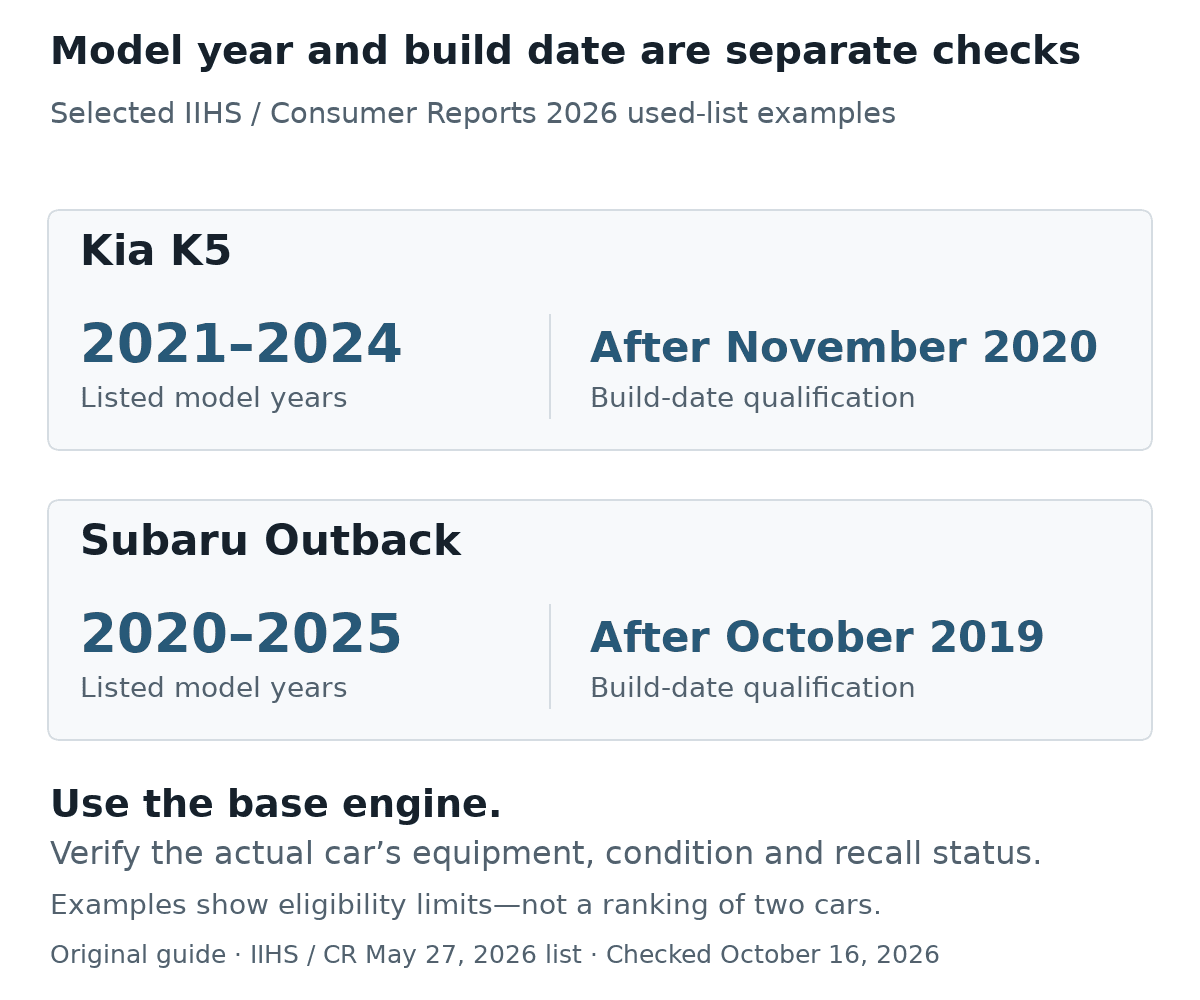
Apply each row’s model-year range and production-date qualification together. The Kia K5 example is 2021–24, built after November 2020; the Subaru Outback example is 2020–25, built after October 2019. Listed prices are Black Book’s April 2026 median retail estimates across all trims for the earliest eligible model year, not current offers for a particular vehicle.
Choose manageable performance and clear controls
The IIHS parent guide advises against very small vehicles and models marketed for high performance. It identifies electronic stability control as essential. Those principles help focus a search without inventing a universal horsepower limit or declaring one vehicle the safest for every family.
The May 2026 joint guidance also tells families shopping the list to stick to the base engine. A higher-output version of a listed model is not automatically part of the recommendation.
Have the teen sit in the actual car and adjust the seat, steering wheel and mirrors while parked. Check visibility and whether routine controls are understandable from that position. A backup camera, parking alert and automatic braking system have different jobs. Establish what is fitted and explain its limitations; do not stage an emergency-braking demonstration to see whether it works.
Check the individual vehicle
| Check | Why it matters |
|---|---|
| VIN, model year and build date | Match the actual car to the recommendation’s qualifications. |
| Installed equipment | Verify the specified headlights and assistance features rather than assuming the badge includes them. |
| Recall status | Look up the VIN and establish the current remedy and any interim instructions. |
| Condition and repair history | Use records and an independent inspection to investigate the individual vehicle. |
| Insurance and running costs | Obtain a quote for the actual vehicle and intended driver before committing. |
Use NHTSA’s recall lookup and follow any manufacturer instructions for an open campaign. A model’s appearance on a recommendation list does not mean every example has completed its recall repairs. A history report is also different from a mechanical inspection. The FTC’s used-car guidance recommends an independent inspection even when a seller has inspected or certified a car.
Include the likely immediate work in the purchase budget. An appealing price leaves less room for the family if the inspection identifies tires, brakes or another repair that is needed before use. Obtain an insurance quote with the actual teen driver and proposed vehicle details; a quote for a different driver or vehicle is not a useful substitute.
The family plan matters after purchase
Agree on phone use, passengers, nighttime driving and seat belts before handing over the keys. NHTSA’s teen-driving guidance explains why graduated licensing restrictions and parental involvement matter. Check the current rules for the state where the teen is licensed; limits vary with the jurisdiction and license stage.
Practice in the vehicle the teen will actually use. Review warning lights and the normal controls while parked, then build experience under suitable conditions. A good purchase provides a sound starting point. It does not replace instruction, attention or the restrictions appropriate to an inexperienced driver.
0 comment(s) so far on Safe Used Cars For Teens: A Family Buying Checklist