

Stability Control Warning: Why It Matters
Vehicle motion and warnings
A stability-control symbol can mean the system is intervening, a function is limited or inactive, or a fault has been detected. Those are different situations. Read the exact lamp and message in the vehicle’s manual before treating every appearance of the skidding-car symbol as either normal or a failed wheel sensor.
Updated October 16, 2026
What stability control is trying to do
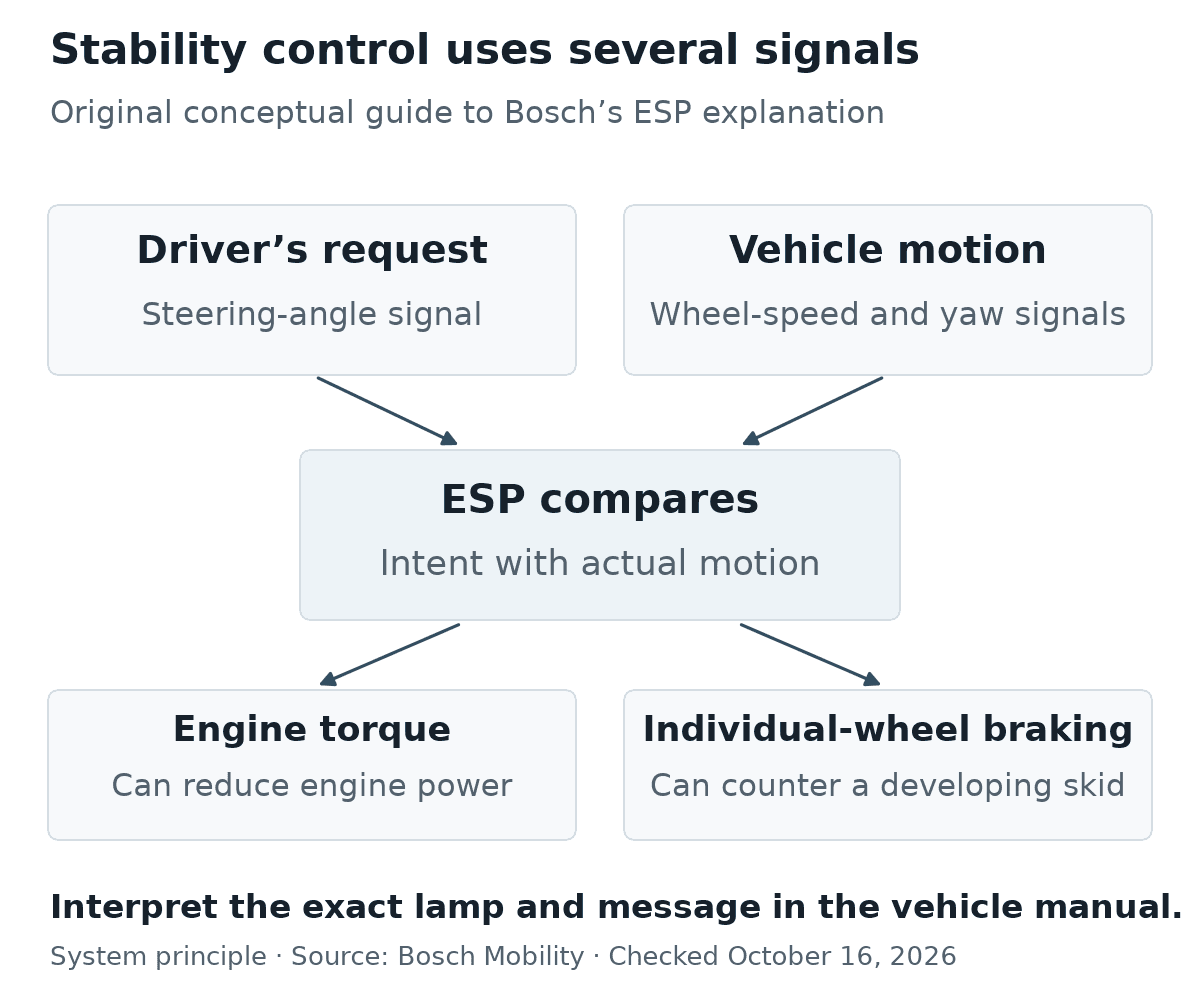
Electronic stability control compares the direction the driver is asking for with how the vehicle is actually moving. In Bosch’s explanation of ESP, steering-angle, wheel-speed and vehicle-motion information help the system recognize a developing skid. It can reduce engine power and brake individual wheels to counter it.
That differs from simply preventing the driven wheels from spinning under acceleration. Stability control and traction control can share hardware and indicators, but their jobs are not identical. Nor is stability control a substitute for the grip available from the tires or a speed appropriate to the conditions.
ABS concerns wheel lock during braking; stability control addresses the vehicle’s direction and motion. Shared sensors help explain why several warnings can appear together. Their simultaneous appearance does not mean several separate parts failed, and it does not tell you which input or function became unavailable first.
Flashing, steady and “off” need separate readings
In the 2021 Honda CR-V manual, pages 90 and 519–520, the VSA system indicator blinks while the system is active. Honda calls for immediate inspection if that indicator stays on while driving. The separate VSA OFF indicator can show partial deactivation with reduced traction-control function, rather than every stability function being switched off. The manual also describes temporary VSA deactivation and indicator illumination after battery reconnection. These are exact-model examples, not a universal decoder or reset procedure for another car.
| Situation | What to establish |
|---|---|
| Brief illumination during startup | Whether it is the specified self-check and then goes out normally. |
| Flashing during slippery driving | Whether the manual identifies it as active intervention; adjust driving to the conditions. |
| A steady “off” indication | Which function is limited or disabled, why that indication appeared and which assistance remains available. |
| A persistent fault message | Follow the manufacturer’s action and arrange diagnosis; do not assume assistance is available. |
If an ABS or brake warning appears too, read that instruction separately. An amber stability warning does not establish that the rest of the braking system is healthy. Abnormal braking or steering requires attention to the actual symptoms, not reassurance based on the color of one lamp.
Why the lamp does not name the failed part
The control unit depends on several signals agreeing with one another. A persistent fault warning tells you that the system has identified a problem or limitation; it does not, by itself, prove that a particular sensor is defective. Diagnosis needs the relevant control-module information and checks of the circuit or component identified by the applicable procedure.
Calibration requirements also depend on the actual system. For example, Bosch describes a steering-angle sensor design that supplies its absolute angle immediately after power-up without steering-wheel movement for initialization. That is a useful reason not to prescribe full-lock turns, battery disconnection or another supposed reset for every vehicle.
Make the next check specific
Save the exact message and note whether the lamp was flashing or steady, whether a mode was selected, whether battery power was recently disconnected and whether other warnings were present. Recent work can provide context, but its timing alone does not prove the cause. Do not recreate a skid or drive aggressively to test whether the system intervenes.
For a persistent fault, ask what evidence distinguishes an input or wiring problem from a failed component, and what procedure confirms that assistance is restored. Erasing a message or finding that the car still moves is not that confirmation.
0 comment(s) so far on Stability Control Warning: Why It Matters