

Forward Collision Warning Light: What Drivers Should Check
Driver assistance
A collision alert during an approaching hazard and a persistent message saying the collision-warning system is unavailable mean different things. Read the exact wording and identify the feature before treating a dashboard symbol as a failed sensor—or as proof that the brakes will intervene.
Updated October 16, 2026
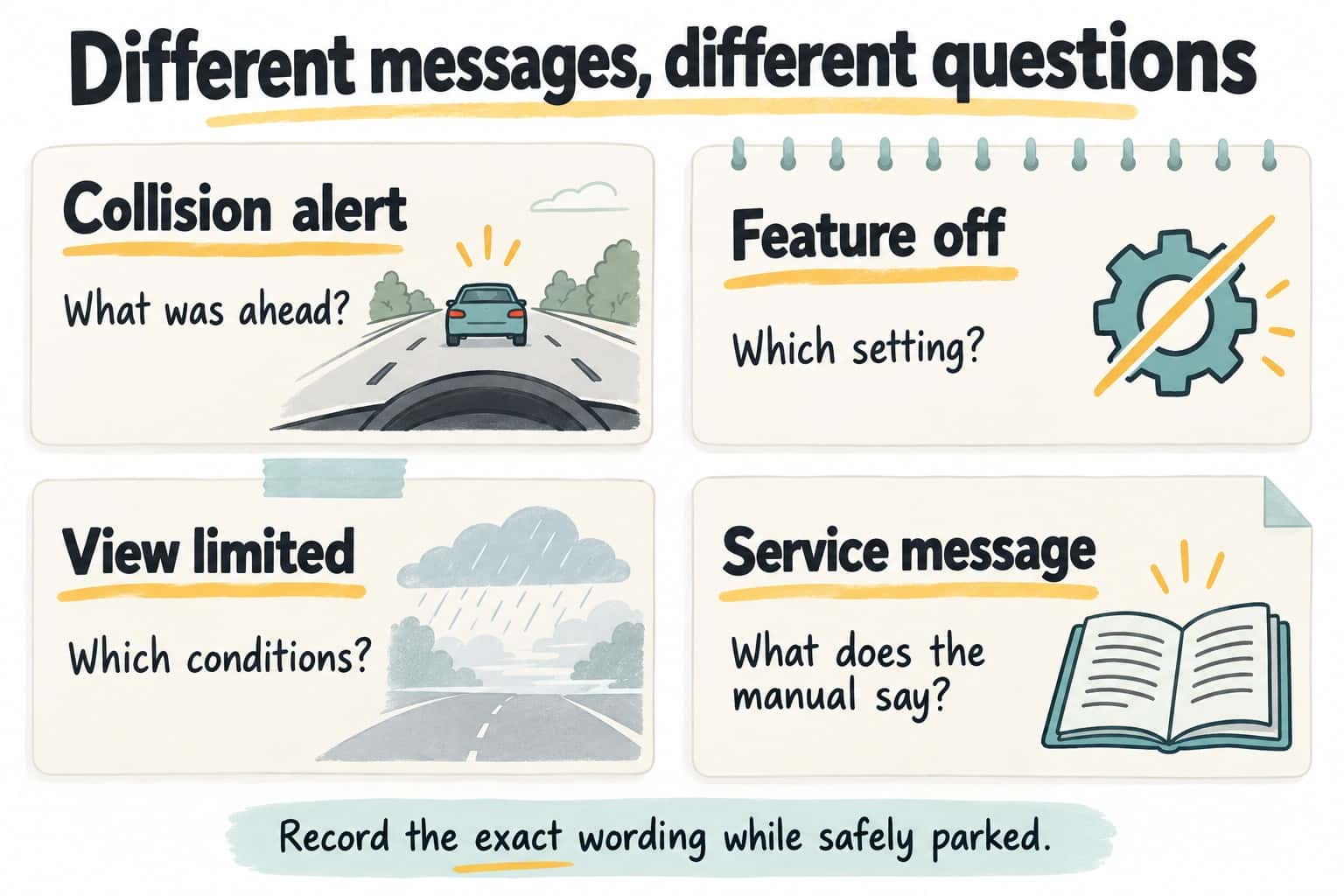
Warning and braking are different functions
NHTSA distinguishes forward collision warning from automatic emergency braking. The first alerts the driver to a potential collision ahead. The second can apply braking in specified circumstances. A vehicle may combine them under one manufacturer name, but that does not make every warning a braking event.
Start with the owner’s manual for the vehicle’s model year and equipment. Find the name of the relevant system, the indicator legend and the message instructions. Record whether the display describes an alert, a selected-off state, reduced visibility or a malfunction. Color alone is not enough to identify the meaning across different vehicles.
Capture the message while safely parked
| What appeared | Useful information to retain |
|---|---|
| Brief collision alert | What traffic or object was ahead, and whether there was an unexpected braking event. |
| Off or disabled indication | The exact feature name and the selected setting shown in the manual. |
| Blocked or poor-view message | Weather, glare, visible contamination and the location identified by the manual. |
| Malfunction or service message | The full text, other warnings and any recent windshield, bumper or collision repair. |
Photograph the display only when it is safe to do so. Do not try to recreate an alert by closing the following distance, approaching an object or waiting for automatic braking. Ordinary driving observations and the stored message are useful; an improvised collision test is not a diagnostic procedure.
Visibility can limit an otherwise functioning system
The 2025 Honda Accord manual, for example, describes conditions in which its Collision Mitigation Braking System may have difficulty recognizing objects or may temporarily shut off. Examples include adverse weather, low sunlight, excessive sensor temperature and an obstructed camera or radar area. Those are conditions for that named system, not a universal explanation for every warning.
If the vehicle’s message directs you to inspect an exterior viewing area, park safely and follow its cleaning instructions. Check the identified area rather than assuming a camera is in the grille or that a badge always covers a radar unit. Avoid removing housings, aiming sensors or applying coatings as a general remedy. A clean surface also does not establish that the equipment is correctly aligned or free of faults.
Repair history changes the next question
The 2025 Civic Sedan camera instructions specifically require camera recalibration after windshield replacement. That is a useful example of why an invoice should identify the actual vehicle and procedure. It does not mean every collision-warning message needs calibration or that every battery replacement creates the same requirement.
After recent work, ask what was removed, replaced or adjusted and whether the current manufacturer procedure called for calibration or another check. If work was performed, request the result and any remaining fault information. A generic note saying the warning was cleared does not explain why it appeared.
When the warning persists
Follow the manual’s service direction when the message remains after its specified conditions have improved, returns in clear conditions or reports a malfunction. Unexpected braking, an accompanying brake-system warning or a change in braking behavior deserves attention under the vehicle’s relevant instructions. Do not assume normal braking is unaffected simply because the collision feature has switched off.
Continue to steer, brake and maintain appropriate separation yourself. Driver assistance does not replace those tasks. If several assistance functions are unavailable together, the distinctions in lane-warning status and operating conditions can help organize the observations without declaring a shared camera fault.
0 comment(s) so far on Forward Collision Warning Light: What Drivers Should Check