

Car Loans With Bad Credit: What to Compare Before Signing
Borrowing and ownership cost
A low credit score alone does not tell you what a particular car loan will cost or whether a lender will approve it. Start by identifying who is lending the money, comparing written terms and checking the whole ownership budget. A payment that fits this month can still come with an expensive loan or leave too little for insurance and repairs.
Updated October 16, 2026
Identify the financing arrangement
There are three distinct routes. With direct financing, you apply to a bank, credit union or another lender yourself. With dealer-arranged financing, the dealership forwards your application to prospective lenders and presents an offer. Buy-here-pay-here generally means the dealership finances the loan in-house.
Being involved in paperwork or collecting an application does not, by itself, make a dealer a buy-here-pay-here lender. Ask which company will be your creditor and where payments will go. The CFPB explains these financing routes and recommends comparing offers, including when your credit history is limited or damaged.
Prepare the information, without assuming approval
Lenders consider more than a score. The CFPB lists credit history, income, debts, loan amount, term, down payment and the vehicle among the factors used in setting auto-loan terms. There is no single down payment or credit-score threshold that guarantees an offer from every lender.
Review your credit reports for errors before applying. Ask each prospective lender what information and supporting documents it needs, rather than treating an online checklist as a universal requirement. Have accurate income, housing and existing-debt information available. If you receive a preliminary quote, ask what remains conditional and when the terms expire.
Put competing offers on the same basis
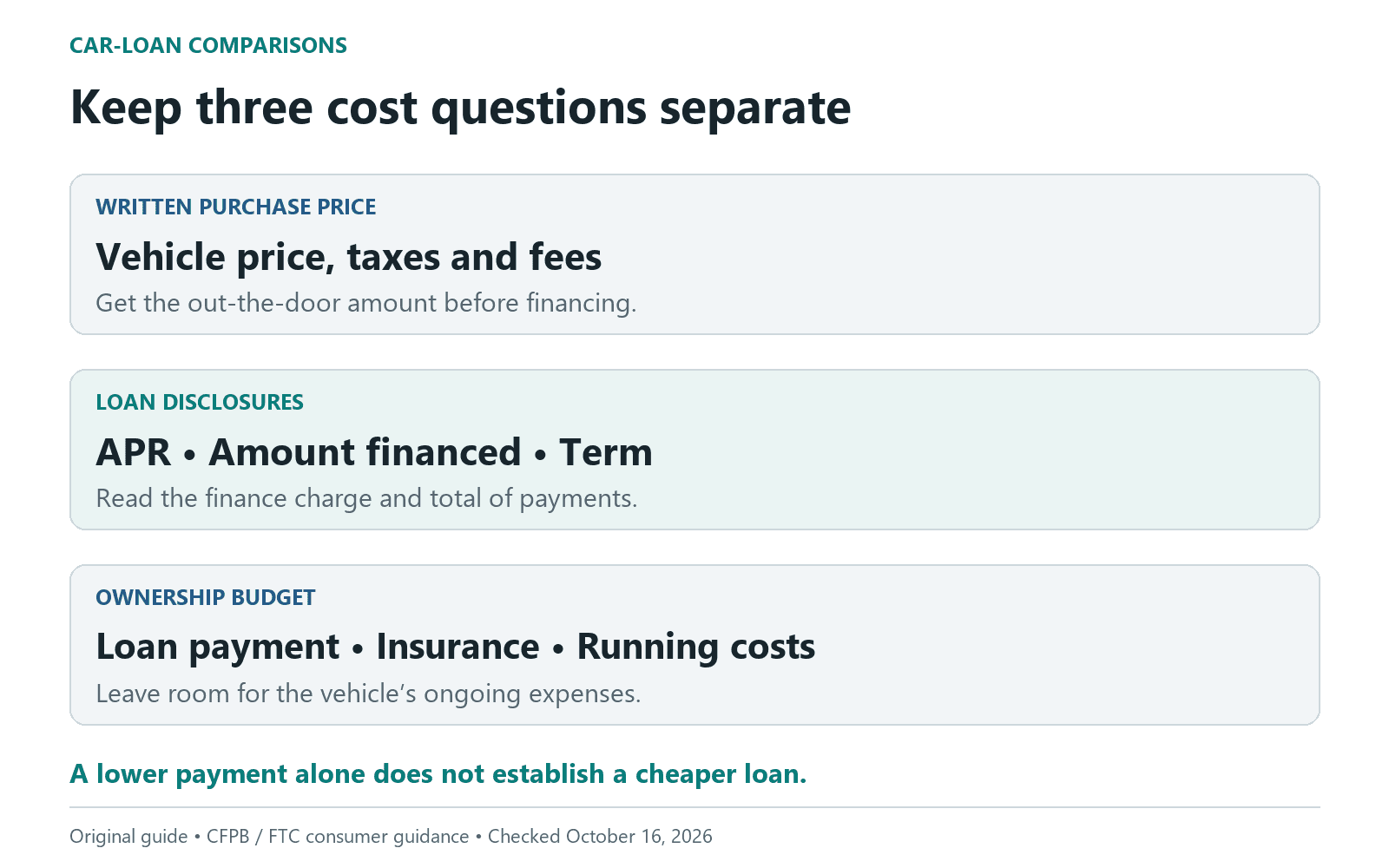
Use the same vehicle price, down payment and proposed amount borrowed when comparing alternatives. Otherwise, a lower payment might reflect more cash upfront or a longer loan rather than a better financing price. Ask for a written out-the-door price, including taxes and fees before financing. Keep this purchase price distinct from the loan disclosures, which spell out borrowing costs.
| Figure | What it tells you |
|---|---|
| APR | The cost of credit expressed as a yearly percentage, including interest and applicable loan fees. |
| Amount financed | The amount you are borrowing, as disclosed in the contract. |
| Term and payment schedule | How many payments are scheduled, their amounts and when they are due. |
| Finance charge | The scheduled interest and certain fees over the loan, assuming every payment is made when due. |
| Total of payments | The sum of scheduled loan payments. Compare cash paid upfront separately; this is not the full ownership budget. |
A longer term can reduce the monthly payment while increasing interest paid when the amount and rate are otherwise the same. The monthly-payment versus total-cost guide separates those loan figures from fuel, insurance, maintenance and other ownership expenses.
Ask for an itemized price for each proposed add-on, such as GAP coverage or a service contract, and whether it would be financed. Decline optional products you do not want; consider their financing costs as well as their purchase prices.
A trade-in payoff is still part of the calculation
If you owe money on the current car, obtain its payoff amount from the lender and compare it with the trade allowance. A shortfall does not disappear because the old vehicle is traded. If it is added to the next loan, you borrow more and pay financing costs on that additional debt. The CFPB’s trade-in guidance explains why the current payoff matters.
Check credit-reporting claims
Do not assume that making payments on an in-house loan will build your credit history. The CFPB warns that some buy-here-pay-here lenders report negative information without reporting on-time payments. Ask which credit bureaus receive positive payment information and request that promise in writing.
Before signing, read the final creditor name, payment schedule, fees and required terms. Resolve differences between the quote and the contract first. The FTC recommends checking whether financing is final before taking the car. If the dealer says lender approval is still pending, that is a different position from having a completed, approved agreement.
0 comment(s) so far on Car Loans With Bad Credit: What to Compare Before Signing