

2021 RAV4 vs. CR-V: XLE AWD and EX AWD Compared
Used SUV comparison
A 2021 Toyota RAV4 XLE AWD and a 2021 Honda CR-V EX AWD offer two distinct approaches to a five-seat used SUV. The gasoline Toyota has a 2.5-liter four-cylinder and an eight-speed automatic; the gasoline Honda uses a 1.5-liter turbocharged four-cylinder and a CVT. Their maintenance instructions and trim-specific safety results add more useful detail than a model-wide reliability label.
Updated October 16, 2026
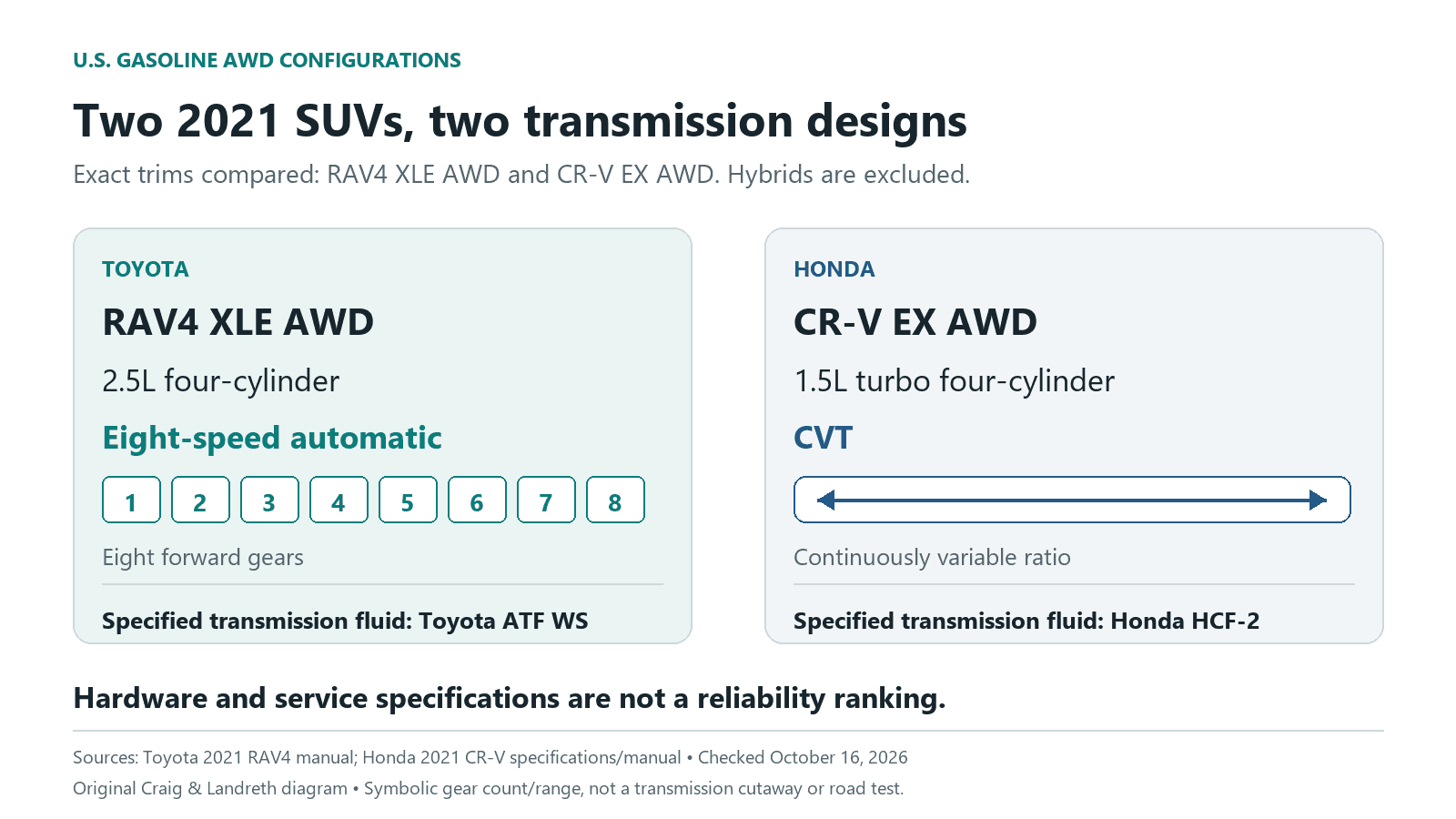
This comparison covers those two U.S. gasoline configurations. RAV4 Hybrid, RAV4 Prime and CR-V Hybrid specifications are excluded. It is a comparison of manufacturer documents and current safety records, not a road test or a prediction of an individual vehicle’s future repair costs.
The hardware and footprint are specific
The 2021 RAV4 owner’s manual identifies the gasoline engine and transmission, while Honda’s 2021 CR-V specifications separate gasoline and hybrid equipment by trim. Keeping those versions apart matters: the hybrid’s transmission description, cargo figures and headlights cannot simply be assigned to the gasoline EX.
| Published specification | 2021 RAV4 XLE AWD, gasoline | 2021 CR-V EX AWD, gasoline |
|---|---|---|
| Engine | 2.5-liter four-cylinder | 1.5-liter turbocharged four-cylinder |
| Transmission | Eight-speed automatic | Continuously variable transmission |
| Seats | Five | Five |
| Overall length | 180.9 inches | 182.1 inches |
| Published width | 73.0 inches | 73.0 inches |
The Toyota selects among fixed gears; the Honda can vary its transmission ratio continuously. Engine speed therefore need not follow the same pattern as road speed in the two vehicles. Transmission type is a meaningful driving distinction, but it does not establish a failure rate. Neither a turbocharger nor a CVT, by itself, supplies a defensible reason to predict which example will need fewer repairs.
Comfort depends on the actual trim
The CR-V is 1.2 inches longer in these published dimensions, while both list the same width. Those numbers help describe their footprint; they do not measure seat support, mirror clearance or how easily a particular passenger enters the rear seat.
Honda lists heated front seats and a moonroof for the EX, with 38.0 inches of front headroom. The LX’s published 40.1-inch front-headroom figure does not belong to this EX comparison. That is a practical reason to sit in the actual trim with the driver’s seat adjusted normally, particularly if headroom is tight. Do not borrow a base-trim measurement to settle fit in a differently equipped vehicle.
AWD brings identifiable maintenance tasks
The 2021 RAV4 maintenance guide lists transfer-case oil replacement for 4WD vehicles at 60,000 miles or 72 months. At that same service point, automatic-transmission fluid and 4WD rear-differential oil replacement appear under the specified towing, car-top-carrier or heavy-loading conditions. The guide separately adds transmission-fluid replacement for extensive idling or low-speed commercial-type use. Read the applicable task and operating-condition entry together.
The 2021 CR-V manual’s U.S. Maintenance Minder table uses code 3 for transmission fluid and code 6 for rear-differential fluid on applicable models. It also requires transmission-fluid changes every 25,000 miles when the vehicle is regularly used for trailer towing or mountainous driving at very low speeds. That instruction is different from a blanket 25,000-mile interval for every CR-V.
The fluids differ too: Toyota specifies ATF WS for the RAV4 automatic, while Honda specifies HCF-2 for the CR-V CVT. A receipt saying only “transmission service” leaves an important detail unresolved. Match the documented work to the vehicle and its required fluid, rather than assume the same product and schedule apply to both.
A safety badge does not cover every headlight
The current IIHS pages for the 2021 RAV4 and 2021 CR-V both display Top Safety Pick awards with a specific-headlight qualification. The gasoline XLE and EX compared here each receive a Marginal headlight rating. A listing that repeats the model-line award without that qualification can give the wrong impression about the fitted lamps.
| Current IIHS result | 2021 RAV4 | 2021 CR-V |
|---|---|---|
| Headlights on the gasoline trims compared here | XLE: Marginal | EX: Marginal |
| Updated moderate-overlap front test | Marginal | Poor |
| Updated side test | Acceptable | Acceptable |
IIHS states which model years each crash rating covers; the updated tests used 2021 AWD base-trim vehicles. These are separate evaluations, not a combined safety score or a reliability ranking. The individual test results are more informative than treating the award as a guarantee about every version or every type of collision.
Check current recall applicability, including later expansions
Current NHTSA model-year records provide concrete examples of what to investigate. The 2021 RAV4 record includes 23V865, an occupant-classification sensor campaign whose remedy is inspection and replacement as necessary. The 2021 CR-V record includes 26V332, the 2026 seat-weight-sensor recall expanding 24V064, with sensor replacement as its remedy. Both remedies are free for affected vehicles.
An older seat-sensor repair receipt does not, by itself, answer whether the later Honda campaign applies. The explanation of Honda’s 26V332 expansion covers that distinction. Use the individual VIN and current manufacturer information to establish applicability and completion, rather than infer either from the trim name.
These are campaign examples, not a count-based comparison of dependability. NHTSA distinguishes a general model-year search from a VIN search for unrepaired recalls, and completed recalls are not listed as unrepaired. The documents above establish equipment, specified maintenance and particular safety findings. They do not establish either SUV as a universal reliability winner.
0 comment(s) so far on 2021 RAV4 vs. CR-V: XLE AWD and EX AWD Compared