

Car Repair Symptoms: Brakes, Oil, Tires, Battery and Steering
Understanding repair symptoms
A warning light, a strange noise and overdue maintenance can demand very different responses. Start with the exact symptom and the vehicle’s instructions. These five categories help you record what changed, recognize urgent situations and ask what evidence supports a repair.
Updated October 16, 2026
1. Brakes: separate a noise from reduced stopping ability
Write down whether the concern is a squeal, grinding, vibration during braking, a changed pedal or longer stopping distance. Those observations help define the inspection; they do not identify a particular pad, rotor or hydraulic fault.
A sudden loss of pedal resistance or difficulty stopping needs immediate action to reach a safe stopping place. Arrange assistance rather than assuming the car can be driven to an appointment. The 2021 CR-V manual’s red brake-warning section, for example, instructs an immediate safe stop if the pedal has no resistance. Warning combinations and instructions differ by vehicle.
For a noise with otherwise normal operation, request findings from an appropriate brake inspection. Ask which measurements or observed defects support the proposed work. Record when the noise occurs without provoking repeated hard stops to reproduce it.
2. Oil: a service reminder and a pressure warning are different
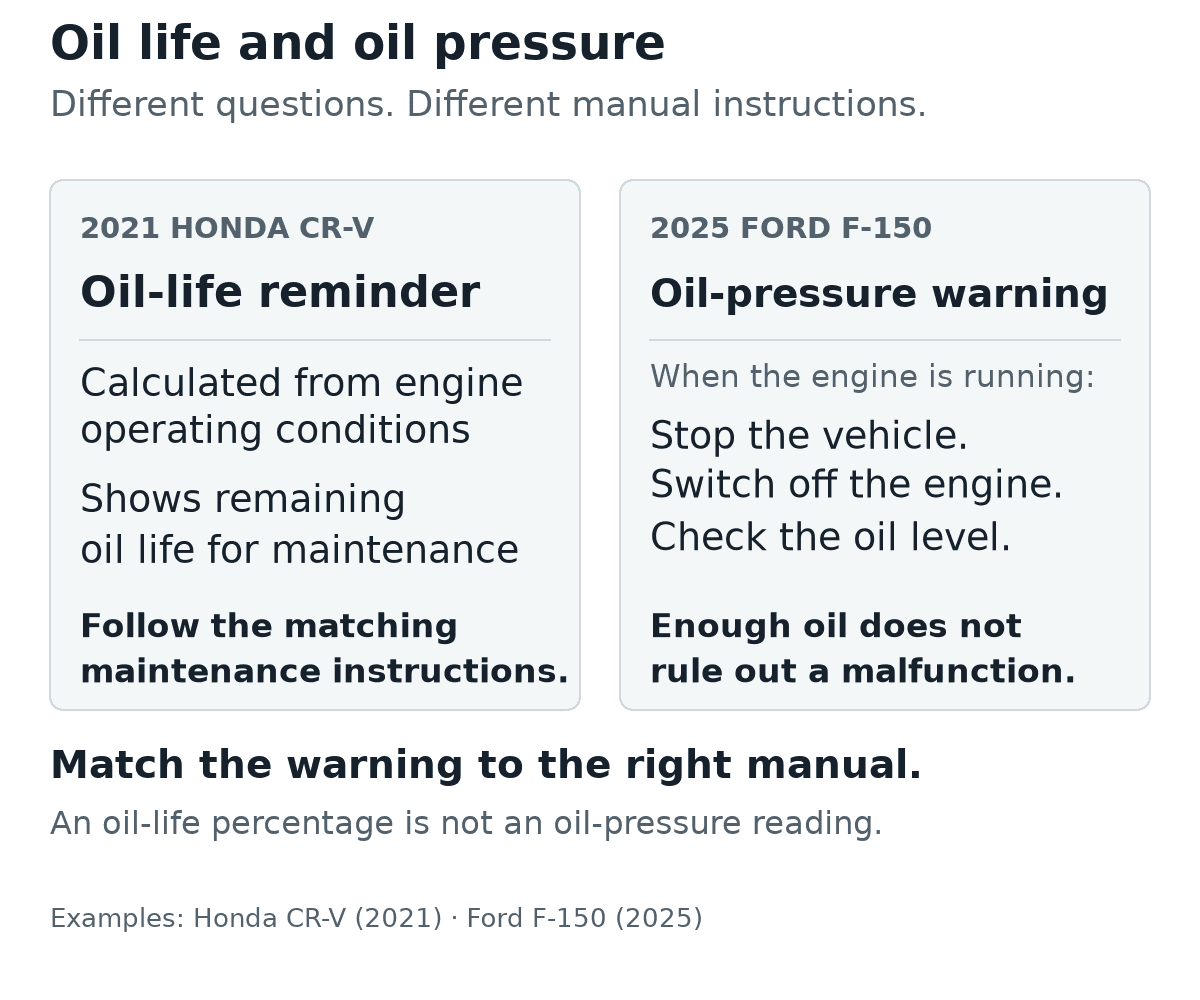
An oil change is scheduled maintenance. Its timing comes from the matching schedule or monitoring system, with the specified oil and filter. Honda’s 2021 CR-V Maintenance Minder description says its remaining oil-life percentage is calculated from engine operating conditions. It is not an oil-pressure reading.
A pressure warning while the engine runs calls for the manual’s immediate response. The 2025 F-150 manual directs the driver to stop, switch off the engine and check the level; sufficient oil does not rule out a system malfunction. Do not treat that warning as an ordinary reminder to book an oil change.
For a leak, record where fluid appears and when the level changes. Let identification and inspection establish its source. A puddle’s location alone does not identify the failed seal or even the fluid.
3. Tires: pressure, damage and wear need separate checks
NHTSA’s tire guidance directs owners to the vehicle label or manual for cold pressure. TPMS warns of significant underinflation; it does not replace regular pressure and condition checks. Record which tire loses pressure, the readings and whether the tire was cold.
Visible damage changes the next step. NHTSA says to stop using tires with damage such as bulges, cuts or cracks. Our sidewall-bubble explanation distinguishes an outward bulge from a possible construction indentation. Adding air does not clear a damaged tire for continued use.
Ask for measured wear and an assessment of the tire and wheel. Uneven wear or vibration needs investigation before assuming an alignment alone will correct it.
4. Starting and charging: describe what the car actually does
Does the starter turn slowly, not turn at all, or turn normally while the engine fails to start? Record that distinction, any warning message and recent jump starts. The 2021 CR-V no-start checklist separates those starter conditions rather than assigning every no-start to the battery.
A charging warning during operation is another concern. Ford’s 2025 F-150 message table distinguishes low state-of-charge messages from charging-system service warnings; its “Charging System Service Now” message requires immediate checking. Follow the exact vehicle’s instructions. Request test findings before authorizing a battery, starter or alternator replacement.
5. Steering: pulling is not automatically an alignment diagnosis
Describe pulling, an off-center wheel, vibration or increased steering effort separately. Note a recent impact and whether braking changes the symptom. Tire, wheel, steering and suspension findings should guide the work.
Loss of assistance deserves different urgency from gradual tire wear. The 2025 F-150 steering instructions say to stop safely for “Steering Loss Stop Safely.” If steering or braking makes the vehicle difficult to control, arrange recovery from a safe place. Do not conduct a road test to force the fault.
Make the work order answer the original concern
Provide the exact message, when it appeared and what changed. Ask the technician to separate observations, test results and the confirmed cause, then identify the work proposed. A service reminder, inspection finding and urgent fault should remain distinct on the estimate.
Other urgent warnings need their own response. The 2021 CR-V overheating instructions begin with parking safely and warn against opening the hood while steam is coming out. Use the matching manual’s emergency guidance or arrange assistance; do not assume driving to a later appointment is safe.
0 comment(s) so far on Car Repair Symptoms: Brakes, Oil, Tires, Battery and Steering