

Tire Sidewall Bubble: Stop Using the Damaged Tire
Tire damage
A confirmed outward bubble in a tire sidewall is structural damage, not a wear pattern to monitor until the next service. Stop using the damaged tire and arrange an appropriate spare or roadside assistance. There is no general speed or distance that makes driving on a bulged sidewall safe.
Updated October 16, 2026
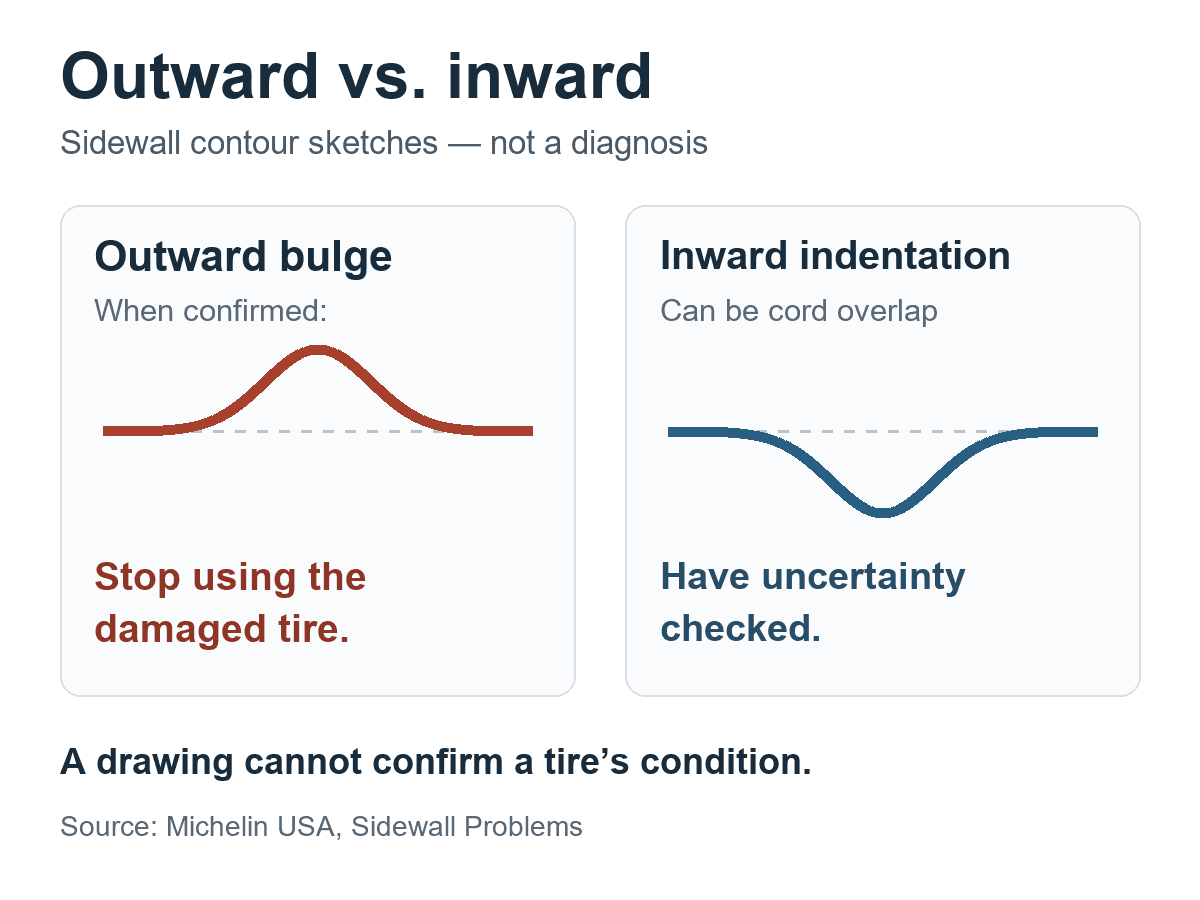
First distinguish an outward swelling from a slight inward indentation. They can look similar in a photograph, but they mean different things. A tire professional should resolve uncertainty rather than an owner pressing, puncturing or flexing the area to test it.
A bulge and an indentation are different conditions
Michelin’s sidewall guidance describes an outward bubble as evidence of internal structural failure. Damaged cords can allow air to enter between layers, producing the raised area. A tire can have an apparently usable tread while its sidewall structure is compromised.
An inward indentation can instead occur where reinforcing cords overlap during construction. Michelin identifies that construction feature as normal. That distinction does not mean every unusual sidewall shape is harmless; cuts, cracks and outward swellings need their own assessment.
| What is visible | What it means for the next step |
|---|---|
| A localized outward bubble | Stop using the damaged tire; arrange replacement and professional inspection. |
| A slight inward indentation | May be a normal cord-overlap feature; have uncertainty checked. |
| A cut, exposed reinforcement or another shape | Do not classify it from the word “bubble”; describe the actual damage. |
Why pressure and a repair plug do not settle it
A pressure reading answers how much air is in the tire, not whether the reinforcing structure is intact. NHTSA explains that tire-pressure monitoring warns of significant underinflation. It is not a structural inspection, and the absence of its warning does not clear a visible bulge.
Likewise, adding air cannot repair damaged cords. A sidewall bubble is different from a small puncture in a repairable part of the tread. A plug, sealant or patch does not restore the failed sidewall structure. Do not puncture the swelling to release it or try to push it back into shape.
If a spare is available, its use still depends on the vehicle’s instructions, the spare’s condition and whether the change can be made in a safe location. A temporary spare has its own restrictions. Where there is no suitable spare or a roadside change is unsafe, arrange assistance rather than inventing a low-speed allowance for the damaged tire.
After an impact, assess more than the visible rubber
A pothole or curb impact can damage a tire internally even when the outside initially looks modest. Michelin’s sidewall-damage explanation identifies impacts as a possible source of broken reinforcement and recommends having tires checked after such a strike. That is a mechanism, not proof that every bulge came from a particular remembered impact.
Tell the tire professional which wheel was involved and what happened. The tire and wheel should be assessed together; a replacement tire does not by itself establish that the wheel escaped damage. Let the findings determine whether further wheel or suspension work is needed rather than assuming every pothole requires an alignment.
Match the replacement to the vehicle
Use the specified tire size, load requirements and vehicle instructions when selecting the replacement. NHTSA directs owners to the vehicle placard or manual for recommended cold pressure, rather than the maximum number molded on the tire. That pressure guidance applies to the replacement; it does not rehabilitate the damaged tire.
Have the other tires’ condition and remaining tread checked at the same time. Whether one tire, an axle pair or more needs replacement depends on the vehicle and tire requirements, including any specified limits on differences between tires. A sidewall bubble alone is not a reason to promise that every vehicle needs four new tires.
0 comment(s) so far on Tire Sidewall Bubble: Stop Using the Damaged Tire