

EV Outlets vs. Home Backup: What V2L and V2H Mean
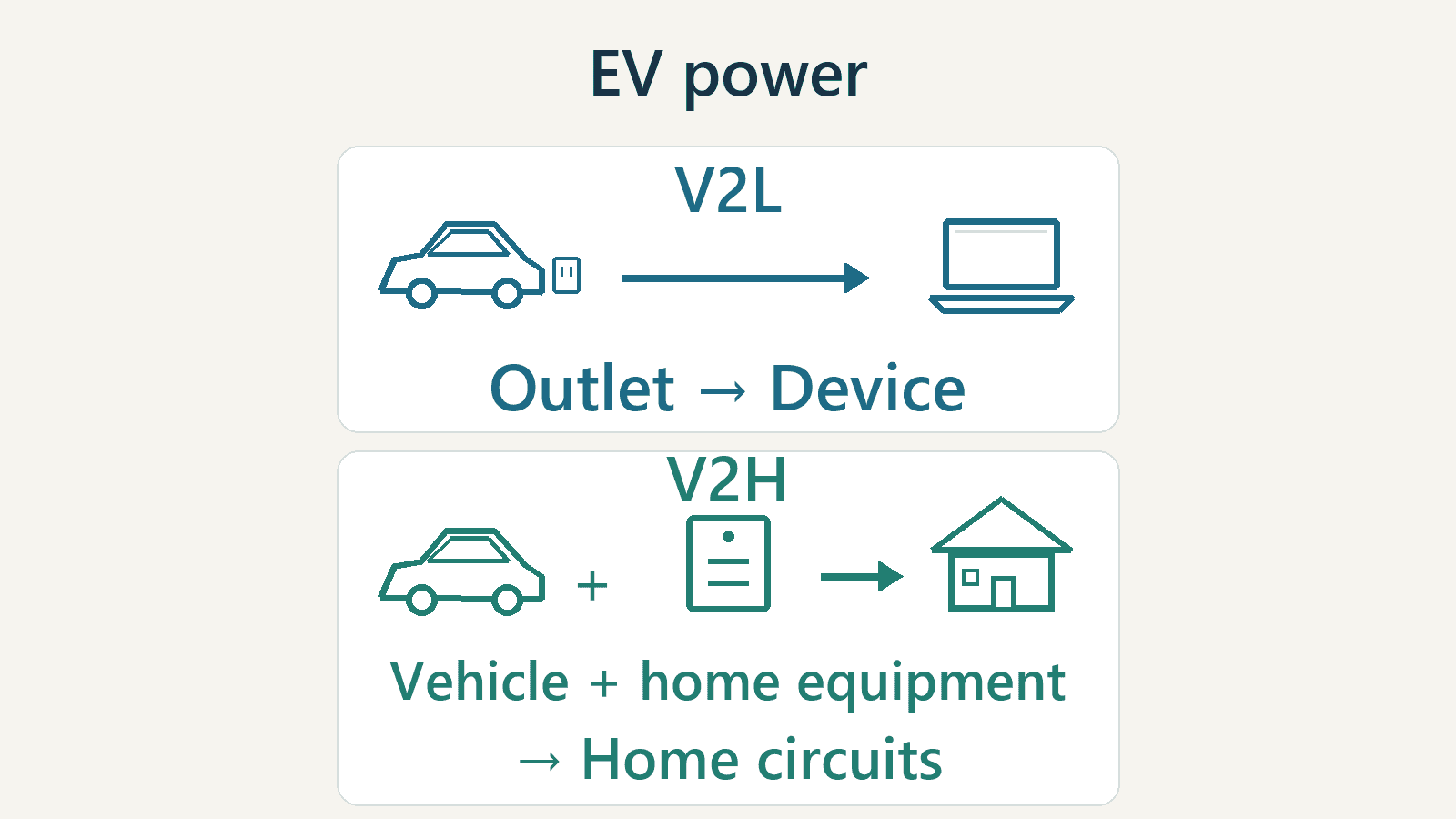
An EV that can run a plug-in device does not automatically provide a working home-backup system. The distinction is the connection and the supported equipment around the vehicle. Before choosing a car for outage power, separate powering an individual appliance from supplying electricity through a home’s circuits.
Both uses can draw on stored vehicle energy, but they solve different problems. An outlet rating, a charging port and a large battery each describe only part of the capability. None alone establishes what a particular vehicle can safely power at a particular house.
V2L supplies a load; home backup integrates a system
The Department of Energy’s explanation of vehicle power export distinguishes vehicle-to-load, or V2L, from vehicle-to-building, or V2B. V2L supplies an individual electrical load outside the vehicle. Building applications supply multiple loads through additional infrastructure. Residential applications are commonly described as vehicle-to-home, or V2H.
That terminology helps frame a shopping question. Powering a compatible device directly is one task. Having home circuits supplied during an outage is another. A household should identify which task it needs before comparing vehicle features, rather than treating every mention of “power export” as the same promise.
An outlet still has operating conditions
The 2025 U.S. Hyundai IONIQ 5 manual’s indoor-power instructions provide a concrete example. They describe using the vehicle’s interior outlet, the required vehicle state, indicator lights and a battery discharge limit. Output stops when the battery reaches that limit. The manual also gives specific instructions for using indoor and outdoor V2L together.
These are instructions for the documented system, rather than a statement that every EV or every version has identical outlets. A listing photo showing a socket leaves its rating, availability and operating restrictions unresolved. Check the manual and actual equipment for the model year, trim and market being considered.
Device suitability also matters. Hyundai prohibits electric heating appliances such as kettles, toasters and irons inside the vehicle. “Household plug” is not a universal approval for household appliances. Confirm the intended device against the vehicle’s instructions instead of assuming a physically fitting plug settles the question.
Supported home backup can use different paths
Home backup is not defined simply by which port the power leaves. Ford’s current energy-solutions page, checked October 17, 2026, describes an outage-power option for F-150 Lightning vehicles equipped with the 240-volt Pro Power Onboard outlet and links to compatible home-connection equipment. Its example shows why an outlet can be part of an engineered backup solution without making an outlet alone a complete one.
The practical comparison is the supported combination: vehicle, output system, connection equipment and home installation. Do not generalize one manufacturer’s arrangement to another vehicle or assume that an existing charging installation supports power export. Equipment supplied with a used car also needs to be distinguished from equipment installed at a previous owner’s home.
Compare the complete capability before assigning value
DOE’s bidirectional-charging overview explains that compatible vehicles and charging equipment must work together for those systems, and that site needs and equipment costs vary. The AFDC material also identifies protective building equipment needed to prevent power from being fed back into the grid. These are system requirements, not an invitation to improvise a connection.
Ask for confirmation of the supported configuration and an installation assessment for the actual property. Establish which loads the system supports and how its battery reserve is managed. A vehicle feature may be useful for occasional device power, household backup, or neither intended task; assigning value requires the complete use case and equipment, rather than the feature name alone.
0 comment(s) so far on EV Outlets vs. Home Backup: What V2L and V2H Mean