

New-Car Supply Rebounds, but Budget Models Stay Tighter
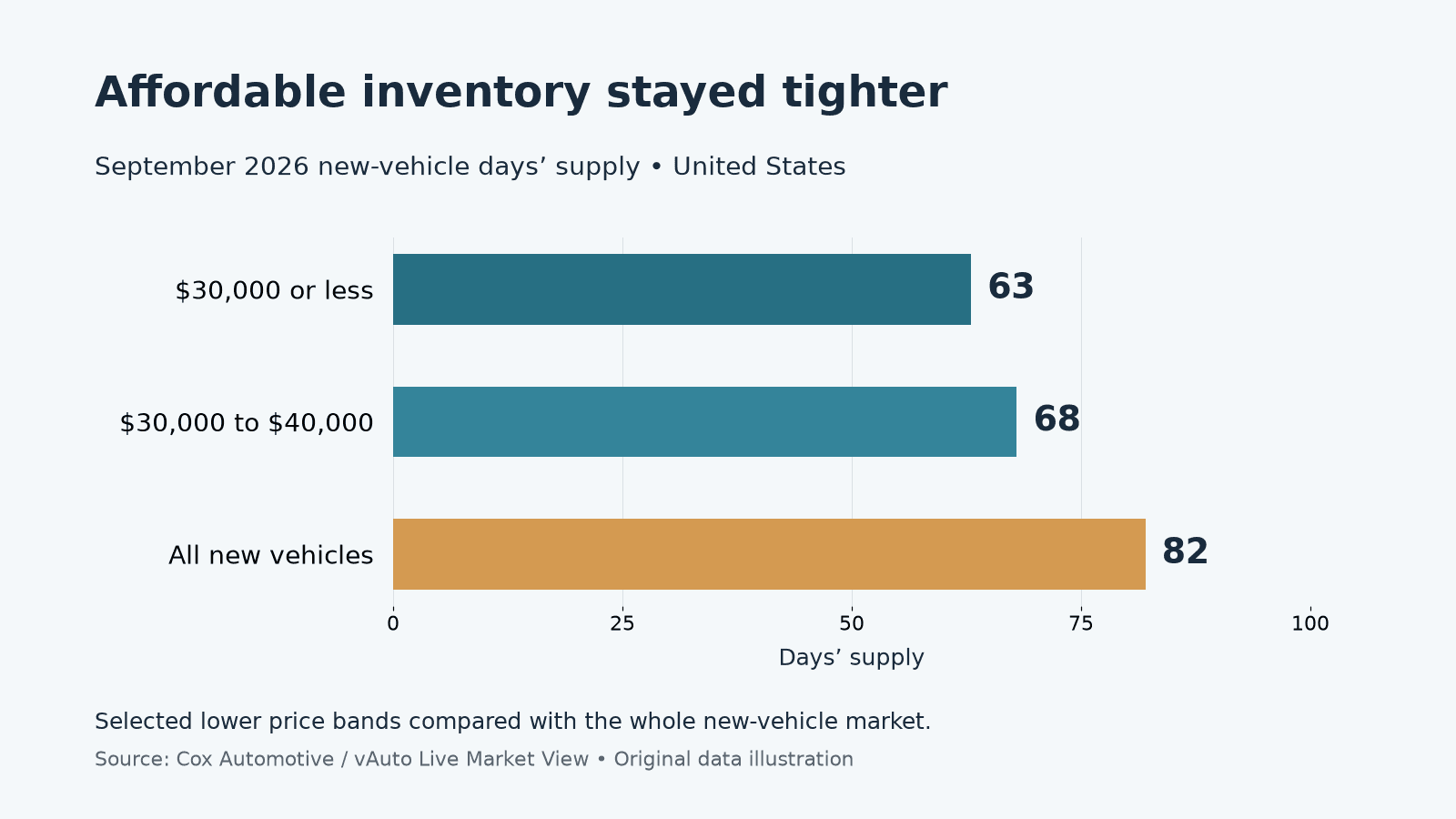
New-car inventory increased in September, but the improvement was uneven across price ranges. Vehicles priced at $30,000 or less remained more tightly supplied than expensive models, according to Cox Automotive’s October 15 report. That distinction matters to buyers who might otherwise expect a national inventory rebound to produce more choices at every budget.
The report addresses availability rather than the final price paid for a particular vehicle. It adds a different perspective to the September transaction-price report: a market can carry more vehicles overall while leaving shoppers in its lower price brackets with fewer alternatives relative to demand.
Lower prices still came with less supply
Cox’s September inventory analysis put available new-vehicle stock at 2.80 million, up 4.5% from the prior month. It reported 82 days of supply overall. Vehicles priced at $30,000 or less had 63 days of supply; those from $30,000 to $40,000 had 68 days.
At the other end, the report showed 91 days for $50,000–$60,000 vehicles, 99 days for $60,000–$80,000 vehicles and 111 days above $80,000. These are price-bracket figures across the market, not estimates for every model in a bracket. They nevertheless show why an improvement in the headline number may feel different to shoppers with different budgets.
The lower-price constraint was not new. Cox’s August inventory report, published September 10, also described comparatively limited supply below $30,000. The latest report follows that pattern while documenting a sequential rebound in the overall market. Neither month establishes that a particular vehicle will be easy to find nearby.
Days supply measures demand as well as stock
According to the definitions in Cox’s Auto Market Snapshot, days supply uses the daily sales rate over the most recent 30-day period. It relates available inventory to the pace of sales. A higher figure can reflect more vehicles, slower sales or both; it does not mean every vehicle has been sitting for that many days.
For a buyer, the useful question is how much choice exists among comparable vehicles. Compare the body style, powertrain and equipment you need before broadening the price search. A large supply of vehicles outside those requirements does not necessarily create more suitable alternatives.
Keep the model year visible too. A lower asking price on an outgoing model and a higher price on a redesigned replacement may describe different equipment or technology. The inventory report cannot determine which is the better fit for a particular household, and a national supply figure cannot establish a specific discount.
Availability and transaction price are different evidence
Kelley Blue Book’s September transaction-price analysis places the industry average at $50,562 and attributes part of the market’s modest annual price growth to sales mix. A mix shift toward less expensive segments can restrain an average even while many individual vehicle prices rise.
That average, a listed asking price and the price in a written offer answer different questions. Use the supply report to understand the breadth of the search, then compare actual vehicles and written prices on the same basis. Taxes, fees, equipment and any financing conditions need their own comparison; they cannot be read from a days-supply chart.
The September rebound is useful context, particularly for buyers deciding how widely to search. Its clearest message is that total availability and affordable availability are different measures. A patient comparison of suitable alternatives remains more informative than assuming that a fuller national market guarantees a particular local price or vehicle.
0 comment(s) so far on New-Car Supply Rebounds, but Budget Models Stay Tighter