

NHTSA Selects 2027 Vehicles for New Safety Testing
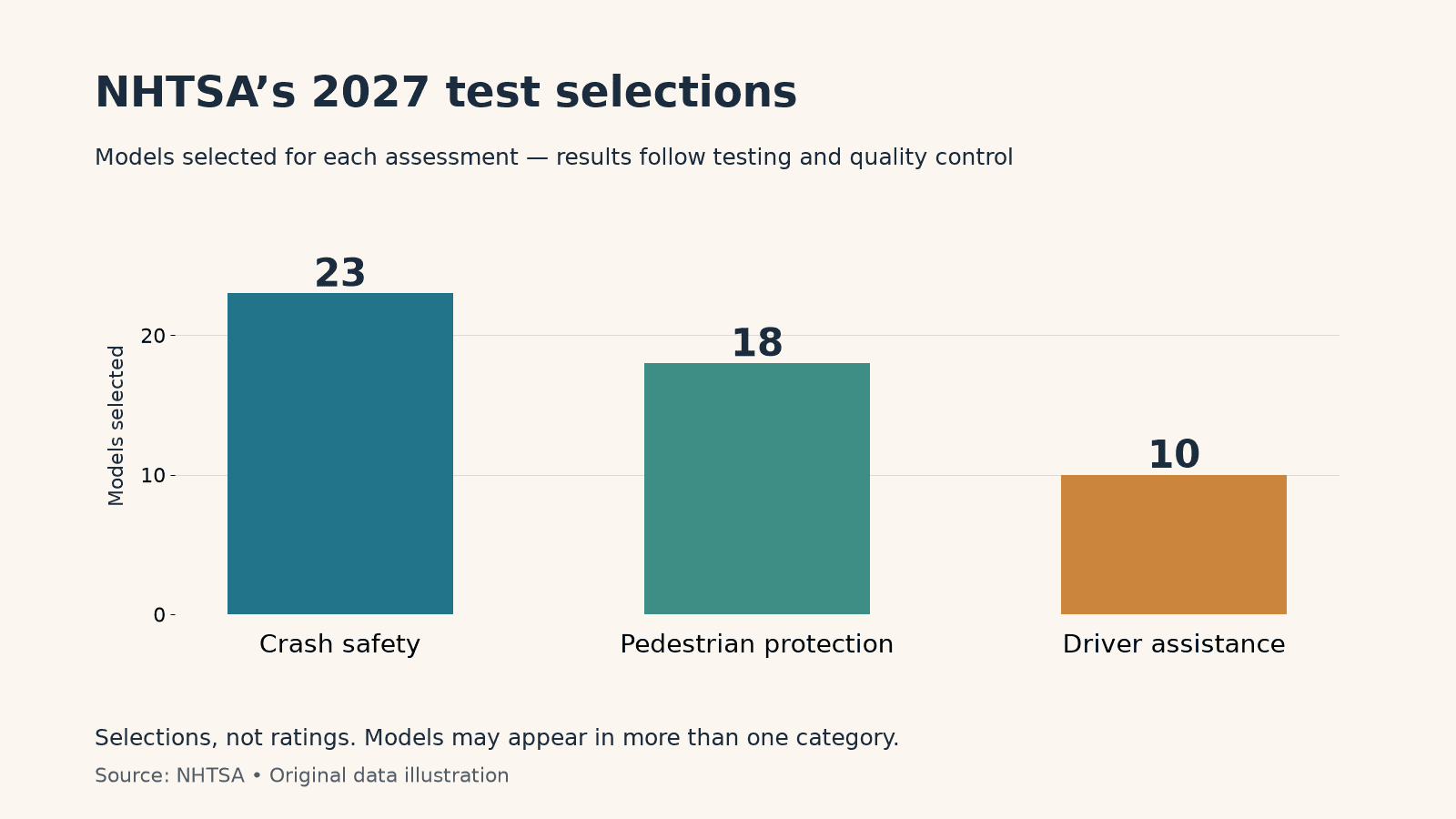
NHTSA has selected model-year 2027 vehicles for a new round of safety evaluations, including familiar family SUVs, pickups and electric vehicles. The October 15 announcement identifies vehicles for testing under three parts of the agency’s New Car Assessment Program. For shoppers, the immediate value is knowing which assessments to watch for as results arrive.
The lists do not announce new star ratings for the selected vehicles. NHTSA says assessments and ratings will be released after testing and quality control are complete. A vehicle’s appearance in the announcement is therefore a testing decision, not a finding that it performed well or poorly.
Three lists answer different safety questions
The official model-year 2027 selection announcement names 23 vehicles for frontal, side and rollover evaluations, 18 for pedestrian-protection verification and 10 for advanced driver-assistance verification. Some models appear in more than one list, so adding those figures would overstate the number of distinct vehicles.
Crash-test selections include the Chevrolet Silverado 1500, Hyundai Tucson, Kia Telluride, Nissan Rogue, Tesla Model 3 and Toyota Sienna Hybrid. The Rivian R2 appears in the driver-assistance list. Those examples illustrate the range of vehicles involved; inclusion in one testing category does not establish inclusion in all three.
The driver-assistance work covers automatic emergency braking, pedestrian automatic emergency braking, lane keeping assist, blind spot warning and blind spot intervention. These systems address different situations. A warning feature and a feature that can intervene are different capabilities, and their names alone cannot establish equivalent performance.
Pedestrian protection is separate from avoiding a crash
NHTSA’s pedestrian-protection assessment examines how a vehicle’s exterior can affect injuries when a person is struck. Its September 18 introduction of the first 2027 pedestrian results describes headform impacts around the hood and windshield, upper-leg impacts at the hood’s leading edge and lower-limb impacts at the bumper.
That differs from pedestrian automatic emergency braking, which attempts to avoid or reduce a collision. One evaluation concerns the consequences of an impact; the other concerns the response of a detection and braking system. Shoppers benefit from considering both rather than treating a pedestrian-related label as one universal score.
The September release already reported pedestrian results for an initial group of models. It is a separate event from the October testing selections. Neither announcement should be used to assume that every newly selected vehicle has completed an assessment.
How to use the results when comparing vehicles
The NHTSA ratings lookup and comparison guidance is the place to check an individual vehicle’s published information. Match the model year and vehicle description, then read the individual categories and any safety-concern notice alongside the overall score. A pending or unrated category is missing test information, not a zero-star result.
Comparisons also have limits. NHTSA restricts comparisons of frontal and overall scores to vehicles in the same class and within 250 pounds of one another. A five-star sedan and a five-star heavier SUV are not interchangeable measurements of protection in every possible collision.
IIHS provides another source of evidence through a different program. Its explanation of its tests and rating updates describes separate crash and crash-prevention evaluations, as well as when ratings can carry over to related or unchanged models. Read each organization’s methods and exact vehicle applicability rather than translating one program’s label into the other’s score.
For now, the new NHTSA list is a guide to forthcoming evidence. Buyers can use existing published results for the exact vehicle they are considering, while watching for the selected models’ completed assessments. The October announcement gives no basis to declare a new safety winner before those results are available.
0 comment(s) so far on NHTSA Selects 2027 Vehicles for New Safety Testing