

Flat Towing a 2025 Jeep Wrangler: What to Verify First
RV ownership
A flat-tow plan needs three kinds of evidence: the Wrangler's instructions, compatible installed equipment and enough motorhome capacity. The 2025 U.S. gasoline 4WD manual explains why “put it in Neutral” leaves out the detail that matters.
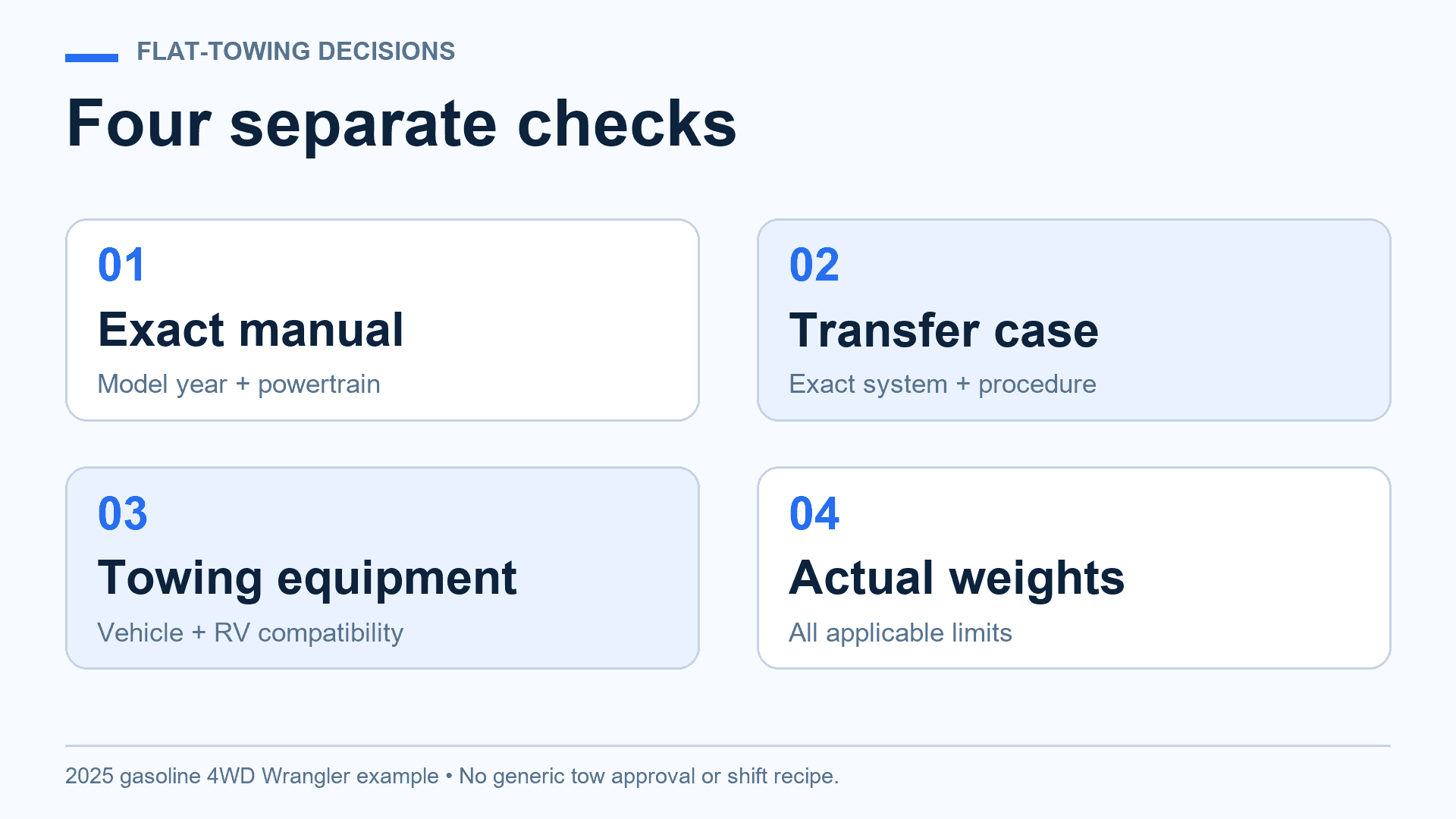
“Can it be flat towed?” is only the first question when choosing a Wrangler to take behind a motorhome. The vehicle’s manual must permit the method, the towing equipment must fit the actual vehicle, and the motorhome must have enough capacity for the complete combination. Passing one of those checks does not settle the others.
Start with the right Wrangler manual
This guide uses the 2025 U.S. Wrangler owner’s manual for gasoline four-wheel-drive models. It does not establish eligibility or a preparation procedure for a Wrangler 4xe, another model year or a modified drivetrain. Those require their own applicable documentation.
The relevant section is “Recreational Towing (Behind Motorhome),” not the Wrangler’s rating for pulling its own trailer and not an emergency recovery procedure. Those are different uses. A high trailer-tow rating tells you nothing by itself about how to tow that vehicle with its wheels on the road.
For the covered four-wheel-drive models, Jeep’s chart permits flat towing with all four wheels on the ground, subject to its instructions. It does not permit dolly towing with just the front or rear pair raised. Transport on a trailer with all four wheels off the ground is listed separately.
| Method | What the manual says |
|---|---|
| Flat tow, all wheels on the ground | Permitted subject to the complete recreational-towing instructions; forward direction only. |
| Dolly tow, front wheels raised | Not allowed. |
| Dolly tow, rear wheels raised | Not allowed. |
| Vehicle trailer, all wheels raised | Listed as an allowed transport method; the trailer, loading and motorhome still need their own capacity checks. |
Transmission Neutral and transfer-case Neutral are different
The manual makes a distinction that a generic “put it in Neutral” instruction misses. For flat towing, the transfer case must be in Neutral, while the automatic transmission is in Park or the manual transmission is in gear. A manual transmission is specifically not left in Neutral for towing.
Those final positions are not a preparation sequence. Jeep provides a complete procedure that includes verifying the transfer case has disengaged and preparing the transmission correctly. Follow that entire procedure in the actual manual, including the instructions for returning to normal driving. An abbreviated checklist can omit a consequential step.
Jeep also warns that transfer-case Neutral allows the vehicle to roll even with the automatic transmission in Park or a manual transmission in gear. Its instructions address securing the vehicle and when the parking brake is used during preparation. Do not experiment with the controls on a slope or leave the vehicle unsecured while trying to interpret a summary.
A compatible tow bar is only part of the system
A complete setup typically includes a vehicle-specific attachment or baseplate, an appropriate tow bar, safety cables, lighting connections, supplemental braking and a breakaway system. Blue Ox’s equipment guide describes those components. Their compatibility and installation need to be checked together, including the motorhome’s receiver and the equipment manufacturers’ instructions.
Exact fitment matters on a Wrangler with a replaced bumper, winch or other front-end changes. As an example of the detail involved, the Blue Ox BX1139 instructions list particular Wrangler applications and installation requirements. A baseplate’s application listing does not approve the vehicle’s drivetrain for flat towing or establish that a modified example has the listed mounting arrangement.
Jeep’s manual separately prohibits a fascia- or bumper-mounted clamp-on tow bar. That is a specific restriction, not a statement that any device attached near a bumper is automatically acceptable. Have an installer identify the actual attachment design and document that it meets the applicable instructions.
Check the motorhome and the loaded vehicle together
The Wrangler’s advertised curb weight is not a measurement of the vehicle you will tow. Added equipment and items carried inside change the actual load. Likewise, the receiver rating alone does not establish how much capacity remains in a fully loaded motorhome.
Use the motorhome’s own towing and combined-weight limits alongside the receiver, tow bar and attachment ratings. Have the actual loaded combination evaluated against every applicable limit; a large number printed on one component cannot raise a lower limit elsewhere. This guide does not calculate or certify a particular combination.
Before buying equipment, assemble the Wrangler’s exact model-year manual, drivetrain identification and modification history; the motorhome’s ratings and loaded-weight information; and the proposed equipment’s application and installation documents. A documented fitment review can resolve whether the plan works before parts are ordered. The final operating checklist should come from those matched instructions, rather than a universal Wrangler recipe.
0 comment(s) so far on Flat Towing a 2025 Jeep Wrangler: What to Verify First