

2026 Hyundai Venue: Prices, Equipment and MPG
Small-SUV equipment
The 2026 Hyundai Venue starts at $20,550 before freight and other charges, but the more useful question is what changes when you move up a trim. Every 2026 U.S. Venue has the same 121-horsepower engine, automatic transmission and front-wheel drive. The extra money primarily buys equipment, rather than a different powertrain or all-wheel drive.
Updated October 16, 2026
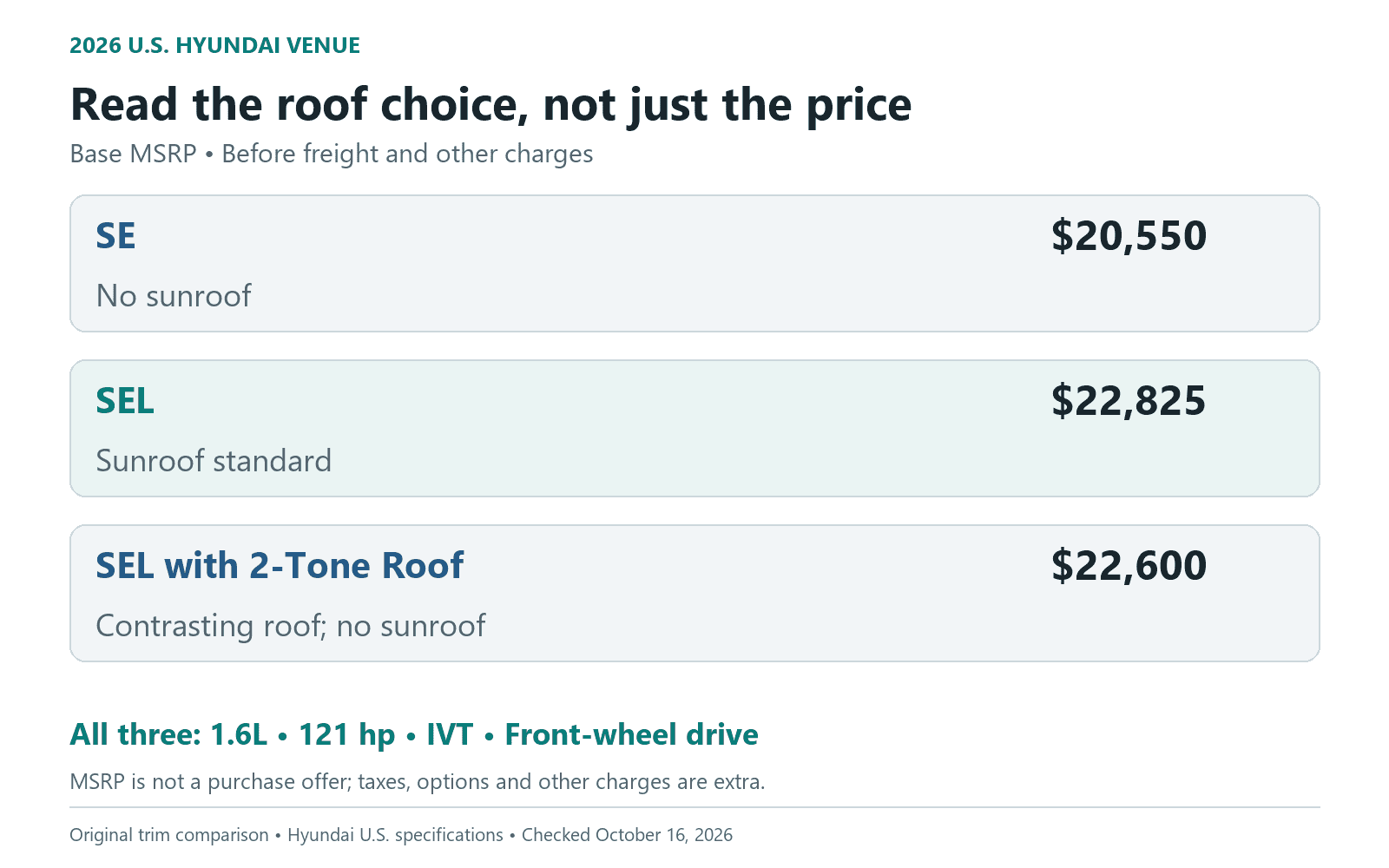
Hyundai lists three configurations: SE, SEL and SEL Two-Tone. The Two-Tone costs slightly less than the regular SEL, which makes the trim names worth reading closely. It adds a contrasting roof while giving up the SEL’s sunroof.
Three trims, one powertrain
Hyundai’s 2026 Venue overview lists these starting MSRPs. They exclude freight, taxes, title, license, options and dealer charges; the figures are not delivered purchase prices.
| Configuration | Starting MSRP | Useful equipment distinction |
|---|---|---|
| SE | $20,550 | 15-inch wheels; wireless Apple CarPlay and Android Auto |
| SEL | $22,825 | 17-inch wheels, heated front seats, automatic climate control and a sunroof |
| SEL Two-Tone | $22,600 | Contrasting roof; heated front seats and automatic climate control, without the SEL’s sunroof |
The SE-to-SEL difference is $2,275 before those additional charges. The Two-Tone is $225 below the SEL. Those are comparisons of published base prices, not a prediction of the difference between two actual cars with accessories or different asking prices.
Hyundai’s U.S. pricing sheet effective September 8, 2025 specifies $1,600 freight on all three. Under that published schedule, an SE starts at $22,150 with freight, before taxes, options and other charges. Hyundai’s current retail site cautions that freight and actual dealer prices can vary. Confirm the charge on the vehicle’s window sticker and get a written full price; that dated freight schedule is not an offer for a particular car.
What every Venue shares
The manufacturer’s specification table shows a 1.6-liter four-cylinder engine and Hyundai’s Intelligent Variable Transmission on all three versions. There is no AWD configuration in the U.S. lineup. The Snow Mode listed for the SEL versions does not change that drivetrain layout.
All three also have an 8-inch touchscreen and wireless Apple CarPlay and Android Auto. Moving up a trim is therefore unnecessary simply to obtain those phone connections. The SEL versions add wireless device charging, among other convenience equipment. A wireless phone connection and a charging pad are separate features.
Hyundai lists forward collision-avoidance assistance with pedestrian detection, lane-keeping assistance and driver-attention warning across the lineup. Blind-spot collision warning and rear cross-traffic collision warning are listed on the SEL versions. These are specific assistance functions, rather than a reason to assume every Venue has every feature pictured in an advertisement.
Put the fuel-economy number in context
The EPA’s 2026 Venue entry lists 29 mpg city, 33 highway and 31 combined for the front-wheel-drive 1.6-liter automatic configuration. Combined economy is a standardized comparison figure, not a promise that every commute will average 31 mpg.
When comparing another vehicle, use its exact model year and drivetrain rather than a model-family headline. Then apply the same annual mileage and fuel-price assumptions to both. A small fuel-cost difference should remain separate from the purchase-price difference, financing cost and insurance quote.
The useful comparison happens inside the car
Start with the items a specification table cannot settle for your household: the driving position, rear-seat fit and the shape of the cargo you actually carry. Bring the normal passengers and luggage where practical. A contrasting roof or larger wheel does not answer those questions.
For a trim decision, identify the feature that justifies the extra price. Heated seats, blind-spot warning and a sunroof serve different needs. Compare the actual equipment list with that short list, then judge the full written price. That produces a clearer decision than treating the most expensive trim as the automatically better value.
0 comment(s) so far on 2026 Hyundai Venue: Prices, Equipment and MPG