

Mercedes-AMG GT 53 EV: U.S. Specs and 2027 Arrival Plan
Electric performance cars
The electric Mercedes-AMG GT 53 adds a two-motor entry to the new GT 4-Door lineup, with a planned U.S. arrival in early 2027. Its appeal is the different balance of output, battery capacity and equipment within that family. “Entry model” describes its position below the GT 55 and GT 63; it does not establish a U.S. price or make this a mainstream-priced electric car.
Updated October 16, 2026
Use the U.S. announcement’s figures and footnotes
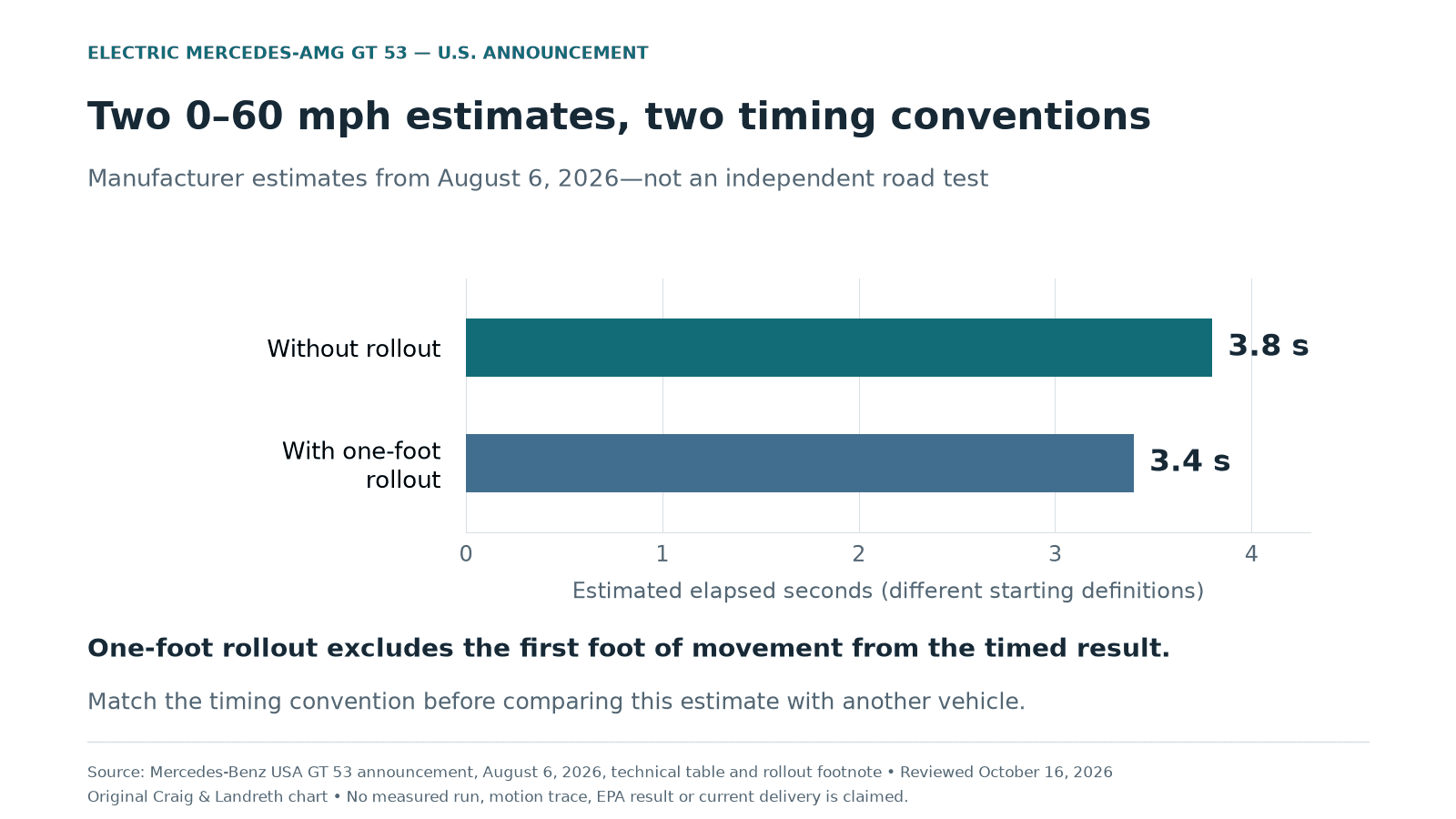
Mercedes-Benz USA’s August 6 announcement specifies 536 horsepower of peak output, 590 pound-feet of torque and a 106-kWh usable battery. It also gives two different estimated acceleration times: 3.4 seconds to 60 mph with a one-foot rollout, or 3.8 seconds without it.
Both belong with their measurement description. Rollout excludes the first foot of movement from the timed result. Comparing one figure with another car’s time without checking that convention can overstate the difference. These are manufacturer estimates, not measurements made for this article.
| Item | Announced value or status |
|---|---|
| Peak / continuous output | 536 hp / 362 hp |
| Estimated 0–60 mph | 3.4 seconds with rollout; 3.8 without |
| Usable battery capacity | 106 kWh |
| U.S. arrival | Early 2027 plan |
| Range basis in the release | WLTP; not an EPA label |
Two motors are a meaningful hardware distinction
The manufacturer’s current model overview distinguishes the GT 53’s two synchronous motors from the three axial-flux motors described for the GT 55 and GT 63. A photograph, platform name or specification from the higher-output variants should not be treated as the GT 53’s configuration.
The GT 53 also combines air suspension with adaptive damping and has its own accelerator-response control. Those are more useful comparison points than describing it only as the least powerful version. For someone assessing the eventual production car, the questions include how the controls operate, which settings are useful and which optional equipment is actually included.
AMG’s staged engine sound and shift sensations are another distinct feature. The model page describes a recorded six-cylinder sound reference for the GT 53, while the higher variants use a V8 reference. This is an electric vehicle’s sound program, not evidence that an internal-combustion engine is providing propulsion.
A charging headline needs an operating context
The global launch details describe an 800-volt battery architecture and charging capability up to 600 kW at suitable DC equipment. The added-range claim uses WLTP assumptions and is marked preliminary. It should not be presented as a guaranteed number of U.S. highway miles added during every ten-minute stop.
A maximum power figure is also different from a complete charging session. Compare the starting and ending state of charge, battery preparation, station capability and duration used in any result. A manufacturer’s best-case claim does not establish what an unfamiliar charger will deliver on a cold-weather trip.
The Department of Energy’s battery-electric-vehicle explanation separates stored battery energy from the way energy is consumed. Battery capacity alone cannot establish driving distance. The route, speed, conditions and vehicle configuration still matter when planning use.
Keep price, range and availability in their own columns
The EPA’s electric-vehicle label guide explains the U.S. comparison fields: estimated range, energy consumption and charging information. An announcement’s WLTP figure is not an EPA-certified range simply because it can be converted from kilometers to miles.
The U.S. release reviewed here does not supply an MSRP or an EPA range. Its early-2027 arrival is an announced plan, not evidence of an available vehicle or a particular delivery appointment. A German price quoted elsewhere includes a different market and tax basis and should not be substituted for a U.S. offer.
When U.S. order and certification details are available, compare the exact version, equipment and label with the charging arrangement you would actually use. Until then, keep the verified launch specifications and the unanswered retail questions separate. The model name identifies an interesting new electric performance car; it does not fill in the missing purchase details.
0 comment(s) so far on Mercedes-AMG GT 53 EV: U.S. Specs and 2027 Arrival Plan