

2026 Volvo XC90 PHEV: What a 49.6-Mile Test Shows
Plug-in hybrids
Updated October 16, 2026
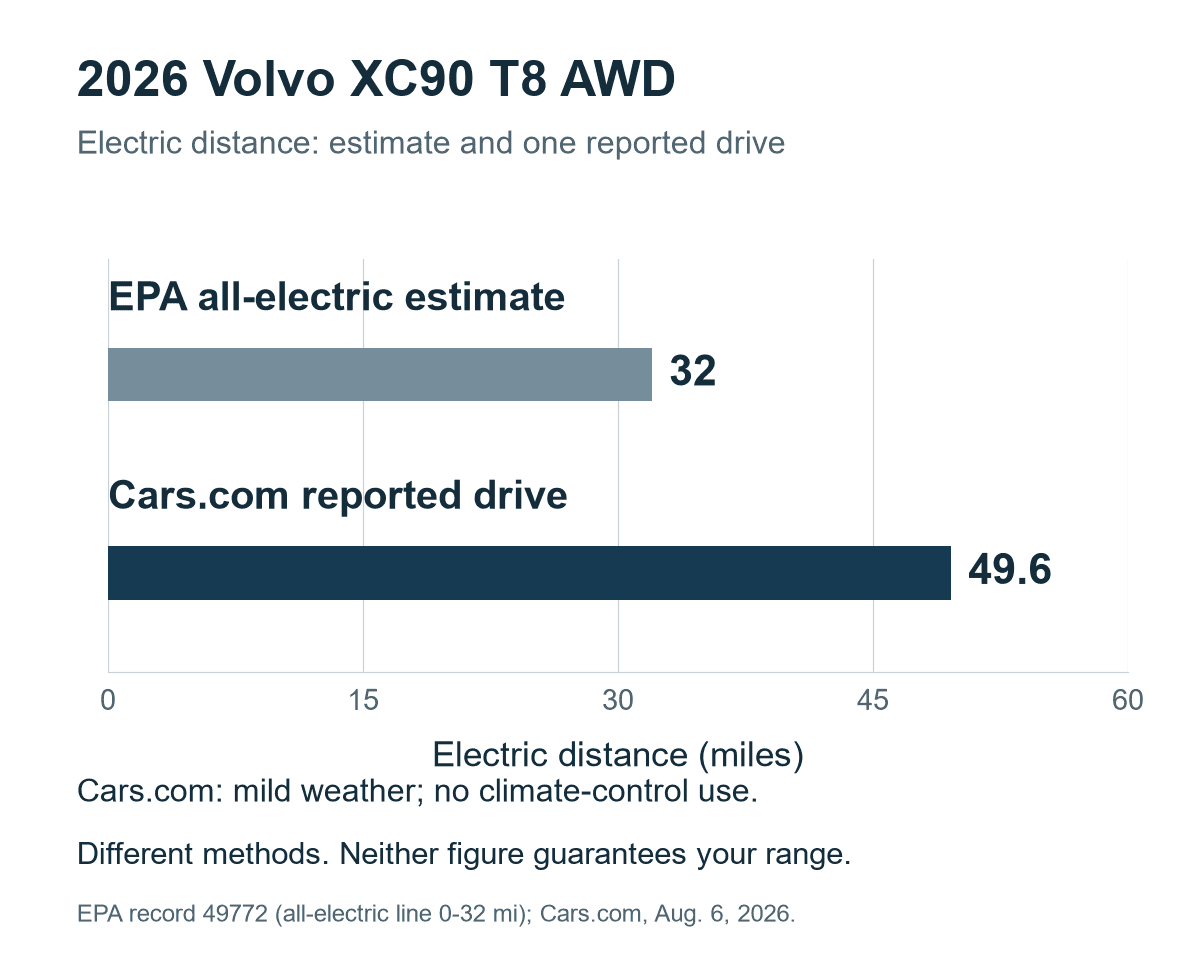
Cars.com reported 49.6 miles of electric driving in a 2026 Volvo XC90 T8 AWD plug-in hybrid, compared with its 32-mile EPA electric-range estimate. The useful part is the context: this was one mild-weather drive in an Ultra-trim test vehicle, on a disclosed route without climate-control use. It shows what happened on that trip, rather than establishing a new rating or a repeatable result for every owner.
What the test actually covered
In his August 6, 2026 report, Cars.com’s Aaron Bragman described a route from Ann Arbor toward Dearborn, Michigan, using surface streets and divided boulevards. Posted limits were no higher than 55 mph, with stop-and-go urban sections and faster suburban travel. Temperatures were in the mid-70s Fahrenheit, with sunshine and very calm wind.
Bragman said he accelerated normally and used neither climate control nor cruise control. He reported 49.6 miles from a full charge to depletion, without needing the gasoline engine’s additional acceleration. This is a much more specific result than “nearly 50 miles in normal driving”: it identifies the driver, vehicle, route and operating choices behind the number.
The report does not establish how the same vehicle would perform on a cold freeway journey with the heater running. It also is not a controlled comparison against every competing three-row plug-in hybrid. Those limits leave the result useful as a documented example without turning it into a ranking.
Range, MPGe and gasoline mpg answer different questions
The EPA record for the 2026 XC90 T8 AWD provides the consistent reference for a specification comparison. Its electricity-assisted efficiency and gasoline-only efficiency are separate entries.
| Figure | Meaning |
|---|---|
| 32 miles | EPA all-electric range estimate; the record’s all-electric line is 0–32 miles. |
| 49.6 miles | Cars.com’s reported electric distance on its disclosed drive. |
| 58 MPGe | EPA combined energy-equivalent efficiency during electricity-assisted operation. |
| 27 mpg | EPA combined gasoline-only fuel economy. |
| 530 miles | EPA total range estimate, using both a full charge and gasoline. |
MPGe expresses energy consumption in a gasoline-equivalent unit. It is not the mpg to expect when the vehicle is being driven on gasoline after charging energy has been used. Likewise, 530 miles is not an electric-range claim. Mixing those figures can make a plug-in hybrid look more efficient, or less dependent on charging, than the relevant part of its rating indicates.
Volvo’s U.S. 2026 model page also lists up to 32 electric miles and 530 miles with a full tank and charge. Volvo qualifies actual range by driving behavior, conditions, maintenance, battery and external factors. The publisher’s longer drive does not remove those variables.
Apply the result to driving between charges
The Department of Energy’s PHEV explanation puts charging frequency at the center of the electric-driving benefit. A plug-in hybrid uses externally supplied electricity as well as fuel; after most charging energy has been used, the combustion engine continues supplying propulsion. The engine can also be needed for rapid acceleration or intensive heating and air-conditioning loads.
A daily route shorter than 32 miles therefore is not a guarantee of engine-off travel. Nor does a longer route mean the vehicle has to stop when its electric range is exhausted. Distance between charging opportunities, the road mix and ordinary climate needs matter more than treating either the EPA estimate or the best published drive as a hard boundary.
For an operating-cost comparison, separate the electricity used while charging from the gasoline used afterward, then apply the actual local energy prices. Cars.com’s distance alone cannot supply that bill. Its contribution is a clearly described electric drive that readers can compare with their own route, while keeping the official rating intact.
0 comment(s) so far on 2026 Volvo XC90 PHEV: What a 49.6-Mile Test Shows