

2026 Ford Bronco MPG: EPA Ratings by Configuration
Fuel economy
EPA estimates for the 2026 Ford Bronco range from 15 to 20 mpg combined across the configurations below. That spread matters in daily use: at an illustrative 12,000 miles a year and $3.50 a gallon, it amounts to a $700 annual fuel-cost difference.
Updated October 15, 2026
The engine alone does not settle the result. Two 2.7-liter automatic Bronco records carry different combined ratings, and the manual and automatic four-cylinder versions do not always match. The useful comparison starts with the complete configuration, then the way you will drive it.
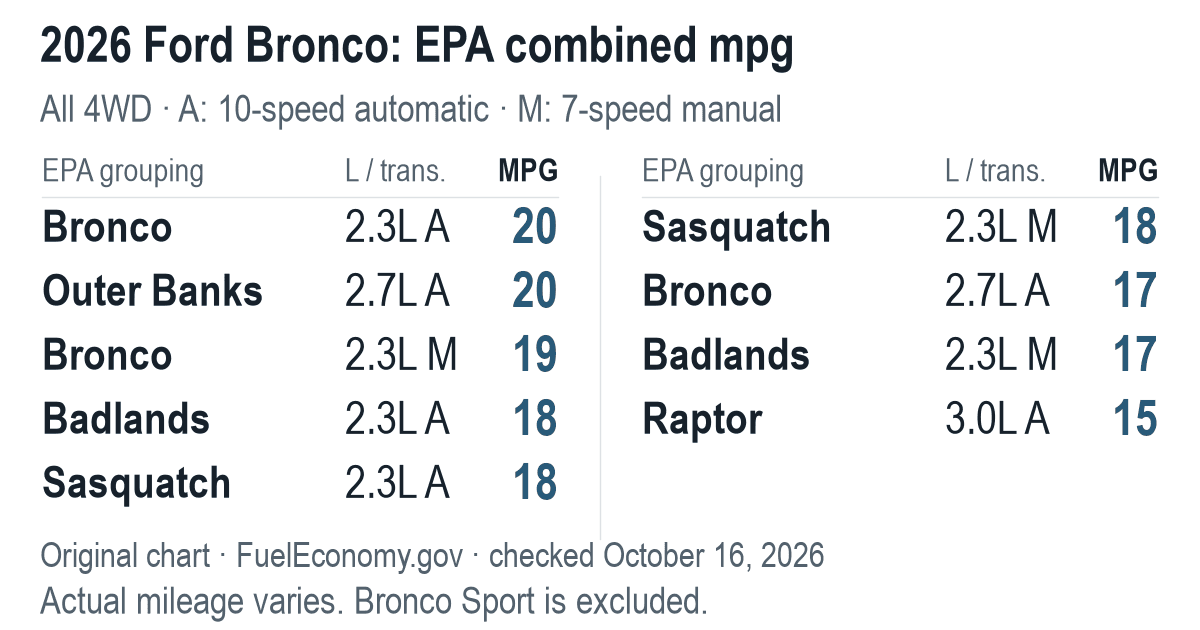
The 2026 Bronco ratings, side by side
These city, highway and combined estimates come from the individual 2026 FuelEconomy.gov vehicle records checked October 15, 2026. The table covers Bronco, rather than the separate Bronco Sport. Each configuration name links to its own EPA record.
| EPA configuration | Engine | Transmission | City | Highway | Combined |
|---|---|---|---|---|---|
| Bronco 4WD | 2.3L turbo four-cylinder | 10-speed automatic | 18 | 22 | 20 |
| Bronco 4WD | 2.3L turbo four-cylinder | 7-speed manual | 18 | 21 | 19 |
| Bronco 4WD | 2.7L turbo V6 | 10-speed automatic | 17 | 17 | 17 |
| Bronco Outer Banks 4WD | 2.7L turbo V6 | 10-speed automatic | 19 | 21 | 20 |
| Bronco Badlands 4WD | 2.3L turbo four-cylinder | 10-speed automatic | 17 | 19 | 18 |
| Bronco Badlands 4WD | 2.3L turbo four-cylinder | 7-speed manual | 17 | 18 | 17 |
| Bronco Sasquatch 4WD | 2.3L turbo four-cylinder | 10-speed automatic | 17 | 19 | 18 |
| Bronco Sasquatch 4WD | 2.3L turbo four-cylinder | 7-speed manual | 17 | 19 | 18 |
| Bronco Raptor 4WD | 3.0L turbo V6 | 10-speed automatic | 15 | 16 | 15 |
The table uses EPA record names, which do not identify every retail trim and option combination. Match the record to the original window sticker before applying its estimate to a particular vehicle. The 2.7-liter Outer Banks entry, for example, is rated at 20 mpg combined; the separate 2.7-liter Bronco 4WD entry is rated at 17. Calling both simply “V6 Broncos” loses that distinction.
Why the equipment list matters
Ford’s model guide shows the range of suspension systems, tire packages and transmission choices in the lineup. Base and Big Bend offer the 2.3-liter engine with manual or automatic transmission. Raptor uses a 3.0-liter V6 and an automatic. The EPA rows show why neither an engine badge nor an off-road package name supplies the whole fuel-economy picture.
For a used Bronco, compare the original configuration with what is fitted now. A vehicle may have different tires or other modifications from its factory specification. Record its model year, engine, transmission, package and current tire size before comparing the listing’s mileage claim with the EPA figure.
The figures describe complete configurations. They do not isolate the effect of a single package or component, because several things can change between rows. Use them to compare the vehicles being considered rather than to calculate an exact MPG penalty for one accessory.
Turn MPG into an annual fuel budget
A five-mpg gap is easier to judge in gallons and dollars. The illustration below uses the same 12,000 annual miles and assumed $3.50-per-gallon price for every row. It is a comparison exercise, not a current gasoline-price quote or a prediction of an owner’s bill.
| Combined MPG used | Gallons for 12,000 miles | Illustrative annual fuel cost |
|---|---|---|
| 20 mpg | 600 | $2,100 |
| 18 mpg | About 667 | About $2,333 |
| 17 mpg | About 706 | About $2,471 |
| 15 mpg | 800 | $2,800 |
At those assumptions, 20 mpg requires 600 gallons for the year and 15 mpg requires 800. The extra 200 gallons cost $700. At 17 mpg, the annual example is about $2,471; at 18 mpg, about $2,333. Rounding the figures keeps the table readable without changing the comparison.
To use your own numbers, divide annual miles by combined mpg, then multiply by your assumed price per gallon. Keep those mileage and price assumptions the same for each vehicle. That makes it possible to weigh the fuel difference against the equipment and driving experience you prefer.
Fuel is one part of ownership, alongside the purchase price, insurance, tires and maintenance. Someone who wants the Raptor’s hardware may accept its estimated consumption; another driver may put more weight on the fuel budget. The point of the calculation is to make that tradeoff visible.
What the EPA number can tell you
EPA estimates provide a standardized comparison. A commute, road trip or weekend carrying equipment can produce a different result. FuelEconomy.gov’s guidance explains how speed, acceleration, cold weather, short trips, roof cargo, towing, load and maintenance affect consumption.
Use the same kind of number on both sides of a comparison: combined against combined, rather than one vehicle’s highway estimate against another’s combined figure. Do not replace the published combined rating with a simple average of city and highway. Once the configuration matches, your own mileage and use turn the official estimate into a more useful buying decision.
0 comment(s) so far on 2026 Ford Bronco MPG: EPA Ratings by Configuration