

2027 Mitsubishi Eclipse Sportback: Charging, Range and Price
Electric vehicles
Updated October 16, 2026
The 2027 Mitsubishi Eclipse Sportback uses two charging connections for different jobs: J1772 for Level 1 and Level 2 AC charging, and NACS for DC fast charging. Mitsubishi’s October 6, 2026 announcement also supplied a starting price and up to 282 miles of range. That updates the earlier launch preview; it does not establish a particular vehicle’s delivery date or an on-road range result.
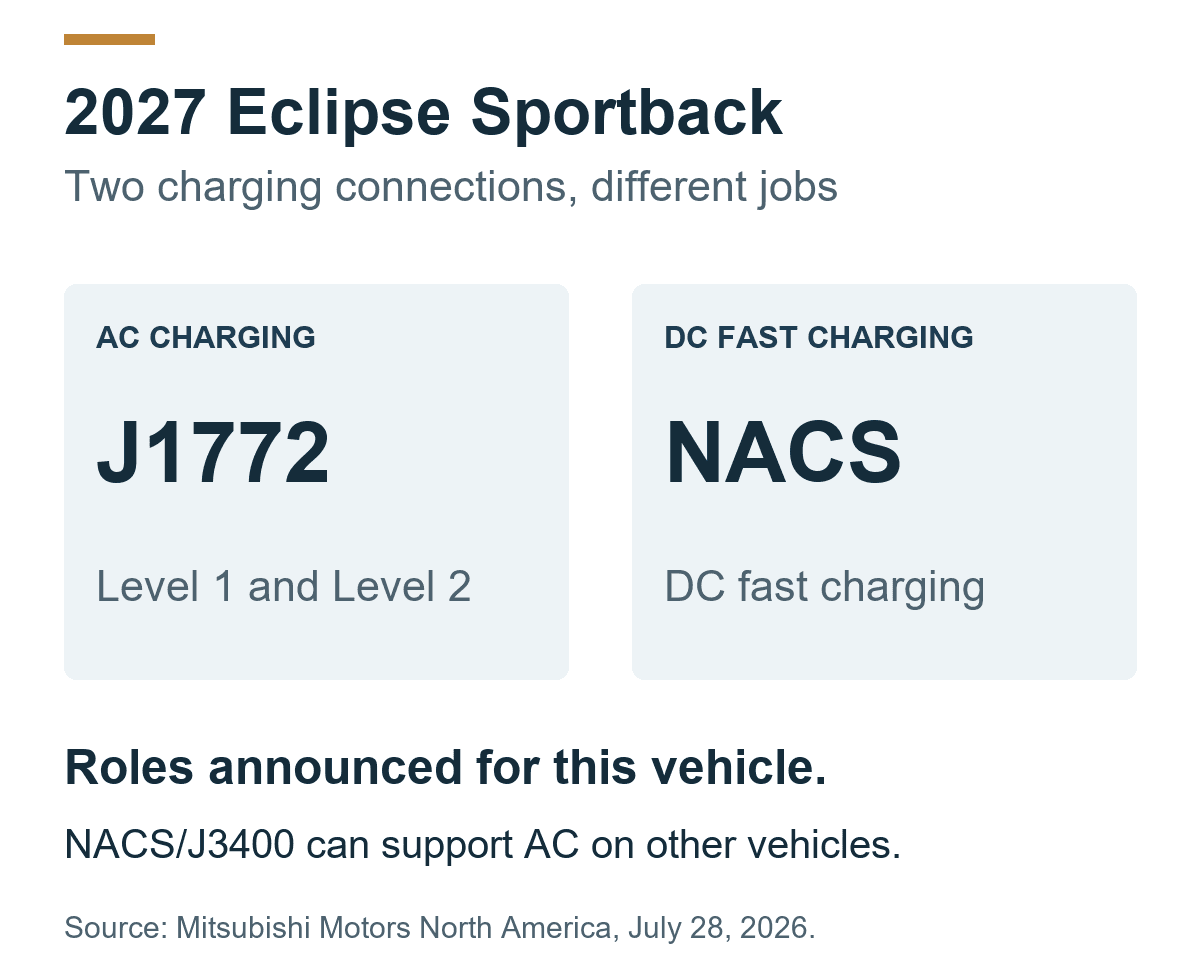
Two connections, different charging jobs
In its July charging announcement, Mitsubishi specified the two formats as standard equipment. J1772 handles the AC charging commonly used at home, workplaces and public destinations. The NACS connection handles the model’s DC fast charging, including announced access to the Supercharger network.
| Connection | Mitsubishi’s stated role |
|---|---|
| J1772 | Level 1 and Level 2 AC charging |
| NACS | DC fast charging, at up to 150 kW |
Those are this vehicle’s assigned roles, rather than universal definitions of the connectors. The Department of Energy’s charging guide describes NACS/J3400 equipment for both AC and DC use. A connector’s name alone therefore does not identify the charging service a particular vehicle supports. Match the car’s instructions to the equipment and network before relying on a station.
AC equipment supplies electricity through the vehicle’s charging system; a public DC fast charger supplies direct current. A larger station rating cannot make the vehicle accept more than its own limit. At home, the useful comparison is the supported AC charging rate and the time available while parked, rather than the advertised DC peak.
What 150 kW and 35 minutes mean
Mitsubishi specifies a liquid-cooled 75-kWh lithium-ion battery and a maximum DC charging capability of 150 kW. Its estimate is approximately 35 minutes to move from 10% to 80% charge on compatible equipment. That is a defined portion of a charging session, rather than a full empty-to-full refill.
The company qualifies that estimate by power source, battery and ambient temperature, battery condition and age, and accessory use. The 150-kW figure describes power; 75 kWh describes battery energy capacity. They are different quantities, and the maximum power figure does not mean the vehicle holds that rate throughout the session.
The October range and price update
The October 6 pricing release quotes up to 282 miles of range and a $37,745 starting MSRP. Keep that manufacturer range statement separate from a measured drive or a particular EPA label. The older 303-mile estimate cited in the launch-preview article should not be carried into a current comparison.
| Configuration | Vehicle MSRP | MSRP plus $1,995 destination |
|---|---|---|
| Standard model | $37,745 | $39,740 |
| With $2,600 Technology Package | $40,345 | $42,340 |
The release lists a different $2,120 destination fee for Hawaii and Alaska. These sums exclude taxes, registration and any other applicable charges; the final selling price is set by the seller. Mitsubishi announced that U.S. sales would begin in October. That timing is an announcement, rather than confirmation of stock or a delivery appointment.
Related to the Leaf, with its own specification
Mitsubishi’s June global announcement identifies the Eclipse Sportback as a Nissan-supplied electric subcompact SUV for the United States and Canada. Mitsubishi changes the exterior, including bumpers, lights, rear gate, D-pillars and wheels. Shared origins do not transfer another model’s range rating, equipment list or price: the Eclipse Sportback’s own specification is the relevant comparison.
0 comment(s) so far on 2027 Mitsubishi Eclipse Sportback: Charging, Range and Price