

2027 Toyota Crown: Hybrid Systems, Grades and Prices
Hybrid sedans
The 2027 Toyota Crown separates into two hybrid powertrain families. XLE, Limited and Nightshade adopt Toyota’s fifth-generation hybrid system, while Platinum retains Hybrid MAX. All have all-wheel drive, but that does not make their transmissions, power delivery or equipment identical.
Updated October 16, 2026
Four grades, with handling kept visible
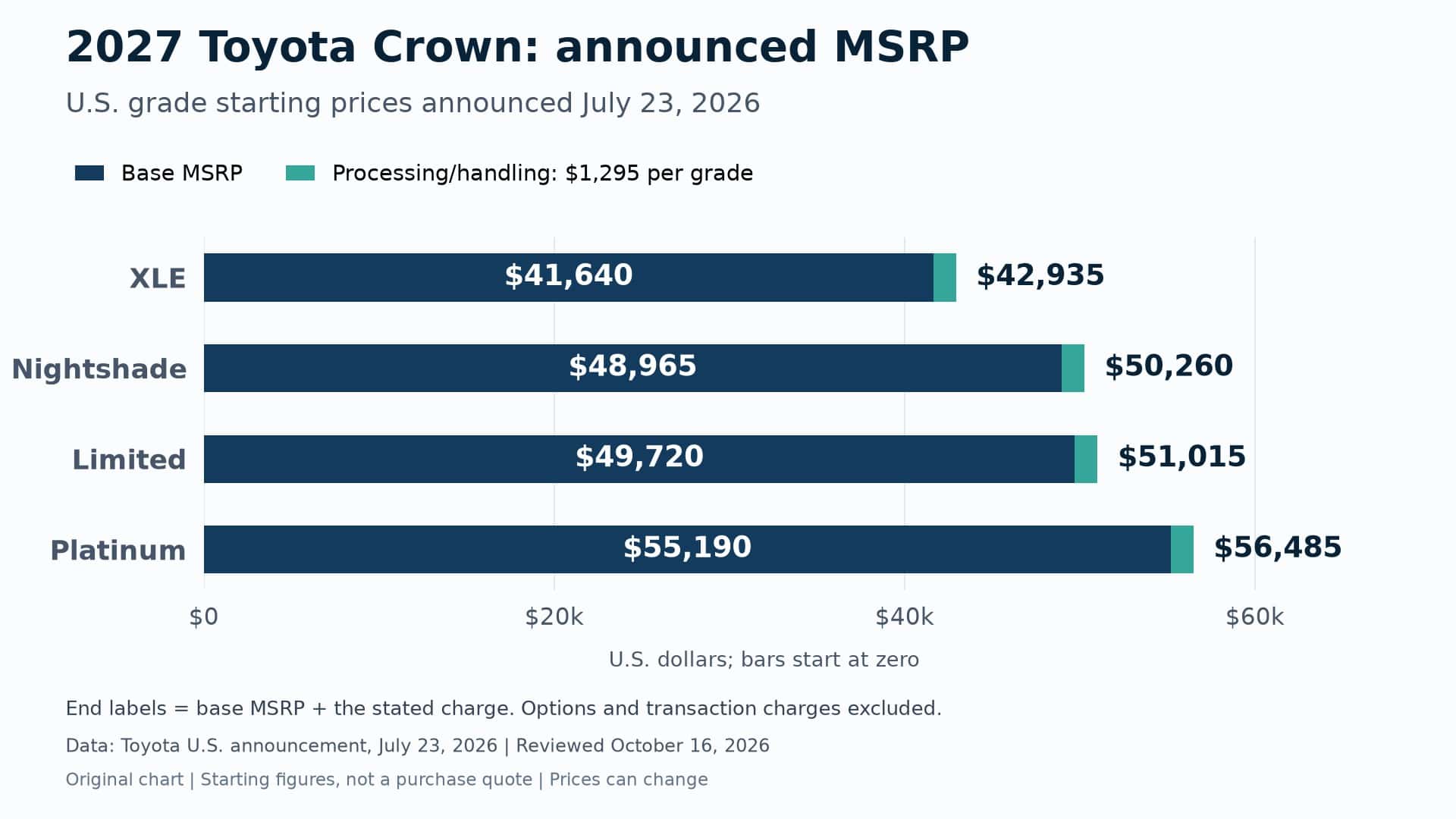
Toyota’s July 23, 2026 announcement lists the following U.S. base prices. The final column adds its stated $1,295 processing and handling charge; it still excludes tax, registration, optional equipment and other transaction-specific charges.
| Grade | Base MSRP | With $1,295 handling |
|---|---|---|
| XLE | $41,640 | $42,935 |
| Nightshade | $48,965 | $50,260 |
| Limited | $49,720 | $51,015 |
| Platinum | $55,190 | $56,485 |
Prices can change. Compare the actual vehicle’s window sticker and written equipment list rather than assuming that an advertised starting figure includes the color, wheels or options shown beside it.
Hybrid does not mean plug-in
The Crown discussed here is a conventional hybrid, rather than a plug-in hybrid. As the Department of Energy explains, a conventional hybrid combines an engine and electric propulsion and recovers energy through regenerative braking. Its traction battery is not charged by plugging the car into an outlet.
Toyota’s specifications distinguish the 2.5-liter hybrid system in XLE, Limited and Nightshade from Platinum’s turbocharged 2.4-liter Hybrid MAX. The former is rated at 236 net combined horsepower; the latter at 340. These are system ratings, not engine-only figures or numbers to add together.
Platinum also uses a six-speed automatic; the other three grades use a continuously variable transmission. A useful test drive should examine the particular system’s response and refinement rather than assume every Crown behaves the same because each carries a hybrid badge.
Check subscriptions alongside the hardware
The Limited gains standard Panoramic View Monitor, Traffic Jam Assist capability and Digital Key capability in Toyota’s announcement. “Capability” needs careful reading: Traffic Jam Assist requires an active Drive Connect trial or subscription; Digital Key requires an active Remote Connect trial or subscription. Toyota identifies both services as network-dependent.
Ask which services are active, when any trial ends, which compatible device is required and what remains usable afterward. A feature appearing on an equipment list does not establish permanent subscription-free operation. Driver assistance also does not transfer responsibility for the road away from the driver.
Decide what the higher grade adds for you
Compare the seating position, entry and exit, rear-seat space and trunk opening with the people and luggage that will actually use the car. A taller sedan stance can feel different from both a conventional low sedan and an SUV; photographs cannot settle that fit question.
Then make an equipment list rather than a ranking by price. Identify the camera views, seat adjustments, wheel-and-tire combination and powertrain that matter on ordinary days. Keep the cost of connected services visible when comparing those choices.
The useful distinction is therefore specific: three grades share the updated efficiency-oriented hybrid family, while Platinum supplies a different performance-oriented system. Start there, then evaluate the exact grade and its written terms instead of treating the entire lineup as one specification.
0 comment(s) so far on 2027 Toyota Crown: Hybrid Systems, Grades and Prices