

84-Month Car Loans: Reading Edmunds’ Q2 Report
Auto loan terms
Updated October 16, 2026
Edmunds reported that 23.9% of financed new-vehicle purchases in its Q2 2026 data used loans lasting at least 84 months.
The July 1 report also put the share at 73 months or longer at 36.5%, the average new-vehicle payment at $777 and the average amount financed at $44,156. These are historical findings from Edmunds’ financing data, not a census of every U.S. purchaser or a current loan offer. The 84-month category includes longer terms; it is not the share choosing exactly seven years. New-vehicle figures should not be relabeled as used-car results.
Hold the borrowing amount and rate constant
A simple comparison shows what term alone can change. Suppose $30,000 is financed at a fixed 8% annual interest rate with equal monthly payments and no fees. Keeping the amount and rate identical gives the following approximate results.
| Term | Monthly payment | Total interest | Total payments |
|---|---|---|---|
| 60 months | $608.29 | $6,497.51 | $36,497.51 |
| 84 months | $467.59 | $9,277.26 | $39,277.26 |
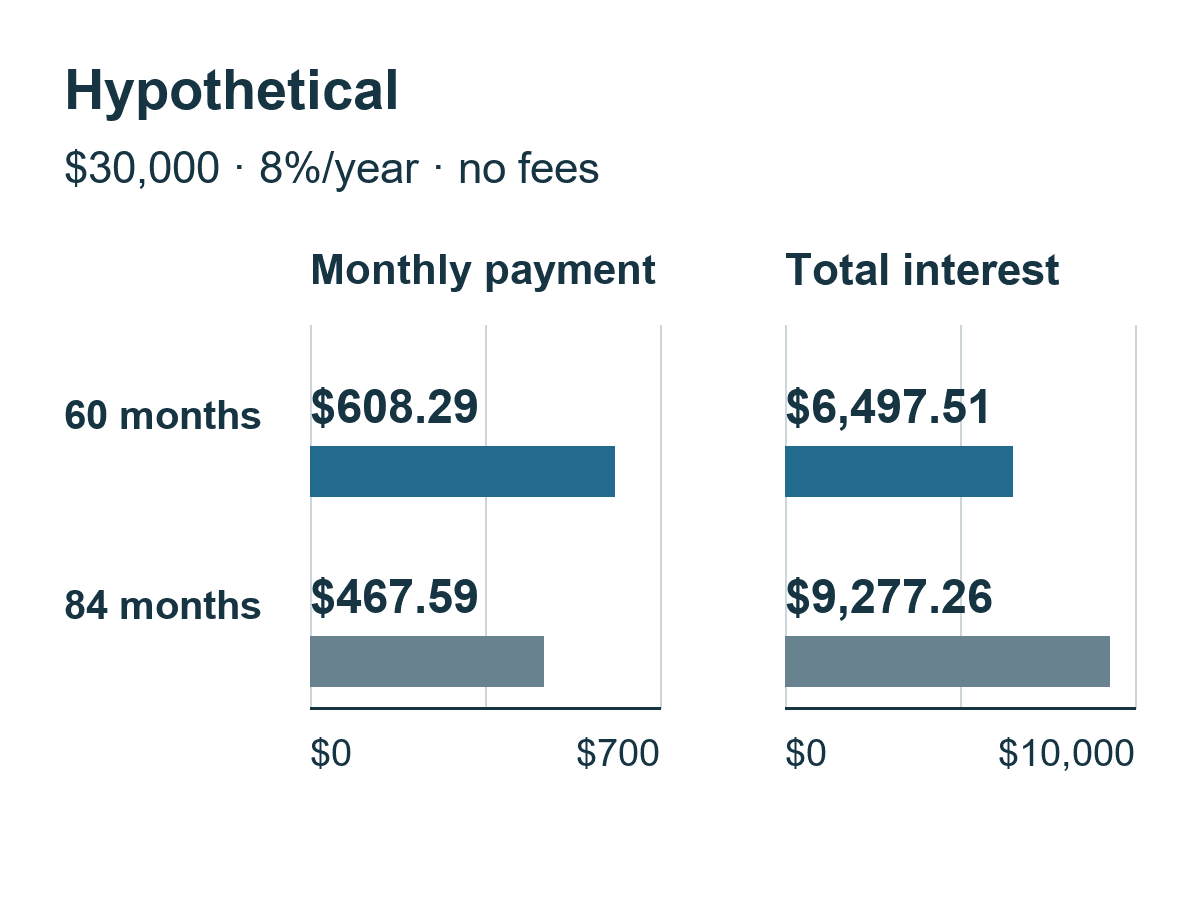
In this example, extending the term lowers the monthly payment by about $141, but adds about $2,779.75 in interest and 24 payments. Totals use the unrounded monthly payment; an actual contract’s rounding and final payment can differ by cents. The example is not an advertised rate, approval or affordability recommendation. APR equals the interest rate here only because the simplified calculation has no fees.
Read the cost fields together
The CFPB’s disclosure guide distinguishes the amount financed, APR, finance charge and total of payments. APR includes the interest rate and mandatory credit fees; the finance charge is the interest and certain fees paid over the loan’s life when payments are made as scheduled. Ask for the completed disclosure before signing and compare its payment count and total with the offer you intended to accept.
When two offers differ, identify what changed before attributing the payment difference to term. A different amount financed, rate or financed charge is a different comparison. Keeping those inputs visible makes it easier to see whether the lower payment came from borrowing less, paying for longer or changing the borrowing cost.
Keep an existing loan separate
For a trade-in with a loan balance, the CFPB recommends checking the payoff amount and vehicle value. Owing more than the trade-in value is negative equity. Adding that shortfall to another loan increases the new borrowing cost; a lower monthly payment does not demonstrate that the old balance disappeared. The payoff can differ from a statement balance, so compare the actual payoff and offer rather than assuming they match.
The useful question is therefore broader than “Can the payment be lower?” Compare the amount borrowed, payment schedule and full repayment cost together, then assess them against your own plans. Neither the quarterly average nor this illustration determines which term suits an individual borrower.
0 comment(s) so far on 84-Month Car Loans: Reading Edmunds’ Q2 Report