

Consumer Reports Used-Car Recommendations: What They Mean
Reading Used-Car Research
Updated October 16, 2026
A Consumer Reports used-car recommendation brings together several kinds of evidence about a model. It can help narrow a search, but it leaves another question open: what is known about the particular car being sold? Reading the recommendation carefully makes it easier to separate useful research from an unsupported claim in an advertisement.
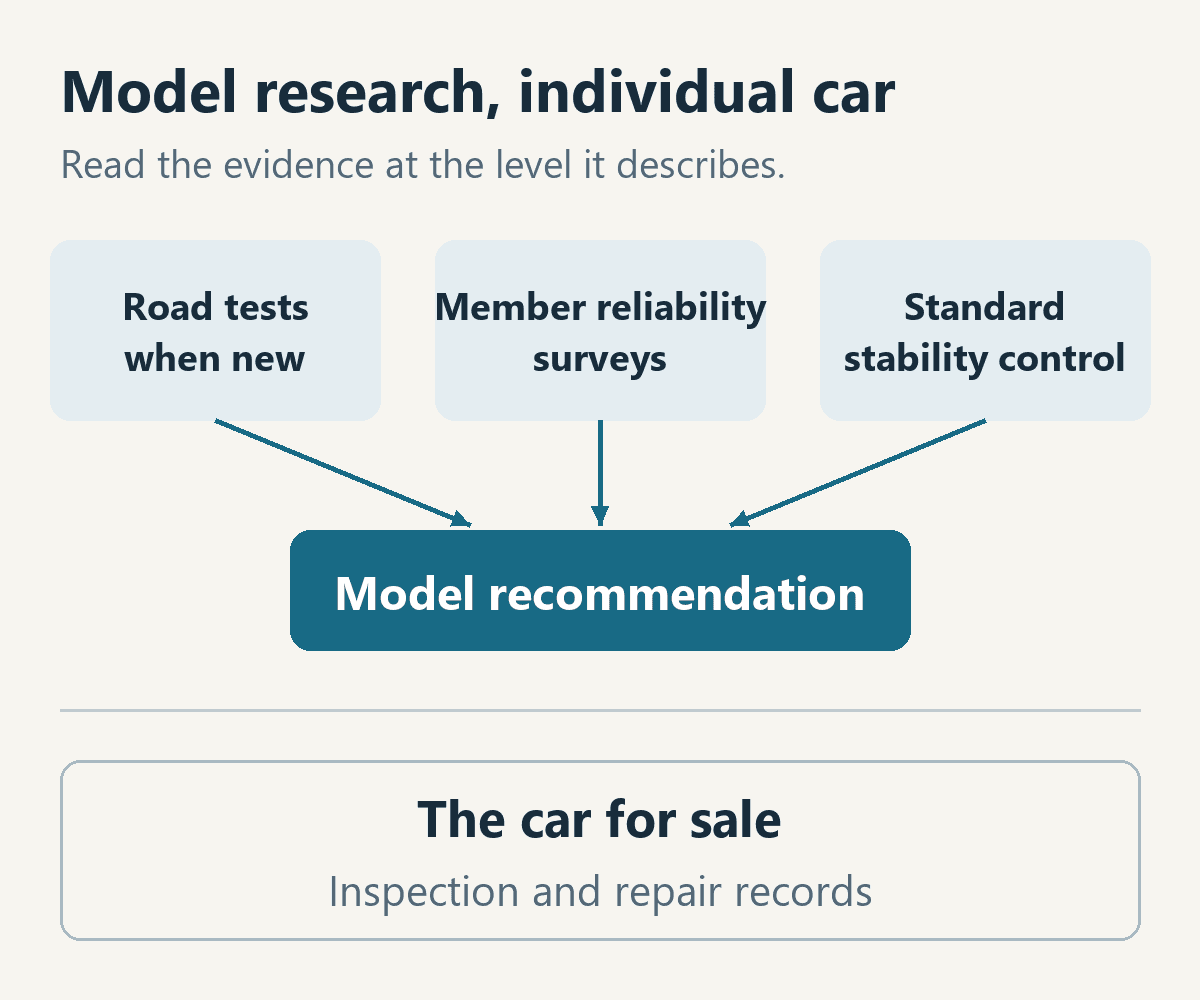
What “CR Recommended” means for a used car
Consumer Reports’ used-car buying guide, updated May 28, 2026, states three requirements: good performance in its road tests when the model was new, consistent above-average reliability across multiple years in member surveys, and standard electronic stability control for the model year.
Those inputs describe different things. The road test examines a vehicle’s performance and usability; the reliability information comes from owners’ reported experiences. Neither establishes the present condition of a particular example. CR itself recommends having the individual car thoroughly inspected before buying, including cars it recommends.
Read safety-equipment wording just as closely. CR distinguishes standard stability control from other assistance features that may be available, including automatic emergency braking and blind spot warning. “Available” is a reason to check the actual car’s equipment, rather than assume every trim includes it.
Separate a model recommendation from the car’s evidence
Consider an advertisement that combines “CR Recommended,” “five-star safety” and “no open recalls.” The three phrases address different questions. Putting them next to each other does not create a single certification of the vehicle’s condition.
| Statement | Useful next question |
|---|---|
| CR recommendation | Which model year and version does the cited recommendation cover? |
| Crash-test rating | Which program, test result and vehicle configuration is being cited? |
| Recall lookup | Was the actual VIN checked, and what does the result include or omit? |
| Condition claim | What inspection findings and repair records support it for this car? |
If the seller cannot identify the recommendation being cited, leave that claim unresolved while checking the underlying information. A model name alone is too broad a reference. Record the publication date, model year and any version-specific qualifications so that later comparisons are about the same vehicle.
A crash score is a separate result
NHTSA’s 5-Star Safety Ratings evaluate frontal, side and rollover performance. They are not reliability ratings or an inspection of a used car. The program’s Overall Vehicle Score combines crash and rollover information; it does not establish maintenance history or whether assistance equipment fitted to a particular vehicle is functioning.
There are also limits on comparisons. NHTSA says frontal ratings and Overall Vehicle Scores should be compared only between vehicles in the same class and within 250 pounds of one another. Side and rollover ratings can be compared across classes. A five-star overall result for one type of vehicle is therefore not a universal numerical yardstick against every other used car.
“Not Rated” means the vehicle has not been tested for a particular crash condition under that program. It should not be rewritten as a failed test. Read the underlying result rather than turning a missing rating into a conclusion the agency did not make.
Know the boundary of a recall search
NHTSA’s recall lookup distinguishes a VIN search from a general year, make and model search. The former can identify unrepaired recalls associated with a specific vehicle; the latter supplies broader records about a model.
The VIN tool also has limits. NHTSA says it does not show already-repaired recalls, some newly announced campaigns whose VINs are still being added, certain older recalls or non-safety customer-service campaigns. A zero-unrepaired-recalls result is useful information within that scope. It is not a complete repair history or a substitute for establishing condition.
Keep the research and the vehicle’s documents together. A recommendation can explain why a model merits attention, a rating can describe performance in specified tests, and a VIN lookup can identify an unrepaired safety recall. The inspection and records still need to answer the questions left about the car in front of you.
0 comment(s) so far on Consumer Reports Used-Car Recommendations: What They Mean