

Three-Row SUV Checklist: Seats, Cargo and Child Seats
Owner Guide
Updated October 16, 2026
A three-row SUV needs to fit the passengers and luggage that travel together. Maximum cargo volume and a seven- or eight-seat description cannot answer that on their own. Before comparing screens or trim packages, work out which seats must stay usable—and what needs to fit behind them.
Car and Driver’s July 3, 2026 comparison brought together eight three-row SUVs in specific tested configurations. Its discussion of seat access and comfort is useful background, but a comparison result cannot establish how your own child seats, passengers and luggage fit. Treat the test as a starting point for a more personal check.
Plan the seating arrangement first
Write down who normally sits in each row, including anyone who uses a child restraint or needs extra help getting in. Then try access with the first- and second-row seats adjusted for their actual occupants. A spacious third row is less useful if reaching it requires a change that will not work with the household’s normal seating arrangement.
Check the vehicle and child-restraint instructions before using any seat-slide or tilt feature with a restraint installed. A demonstration of a release handle is not approval for every restraint or installation. If access requires removing a child seat, establish that while the SUV is parked, before assuming the arrangement will work for a regular school or family trip.
Compare cargo space with the required seats up
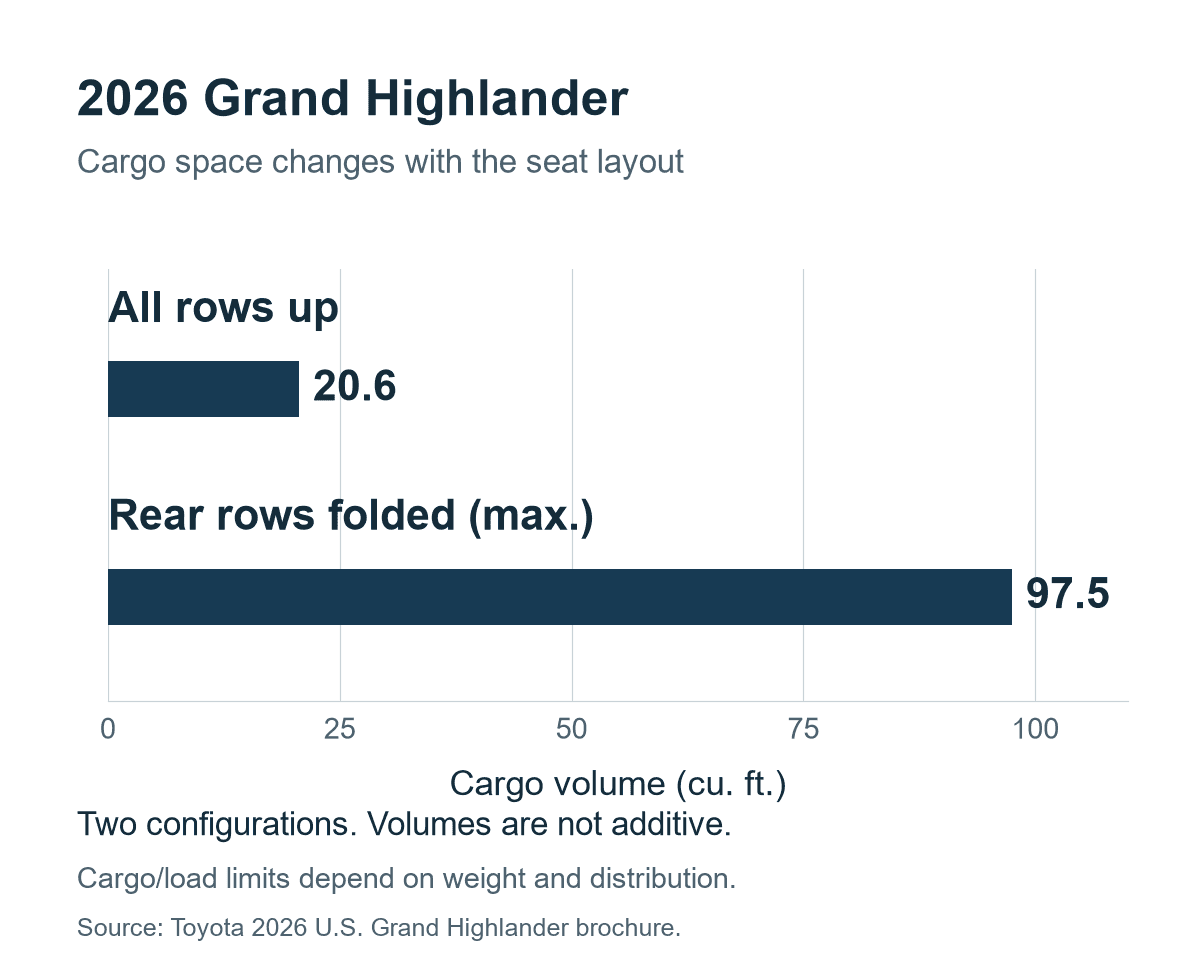
Toyota’s 2026 Grand Highlander brochure illustrates the difference: it lists 20.6 cubic feet behind the third row with the seats up, compared with a maximum of 97.5 cubic feet with the rear seats folded. Both figures describe the same model, but they answer different questions. The larger number does not describe luggage space for a full set of passengers.
Use the stroller, bags or mobility equipment that actually need to travel. Check the opening as well as the floor area, and confirm that the liftgate can close without interfering with the load. A cubic-foot figure cannot tell you whether one awkward item fits through the opening or whether it can be secured appropriately.
Volume also differs from carrying weight. Toyota explicitly limits cargo and load capacity by weight and distribution and instructs owners to secure cargo. Passengers, luggage and accessories must fit within the particular vehicle’s loading instructions; an apparently empty cargo area is not a measurement of remaining weight capacity.
Read child-seat information by seating position
IIHS LATCH ratings evaluate how easy the attachment hardware is to find and use. They are not a substitute for checking an actual child restraint in the intended seat, and a poor ease-of-use rating does not mean the connectors are unsafe. Look at the seating-position information, not just the vehicle’s overall label.
For example, Toyota’s 2026 Grand Highlander equipment table lists lower anchors and tethers at the outboard second-row seats, and tether anchors in the third row. That distinction matters: a tether anchor is not a pair of lower anchors. Follow both manuals for the permitted installation method rather than assuming every rear position has identical hardware.
Try the everyday tasks together
Once the seating and luggage arrangement works, check visibility, entry height, climate controls and the controls passengers will actually use. Evaluate comfort in each occupied row on an ordinary, appropriate test route. Keep any phone pairing or seat adjustments for when the vehicle is parked, and do not recreate a publication’s emergency maneuvers.
Keep a short comparison sheet for the vehicles you inspect: the seating arrangement that worked, items that fitted, access limitations and unresolved questions. That is more useful than calling one SUV universally best for families. A strong choice is one whose verified layout and equipment solve the household’s real transport problem.
0 comment(s) so far on Three-Row SUV Checklist: Seats, Cargo and Child Seats