

2026 Toyota Camry MPG: FWD, AWD and Trim Differences
Hybrid sedan fuel economy
Updated October 16, 2026
The 2026 Toyota Camry’s EPA combined estimates run from 43 to 51 MPG across the five federal configuration groups below. The LE with front-wheel drive has the highest rating in that comparison, but the difference between versions is more useful when the trim, drivetrain and driving category stay attached to each number.
Start with the exact 2026 configuration
Toyota’s 2026 U.S. Camry brochure describes an all-hybrid lineup. It lists 225 net combined horsepower with front-wheel drive and 232 with available all-wheel drive. Those are whole hybrid-system outputs, separate from the gasoline engine’s rating. Choosing between them changes more than a badge.
The federal records identify 2.5-liter, four-cylinder hybrids using regular gasoline. Their names group some trims together rather than supplying one MPG figure for every car wearing a Camry badge. The front-wheel-drive label below spells out the drivetrain that the EPA model names abbreviate as “FF.”
Five EPA groups, three MPG columns
These are the published city, highway and combined estimates for the named configurations, checked October 16, 2026. Each configuration links to its own federal record.
| Configuration | City | Highway | Combined |
|---|---|---|---|
| LE — front-wheel drive | 52 | 49 | 51 |
| LE — all-wheel drive | 50 | 49 | 50 |
| SE / XLE / XSE — front-wheel drive | 47 | 45 | 46 |
| SE / XLE — all-wheel drive | 46 | 46 | 46 |
| XSE — all-wheel drive | 43 | 43 | 43 |
The LE’s highway estimate is 49 MPG with either drivetrain, while its city and combined figures differ. Farther down the table, the SE/XLE AWD group and the SE/XLE/XSE front-wheel-drive group both have a 46-MPG combined estimate, although their city/highway splits differ. A combined number alone conceals those distinctions.
The table does not isolate an AWD or wheel-size effect
These ratings compare complete configurations. They do not establish how many MPG a particular wheel, tire, appearance feature or rear-drive component changes on its own. An XSE AWD-to-LE FWD comparison changes both grade and drivetrain; calling the entire eight-MPG spread an AWD penalty would misdescribe the evidence.
The same caution applies to a different model year. Match the rating to the vehicle’s own year and configuration before using it in a comparison. A familiar trim name does not establish that its equipment or federal rating stayed the same.
Convert MPG into fuel used over the same distance
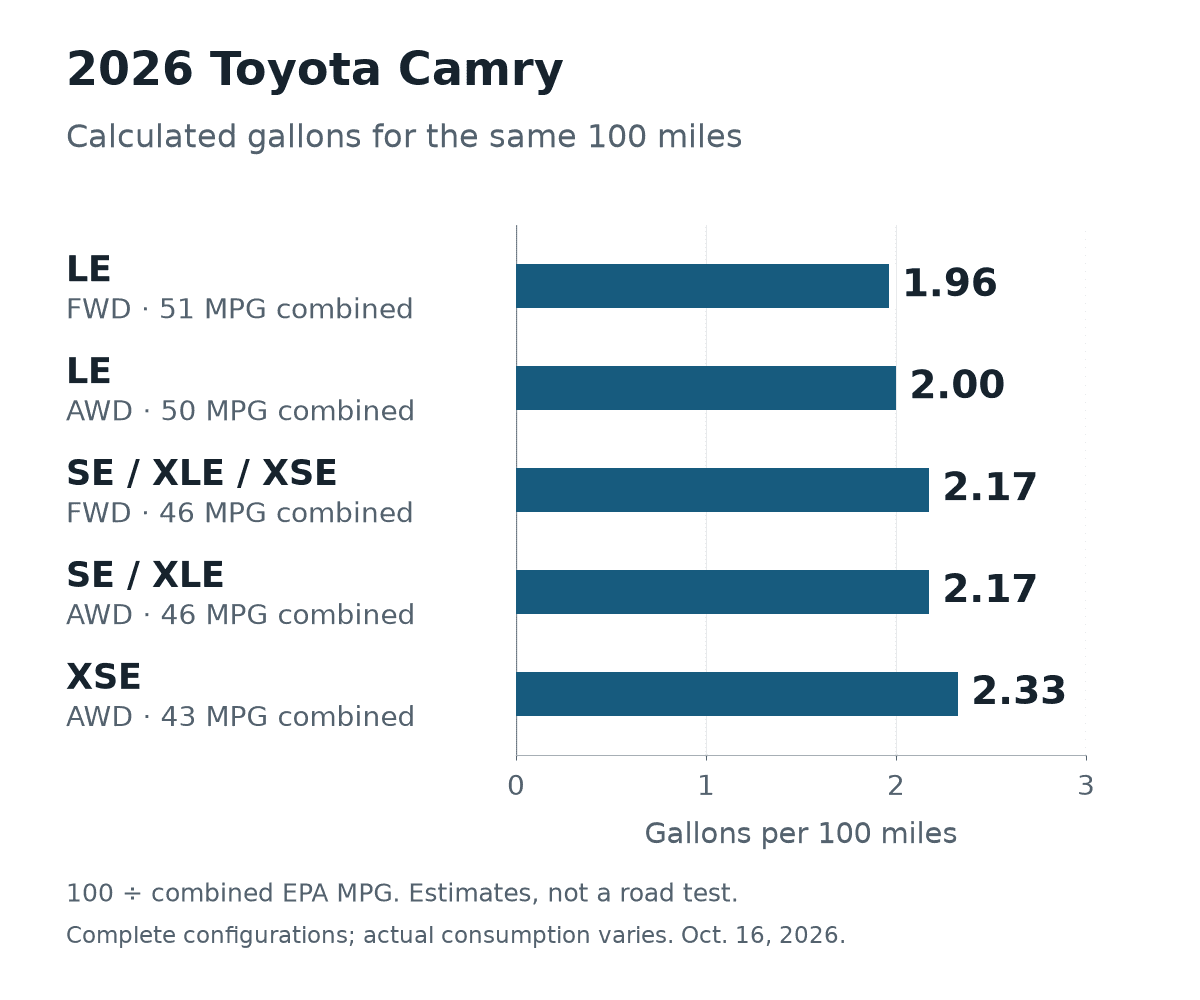
For an illustrative 100 miles, divide 100 by the combined MPG estimate. That gives about 1.96 gallons at 51 MPG, 2.00 at 50 MPG, 2.17 at 46 MPG and 2.33 at 43 MPG. These calculations use the published rounded ratings; they are not measurements from an owner’s commute or a road test.
Keeping the distance equal makes the consumption comparison concrete. For a different distance, divide that mileage by the chosen MPG figure before rounding. Converting those gallons into dollars would also require a stated fuel price. It would still leave purchase price, financing, insurance, maintenance and resale outside the calculation, so fuel use alone does not settle which trim costs less to own.
Compare the equipment you will actually use
The brochure lists 16-inch wheels and an 8-inch multimedia screen for the LE. The XLE has 18-inch wheels, a 12.3-inch multimedia screen and heated front seats; the XSE pairs its 12.3-inch screen with 19-inch wheels. These are specific equipment differences to evaluate, rather than proof that a higher grade is automatically better value.
Nightshade is also a 2026 grade, but it is not separately named in these five EPA entries or the brochure’s MPG footnote. Check the specific Nightshade’s fuel-economy label instead of silently assigning it an SE or XSE rating.
Toyota qualifies the brochure’s MPG figures as comparison estimates and says vehicle condition and driving circumstances affect actual mileage. Use the table to narrow the configuration comparison, then keep its rating and actual equipment together. It supports a clearer choice without promising a particular owner result.
0 comment(s) so far on 2026 Toyota Camry MPG: FWD, AWD and Trim Differences