

2026 Lexus ES 350h: MPG and Road-Test Results
Hybrid sedan efficiency
Updated October 16, 2026
The 2026 Lexus ES 350h AWD has an EPA estimate of 44 MPG combined. Its published road-test acceleration and a 638-mile range figure tell different stories: one is a magazine’s test result, while the other appears in its specification table as an EPA-labeled estimate. Neither establishes how far a particular owner will travel before refueling.
Start with the exact hybrid
In its May 1, 2026 ES announcement, updated October 13, Lexus describes a 2.5-liter four-cylinder hybrid with front-wheel drive or an all-wheel-drive option that adds a rear electric motor. Both versions have a manufacturer-stated combined system output of 244 horsepower.
The ES 350h is distinct from the battery-electric ES 350e and ES 500e in that announcement. A gasoline hybrid’s MPG or refueling-range figure should not be transferred to those electric models. The shared ES name and body design do not make their energy use interchangeable.
FWD and AWD have separate EPA estimates
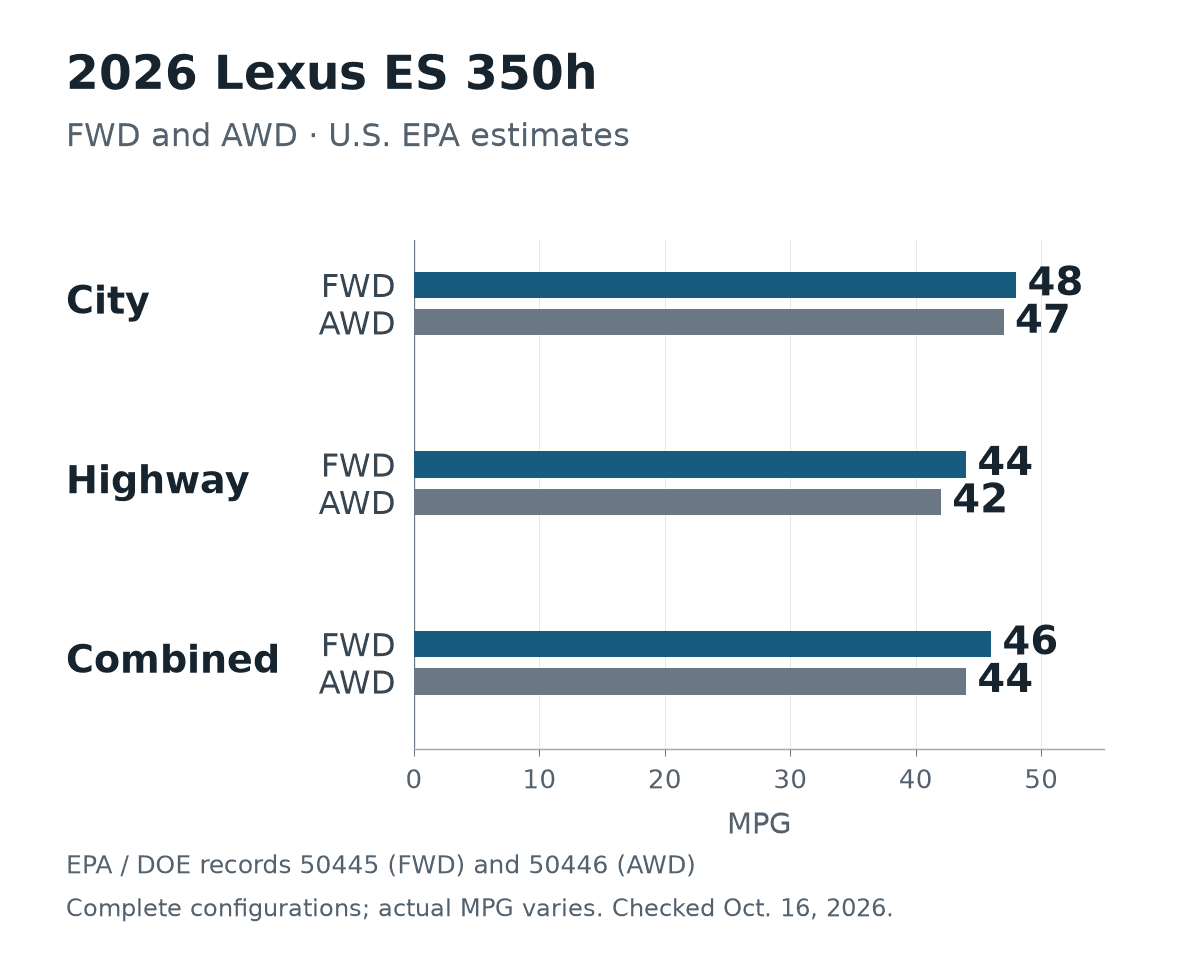
The federal entries for the 2026 ES 350h FWD and 2026 ES 350h AWD identify the same model year and 2.5-liter hybrid engine size, with these published ratings:
| Configuration | City | Highway | Combined |
|---|---|---|---|
| ES 350h — front-wheel drive | 48 | 44 | 46 |
| ES 350h AWD | 47 | 42 | 44 |
The 44-MPG number therefore needs its label: it is the FWD highway estimate and the AWD combined estimate. These are complete vehicle configurations, not a controlled experiment isolating the effect of driving the rear wheels. The federal records also classify both under premium gasoline; verify the actual vehicle’s fuel instructions before turning an MPG comparison into a spending estimate.
What the 638-mile figure establishes
MotorTrend’s June 29, 2026 first test identifies its car as an ES 350h Premium+ AWD and lists 638 miles under “EPA Range.” That is separate from the article’s measured-performance table. The report does not document a 638-mile tank-to-empty run, so it should not be described as a distance MotorTrend demonstrated on a road trip.
The current federal pages linked above confirm the MPG estimates but do not display a tank-capacity or total-range value. They do not independently establish that 638-mile total. Keep it identified as the publication’s EPA-labeled figure here, rather than a verified trip distance or a recommended distance between fuel stops. It supplies no usable-reserve allowance.
What the road test adds beyond MPG
MotorTrend reports a 7.2-second 0–60-mph result for that AWD test car. It also describes a comfortable ride and spacious rear seating, while criticizing abrupt brake response near a stop. Those are the publication’s measured result and driving impressions, not tests performed by Craig & Landreth or proof that every ES behaves identically.
Acceleration, ride comfort and low-speed brake response answer different questions from fuel consumption. The test’s brake-feel criticism is worth separating from any claim of a diagnosed defect or recall. Likewise, a good acceleration result would not validate the stated fuel range.
Compare fuel used over the same distance
The EPA’s gasoline-label explanation distinguishes MPG from gallons consumed and notes that driving, weather, loads, maintenance and accessories affect actual results. Using the published combined estimates, 100 miles corresponds to about 2.17 gallons at 46 MPG or 2.27 gallons at 44 MPG. Those are calculations from the ratings, not observed owner results.
Keep the distance, fuel grade and chosen price per gallon explicit when comparing spending. Fuel use alone does not establish purchase-price payback, insurance costs, resale value or a total ownership-cost winner. The useful comparison matches the exact car to the trip and keeps an estimated range separate from the fuel stops a driver actually plans.
0 comment(s) so far on 2026 Lexus ES 350h: MPG and Road-Test Results