

Used SUV Buying Checklist For Everyday Shoppers
Used-vehicle inspection
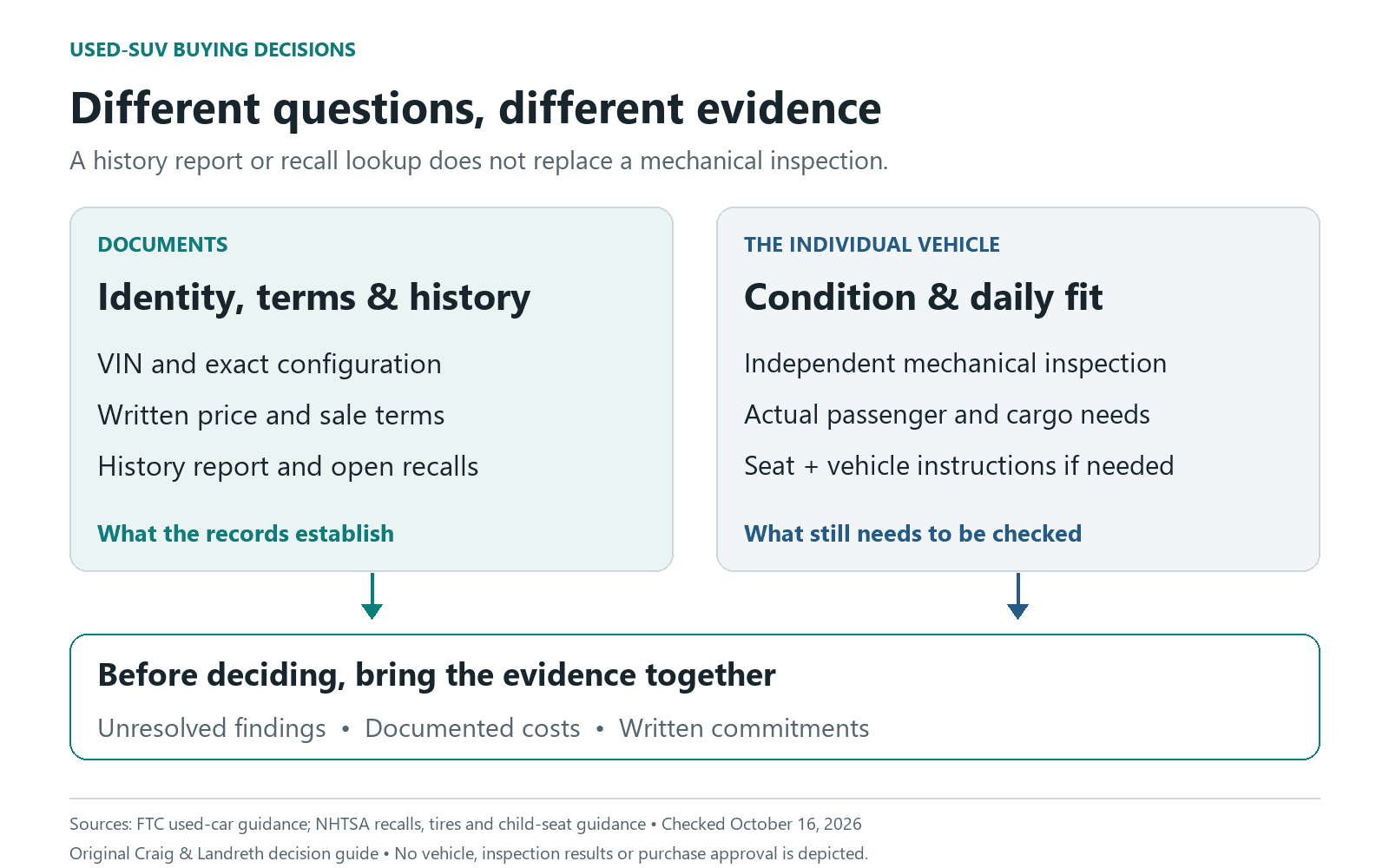
A useful used-SUV inspection follows the vehicle from its paperwork to its everyday job. Verify the identity and configuration before comparing condition, then test whether the passengers and cargo actually fit. Keep unresolved findings and their likely costs visible instead of letting a comfortable test drive settle everything.
Updated October 16, 2026
Before the visit: identify the exact vehicle
Obtain the VIN, model year, engine or hybrid system, drivetrain and seating layout. Ask for maintenance records and an itemized purchase quote. A model badge can cover several powertrains, tire sizes and equipment packages; it is not a complete description of the SUV being offered.
The FTC’s used-car guidance recommends written out-the-door pricing and an independent inspection. Treat the inspection as part of evaluating the vehicle, rather than a warranty that can be inferred from a seller’s description.
Check the VIN through NHTSA. Record an outstanding campaign and its instructions separately from routine maintenance. A zero-open-recall result is not a mechanical inspection or a complete history of prior repairs.
At the vehicle: compare evidence with the description
Match the VIN on the vehicle and documents. Review the history report alongside service records, then investigate inconsistencies rather than assuming a report contains every event. The CARFAX explainer describes why reported history cannot establish current condition.
Inspect visible tire size, condition and tread wear. NHTSA directs owners to the vehicle placard or manual for tire requirements and cold pressure. A familiar tire brand does not prove the tires are the correct specification or that a mismatched set is acceptable for the drivetrain.
| Checkpoint | Useful result to retain |
|---|---|
| Paperwork | Matching VIN, identified configuration, written price and applicable sale terms. |
| Condition | Specific tire, leak, warning or damage findings, with inspection scope. |
| Daily fit | Actual passenger and cargo arrangement, with needed seats upright. |
| Costs | Documented work due, insurance and fuel estimates using the same assumptions. |
Use a normal drive and parked checks for different tasks
Set a normal driving position, then assess visibility, braking feel, steering, ride and noise during an ordinary route. A noise or warning belongs in the inspection discussion; it does not identify the failed part. Do not turn a demonstration into hard braking, an off-road test or experimentation with drivetrain modes.
While parked, operate the seating controls and check cargo access. Bring the difficult item—a stroller, mobility device, crate or suitcase—rather than relying solely on maximum cargo volume. Keep the seating rows needed by passengers in their normal positions.
For a child restraint, follow both the restraint and vehicle instructions. NHTSA’s child-seat guidance emphasizes the child’s age and size, correct installation and a seat that fits the vehicle. A large SUV or easy-to-reach anchor does not, by itself, confirm compatibility or correct installation.
Before deciding: resolve the expensive unknowns
Have the independent inspection identify the particular vehicle and findings, including unresolved items and estimated repair costs. A safety inspection, history report and mechanical inspection serve different purposes. Clarify what was examined rather than accepting “passed inspection” as an unlimited statement.
Compare documented near-term work with insurance, fuel and the itemized purchase total. Do not assume large wheels, AWD or a higher grade will pay for themselves. Separate a feature needed for the daily job from one that is merely appealing.
Finally, obtain any agreed repairs or coverage in writing and reconcile them with the sale documents. A vague promise to address a concern later does not resolve the inspection finding. The checklist is complete when the particular SUV, its useful equipment and its outstanding questions are clear enough to support a decision.
0 comment(s) so far on Used SUV Buying Checklist For Everyday Shoppers