

Pacifica PHEV Recall: Do Not Charge; Park Outside
Recall and interim instructions
Owners of Chrysler Pacifica plug-in hybrids included in recall 26V362 should not recharge the vehicle and should park outside, away from structures and other vehicles, until the remedy is completed. The battery can cause a fire even while the minivan is parked with the ignition off.
Updated October 16, 2026
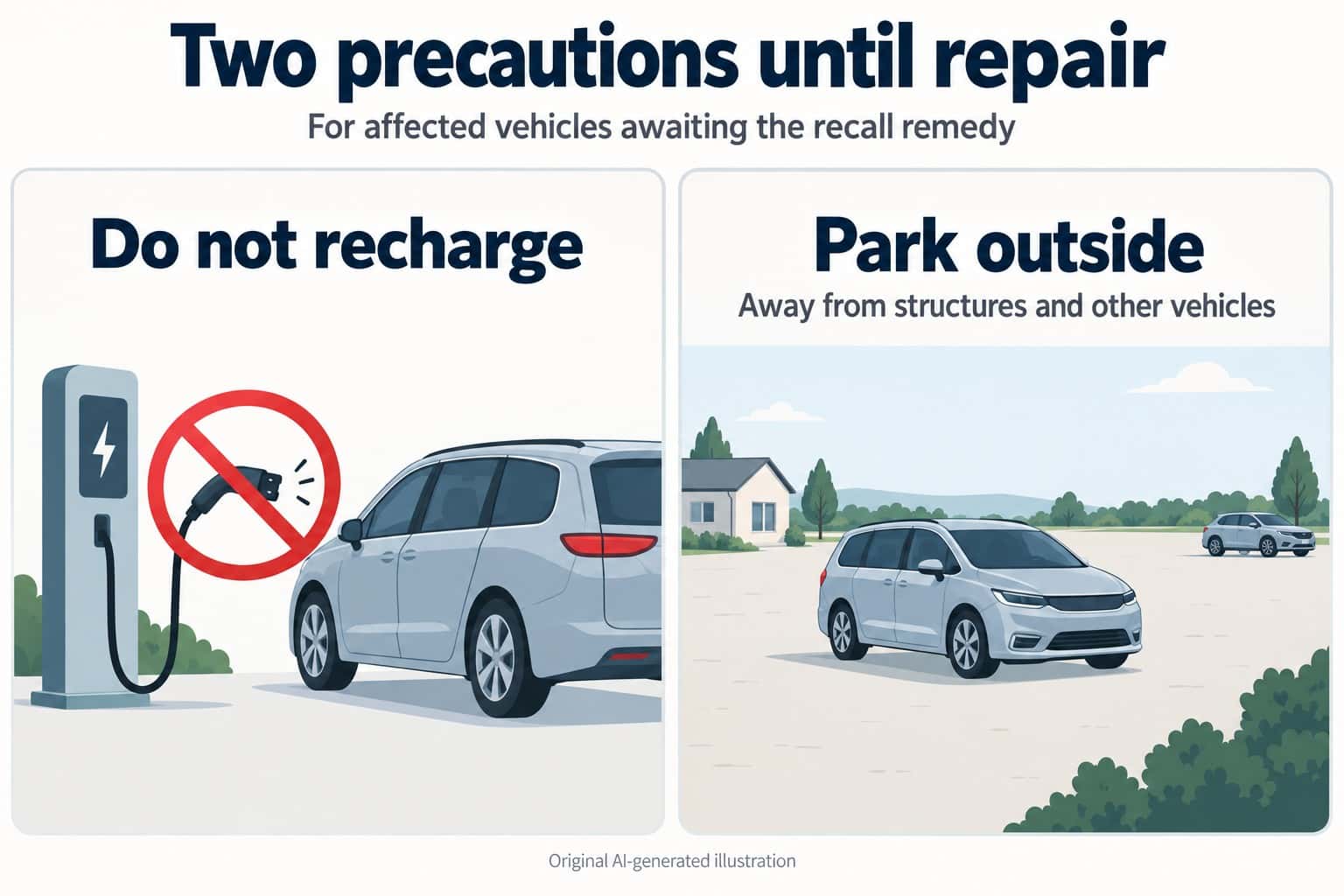
The U.S. campaign covers certain 2020–2022 Pacifica PHEVs. It is a charging restriction as well as a parking precaution. Switching off the vehicle, choosing a different charger or completing an unrelated software update does not establish that the campaign’s battery remedy has been performed.
A battery-production population, not every Pacifica
FCA’s June 4 recall filing identifies 17,277 potentially involved U.S. vehicles. They have high-voltage batteries containing cells made on a particular alternative assembly line. Supplier and vehicle manufacturing records were used to define the population.
The filing gives an August 5, 2020–May 2, 2022 vehicle-production period, but a date alone is not enough to identify an affected minivan. It distinguishes other battery-cell production and non-PHEV vehicles from the suspect population. The campaign does not apply to every gasoline Pacifica or establish that every plug-in hybrid battery has this condition.
FCA describes possible internal battery failure leading to thermal runaway and a vehicle fire. Its June filing says the root-cause investigation was continuing. The production history identifies the population being recalled; it should not be turned into an unsupported claim that a particular manufacturing defect was conclusively found in every battery.
Keep both interim instructions in effect
The current NHTSA summary, reviewed October 16, retains the instruction not to charge and to park outside away from structures until repair. FCA’s filing also specifies separation from other vehicles. NHTSA’s acknowledgement of the recall expressly describes fire risk with the ignition off.
An affected owner who normally plugs in inside a garage needs to change both habits while arranging the work. Stopping external charging does not, on its own, cancel the outside-parking instruction. The filing identifies no advance warning for the condition, so normal dashboard behavior should not be treated as clearance to resume charging.
The software update and battery inspection have separate roles
The listed remedy updates the high-voltage battery pack control module. The revised software monitors battery operation for conditions associated with a potential fire. The campaign also calls for inspection and replacement of the battery pack assembly as necessary, free of charge.
That is neither a promise that every included minivan receives a new battery nor evidence that a general software update closes the recall. Have the service provider identify the campaign work performed and whether the battery inspection led to further action. A battery replacement from an earlier visit should likewise be reconciled with the current VIN-specific campaign record.
Letters have begun; the VIN determines the next step
The current federal record says owner letters were mailed beginning June 23, 2026. The original filing planned different notice stages for 2020–2021 vehicles and 2022 vehicles. A mailing date does not establish that an individual vehicle is repaired or that the same appointment arrangements apply to every model year.
Check the VIN through the official Mopar lookup or NHTSA, and identify FCA campaign 52D when contacting Chrysler at 1-800-853-1403. Ask for the current procedure and any instructions for bringing the vehicle to service. Keep the completed campaign record, and follow the charging and parking restrictions until the applicable remedy is complete.
0 comment(s) so far on Pacifica PHEV Recall: Do Not Charge; Park Outside